
Retro Recliner Chair Buying Guide for Every Style

A shopper walks into a furniture showroom looking for comfort and stops between two very different chairs. One has a clean modern profile and power controls. The other has a rounded back, warm upholstery, and the familiar shape of a chair from a grandparent's den. The second chair looks right, but the shopper still needs to know whether it will support daily use, fit the room, and leave the showroom without a long wait.
That's the decision behind a retro recliner chair. Vintage character matters, but so do body fit, mechanism quality, cleaning, delivery, and durability. The strongest choice borrows the look of the past while meeting current expectations for comfort and practical living.
Why a Retro Recliner Chair Still Belongs in a Modern Home
A living room can have clean lines and still need one chair with warmth and shape. Rounded arms, channel-backed cushions, tapered legs, warm leather, boucle, and textured fabric give the space more personality than another block-shaped seat. Choose a new chair with vintage styling when you need dependable support and want to take it home the same day. Choose restoration only when the older piece has sound bones and the repair time fits your plans.
Retro styling also works across interiors. A mid-century room suits a low recliner with exposed wood. A farmhouse setting can handle a softer upholstered version in a warm neutral. In an open floor plan, a curved chair defines a reading or conversation zone without making the room feel like an office.
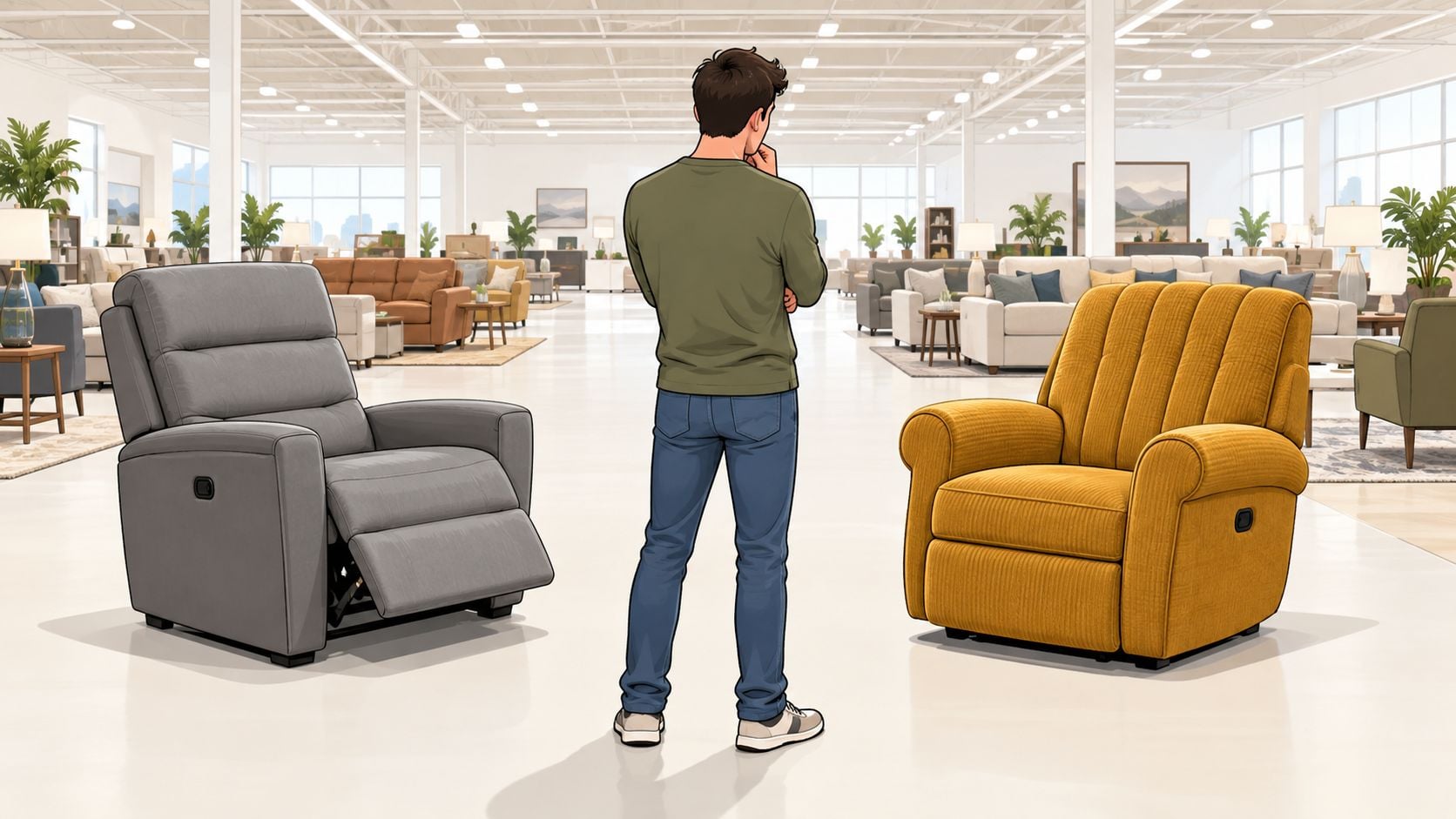
The appeal is visual, but the decision is practical
Contemporary recliners often emphasize minimalist lines, concealed mechanisms, and motorized movement. Retro designs make the chair read as genuine furniture, even when the reclining hardware remains hidden. That quality matters when you are furnishing a complete room and need the chair to work with a sofa, bedroom pieces, or mattresses without making the living area feel oversized.
A decorator may want a sculptural accent. A caregiver may prioritize easy entry, stable arms, and dependable operation over exact period details. Test those points in a showroom, especially if taking the chair home that day matters more than placing an order and waiting.
The modern commercial recliner traces back to 1928 and 1929, when Michigan cousins Edward Knabusch and Edwin Shoemaker created and patented reclining chair designs. Their first model used slatted wood in 1928, followed by an upholstered version in 1929. That history is described in the Lemelson-MIT history of Edward Knabusch and Edwin Shoemaker.
Practical rule: A retro silhouette earns its place in a modern home when its support, footprint, and mechanism suit everyday use. If a showroom model fits and is available now, it usually serves a household better than a beautiful chair that requires a long wait.
For visual direction, review examples of retro 1970s furniture. The strongest purchase delivers warmth and character while giving the household reliable support and movement from the day it comes home.
What Actually Makes a Recliner Retro
A retro recliner isn't defined by one color or decade. It's recognized through a combination of silhouette, materials, base design, and operating method. Shoppers who learn those signals can compare chairs across collections instead of relying on a label.
Start with the silhouette
Look for a barrel back, rounded outer arms, a low-slung body, or a winged headrest. Channel tufting and segmented cushions create a strong vintage impression, while exposed walnut or teak-colored legs make the chair read more like an accent piece than a conventional recliner.
Contemporary power recliners usually have taller backs, broader arms, and a cleaner block profile. That shape can be comfortable, but it tends to announce the chair's function. Retro designs disguise the function through proportion and upholstery.
A chair can still feel retro without copying an exact historical model. A rounded back with slim arms and a warm fabric may suggest mid-century design. A deep channel back, plush upholstery, and darker leather can lean toward a 1970s mood.

Then identify the recline style
Three operating patterns show up often:
- Push-back manual: The sitter shifts body weight against the back, creating a cleaner exterior with no visible handle.
- Side-lever operation: A lever controls a limited reclining range and is easy to find without reaching between cushions.
- Pull-handle vintage mechanism: Older chairs may use a handle that activates multiple positions, but the movement and hardware deserve careful inspection.
Material adds another layer. Patinated leather, woven tweed, boucle, velvet, and wood bases all support a retro reading. The material should still match the household. A textured fabric may suit the room beautifully, while a performance upholstery option may be the smarter choice for children, pets, or frequent entertaining.
The buyer's task is simple: separate retro DNA from surface decoration. A yellow chair isn't automatically vintage-inspired, and a brown leather chair isn't automatically durable. The combination of form, finish, and function tells the fuller story.
Build Quality Features That Separate a Lasting Recliner
A retro recliner can look excellent on a showroom floor and still disappoint if the frame, suspension, cushion, or mechanism is weak. Upholstery hides most of the important components, so buyers need a practical inspection routine.
Start underneath the comfort
A kiln-dried hardwood frame generally offers a stronger foundation than softwood or particleboard construction. Buyers should ask how the rails are joined, whether high-stress areas are reinforced, and whether the footrest structure feels solid when extended.
Suspension changes the sitting experience. Eight-way hand-tied springs can provide carefully distributed support, sinuous no-sag wire offers a consistent formed support system, and webbing creates a lighter deck structure. None should be judged by name alone. The useful test is whether the seat remains supportive without feeling harsh, and whether it returns to shape after repeated pressure.
Cushion construction matters just as much. A high-resilience foam core wrapped in down or polyester can balance support and softness. Flat, loose fill may feel inviting at first but can require more maintenance and may lose its refined appearance sooner.
The reclining mechanism deserves its own test. Movement should feel controlled, quiet, and even. The footrest shouldn't snap open, wobble, or require awkward force. Buyers comparing motorized models can review how power recliners work before deciding whether powered movement suits the household.
Build Quality Features at a Glance
| Feature | What to Look For | Why It Matters |
|---|---|---|
| Frame | Kiln-dried hardwood, reinforced joints | Supports long-term structural stability |
| Suspension | Springs, sinuous wire, or firm webbing | Controls seat support and recovery |
| Cushion | Resilient foam with a durable wrap | Helps preserve comfort and shape |
| Mechanism | Smooth travel and stable footrest | Reduces strain during daily use |
| Upholstery | Welted seams, double-needle stitching, durable fabric | Protects high-wear areas |
| Hardware | Secure brackets and a reinforced footrest crossbar | Limits wobble and premature loosening |
Upholstery details reveal workmanship. Welted seams, double-needle stitching, and carefully aligned patterns signal attention to high-stress areas. Fabric durability ratings can help compare options, but the rating should be considered alongside the household's cleaning needs and the chair's construction.
Sizing and Comfort Considerations for Real Bodies
A chair can be attractive and well built yet still feel wrong because its proportions don't match the person using it. Ergonomic guidance for lounge seating places seat height around 405 to 460 millimeters, seat width around 405 to 508 millimeters, seat depth around 380 to 460 millimeters, armrest height around 127 to 203 millimeters above the seat, and a seat-to-back angle of roughly 95 to 120 degrees, according to the University of Melbourne ergonomics guidance.
Those figures are useful starting points, not a substitute for sitting in the chair. A lower seat can make entry harder for some adults, while excessive depth can leave shorter users unsupported behind the knees. A taller person may need greater back height and enough seat depth to support the thighs without forcing the pelvis into an awkward position.

Use the showroom sit-test
A wide chair isn't automatically an oversized comfort chair. Sometimes it adds width without adding useful depth, leaving the sitter unsupported. Armrests should let the shoulders relax rather than forcing them upward or allowing the elbows to fall too far outward.
A room also imposes limits. Measure doorway clearance, wall spacing, nearby tables, and the chair's rear movement before choosing a deep model. A wider stance may improve stability but can make placement difficult near a passage or narrow wall.
The practical sequence is short:
- Sit fully back and check whether the feet rest naturally.
- Recline slowly and confirm that the head and shoulders remain supported.
- Rest both arms without lifting the shoulders.
- Extend the footrest and check for pressure behind the knees.
- Stand up without pulling heavily on the arms.
A buyer who wants more detail on proportions can review recliner chair sizes. The final decision should still come from the body's response, not the label on the floor tag.
New Retro Style or Restored Vintage
There are two honest routes to owning a retro recliner chair. A new chair with vintage styling offers current construction, available service support, and a predictable buying process. A restored vintage piece offers history and individuality, but it may require significant work before it becomes dependable daily seating.
New retro-styled chairs can use rounded silhouettes, tufted backs, warm leather tones, exposed legs, and discreet reclining hardware. They may also offer power movement, performance fabrics, and configurations designed for current homes. For a household that needs a chair ready without a restoration project, this path is usually more practical.
A genuine vintage chair has a different appeal. Its frame, patina, and proportions may be impossible to duplicate. Yet the buyer may need to budget for reupholstery, mechanism service, cushion replacement, transport, and frame repairs. Older mechanisms can also be difficult to assess until the chair is opened or used repeatedly.
New Retro Style vs Restored Vintage Recliner
| Factor | New Retro Style | Restored Vintage |
|---|---|---|
| Character | Vintage-inspired and consistent | One-of-a-kind with authentic age |
| Comfort | Designed around current support expectations | Depends on restoration quality |
| Timing | May be available for pickup or delivery | Restoration can take an extended period |
| Cost predictability | Easier to understand before purchase | Hidden repair costs may appear later |
| Warranty | Current manufacturer support may apply | Usually limited or absent |
| Maintenance | Modern upholstery and hardware options | Older materials may need continued care |
| Best for | Buyers who want style without delay | Buyers who value history and accept risk |
The choice depends on tolerance. A new homeowner furnishing a room quickly should favor a new model that can be taken home today. A collector or design-focused buyer who enjoys restoration may accept the wait and uncertainty for a chair with genuine history.
A local showroom can also offer a middle path. A shopper may choose a new retro profile from La-Z-Boy for dependable daily use, consider Rowe Furniture for custom style and performance, or explore a restored piece separately without confusing nostalgia with readiness.
Why Shopping a Local Showroom Changes the Outcome
Online photographs can show a chair's color and general shape, but they can't reveal how the seat supports the hips, how far the head moves from the backrest, or whether the footrest feels smooth. A retro recliner chair needs a sit-test because comfort is personal and upholstery color can look different on a screen.
A local showroom also lets shoppers compare several frames in one visit. The difference between a push-back chair, a side-lever recliner, a power recliner, and a lift chair becomes obvious when each can be tested back to back. That comparison is especially useful for older adults, caregivers, and multi-generational households where ease of entry and movement stability matter.

Selection only matters when it saves time
Stahl Home Center's Bloomington showroom covers 88,000 square feet, and the company presents that scale alongside an “Endless Styles, All In Stock” merchandising promise on its showroom and furniture information. The practical value isn't floor space by itself. It's the chance to compare living room furniture Bloomington shoppers can see, touch, and test in person.
The store is Indiana's Largest La-Z-Boy Dealer, and it also carries Rowe Furniture for shoppers focused on custom style and performance. Its Design Your Way service supports hundreds of fabrics and configurations for buyers who want a specific result and aren't in a rush.
For immediate-gratification homeowners, in-stock furniture can be taken home today through customer pickup, while scheduled professional delivery remains available for pieces that need careful transport and setup. That is a better decision path than waiting for an online order without knowing whether the chair will fit the body or the room.
Showroom advice: Sit in the chair before discussing color. Comfort problems are harder to solve after delivery than upholstery preferences are to solve on the floor.
The local advantage also includes neighbor-to-neighbor service. Since 1967, Stahl has operated as a locally owned furniture business, giving Bloomington-area shoppers a place to discuss room dimensions, fabric concerns, and delivery needs in person. Buyers seeking recliners in stock near me can use the showroom visit to turn a long browsing session into a clear choice.
Styling and Customization Options to Match Your Room
The right retro recliner chair should support the room's design language rather than look like a themed prop. Start with the era that feels natural. Mid-century rooms usually benefit from upholstery, tapered wood legs, and restrained pattern. A 1970s-inspired space can handle deeper color, channel tufting, plush texture, or warmer leather.
Fabric changes the chair's personality quickly. Leather develops visual character and can create a grounded, substantial look. Boucle and woven textiles soften a sculptural frame. Velvet adds richness, but it may need more careful placement. Performance fabrics make more sense for children, pets, frequent guests, or anyone who wants easier day-to-day upkeep.
Match the configuration to the room
A tall chair back can block a windowsill or dominate a small wall. A swivel base works well in an open-concept room because the sitter can turn toward the television, conversation area, or view. A rocker configuration can suit a nursery or reading corner, while a power recline option may help someone who wants controlled movement without operating a manual lever.
The distinction between immediate and custom buying should stay clear:
- In-stock floor sample: The chair can be taken home today, subject to pickup arrangements, or scheduled for professional delivery.
- Custom order: The buyer can select fabrics, leather, configurations, stitching, trim, and finishes, but the chair will require a longer production timeline.
- Room-matched approach: A shopper can select the silhouette first, then compare swatches and nearby furniture before committing.
Brands such as Best Home Furnishings and La-Z-Boy offer custom paths with hundreds of fabric, leather, and finish combinations. Options such as contrasting stitching, nailhead trim, and wood leg finishes can sharpen or soften the vintage effect.
A shopper who needs help coordinating pieces can use a furniture style guide before visiting. The more useful step, however, is still physical comparison. Seeing fabric swatches beside floor samples reveals undertones and texture that screens often hide.
Your Next Step Toward the Right Recliner
A confident retro recliner chair purchase comes down to five decisions. The buyer doesn't need to solve every design question at once, but each answer should be clear before money changes hands.
- Which era or silhouette fits the room? Choose between a slim mid-century outline, a rounded barrel form, or a plush 1970s profile.
- Which upholstery suits the household? Consider leather, boucle, velvet, woven fabric, or performance material based on cleaning and wear needs.
- Which dimensions fit the sitter? Check seat height, depth, back support, arm position, doorway access, and standing effort.
- Which recline method feels natural? Manual push-back, lever control, and power movement each create a different experience.
- Does availability or customization matter more? An in-stock chair can leave the showroom today. A custom order delivers a more precise look but requires patience.
The strongest choice is the one tested in person
A screen can narrow the search, but it cannot perform the final evaluation. The shopper needs to sit fully back, recline, rest the arms, extend the footrest, and stand. That sequence exposes poor fit faster than a product description.
For new homeowners and relocators, the same visit can cover more than one chair. Stahl Home Center offers recliners in stock, living room furniture, custom sofas, bedroom sets, mattresses, power recliners, lift chairs, and immediate delivery furniture options. Its Good-Better-Best approach gives quality seekers a way to compare value without treating every household as if it needs the same construction or finish.
The store also supports buyers who want a specific result rather than immediate pickup. Custom fabrics and configurations from La-Z-Boy and Rowe allow a decorator to coordinate the chair with a larger room plan. The key is to decide whether the household values a chair that can be taken home today or a carefully specified piece that requires a longer timeline.
A retro recliner chair should bring personality without creating a daily compromise. The right model looks distinctive, supports the body, fits the room, and matches the buyer's willingness to wait or restore.
Stahl Home Center offers an 88,000-square-foot Bloomington showroom, thousands of items ready to take home today, and custom recliner options through La-Z-Boy and Rowe. Visit Stahl Home Center to sit-test retro-styled chairs, compare fabrics and configurations, and choose immediate pickup or scheduled professional delivery with confidence.