

How Do Power Recliners Work and What to Look For


A reader often discovers the difference between a manual recliner and a power recliner in one quiet moment. After a long day, they press a button on the chair's side panel, and the backrest eases backward while the footrest rises without a lever, kick, or sudden lurch. The movement feels simple, but a compact electrical system is coordinating the power supply, motor, gearbox, actuator, controls, and safety stops underneath the upholstery.
Understanding how do power recliners work helps shoppers look beyond a chair's appearance. The right questions include how the motor creates movement, which powered features are useful, how much room the chair needs, what safety protections matter, and how the mechanism should be maintained. A showroom Sit-Test also reveals details that photos can't, including motion smoothness, button placement, true fabric color, head support, and whether the chair fits the user's body.
Introduction to How Power Recliners Move
A manual recliner depends on a lever, linkage, springs, and the sitter's body weight. A power recliner replaces much of that physical effort with an electric actuator. The actuator converts rotary motion from a motor into a controlled push-pull movement, tilting the back and often extending the footrest. A current actuator data sheet shows how a compact motor can support heavy seating assemblies, with a model rated for up to 6000 N, about 1,350 pounds of force, while its load speed is measured in millimeters per second in the actuator's technical data sheet.
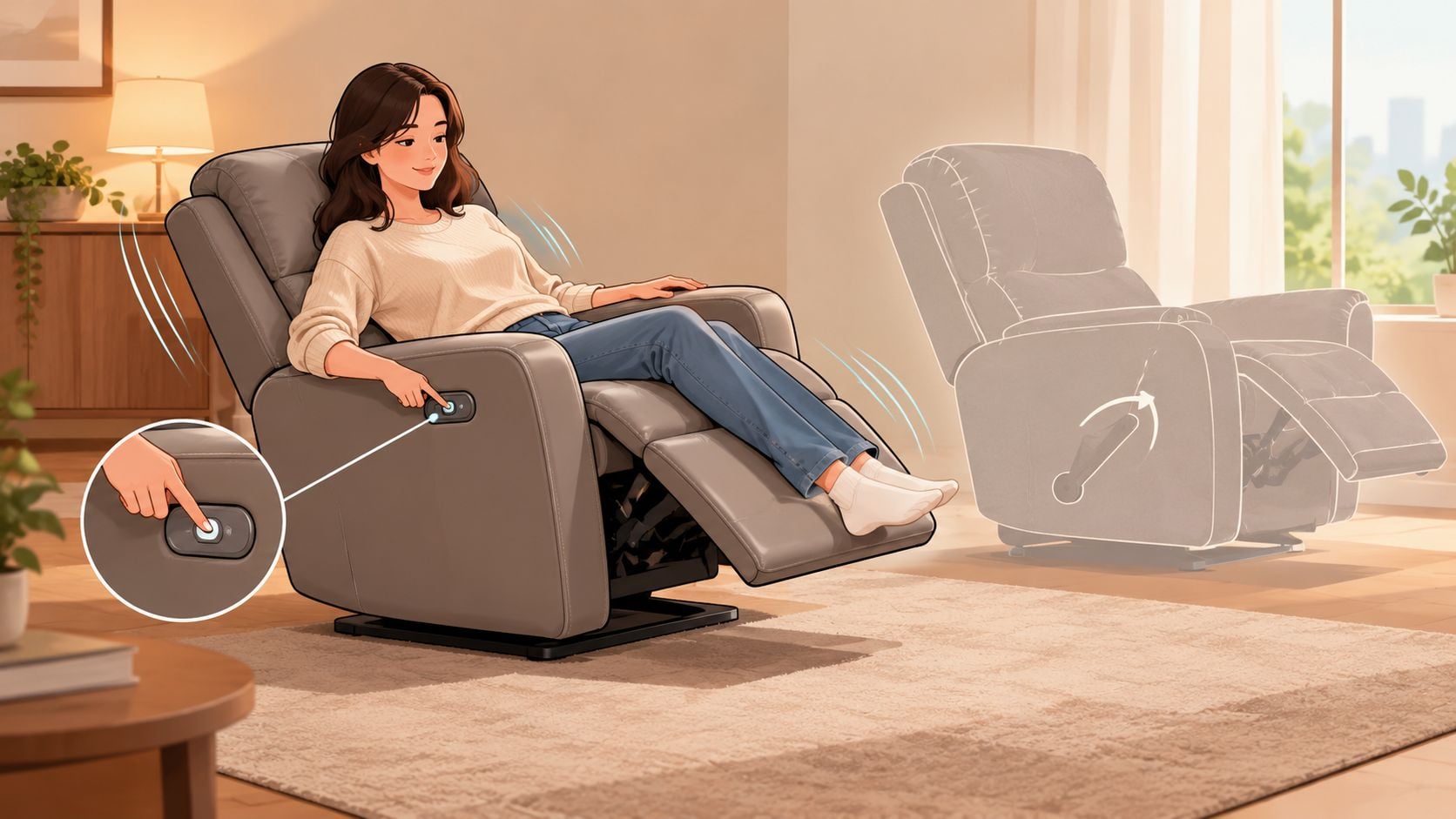
The user sees only the result. A button sends a command, the motor turns, and the actuator extends or retracts. Because the motor operates through gearing and a screw mechanism, the chair moves gradually rather than behaving like a direct-drive machine. The user can often stop the chair at an intermediate position, which makes it easier to find a comfortable angle for reading, conversation, television, or rest.
The design also reflects a long history of reclining furniture. An adjustable reclining-chair patent appeared in 1904, later filings described recliner mechanisms in 1935, and rocking-reclining chair patents followed during the 1950s and 1960s. A 1987 patent explicitly described a motorized recliner chair with a release mechanism, showing how powered seating developed after decades of manual linkage design in the documented patent history.
Showroom insight: The mechanism matters, but fit matters just as much. A chair that operates smoothly still needs to support the user's head, lower back, legs, and feet in the preferred positions.
That combination of mechanical understanding and hands-on testing is especially useful for homeowners furnishing a new space, relatives choosing seating for an older family member, and decorators balancing comfort with room design. A power recliner is furniture, but it's also a low-voltage appliance with moving parts. The sections ahead make both sides easier to evaluate.
Inside the Mechanism That Powers Every Recline
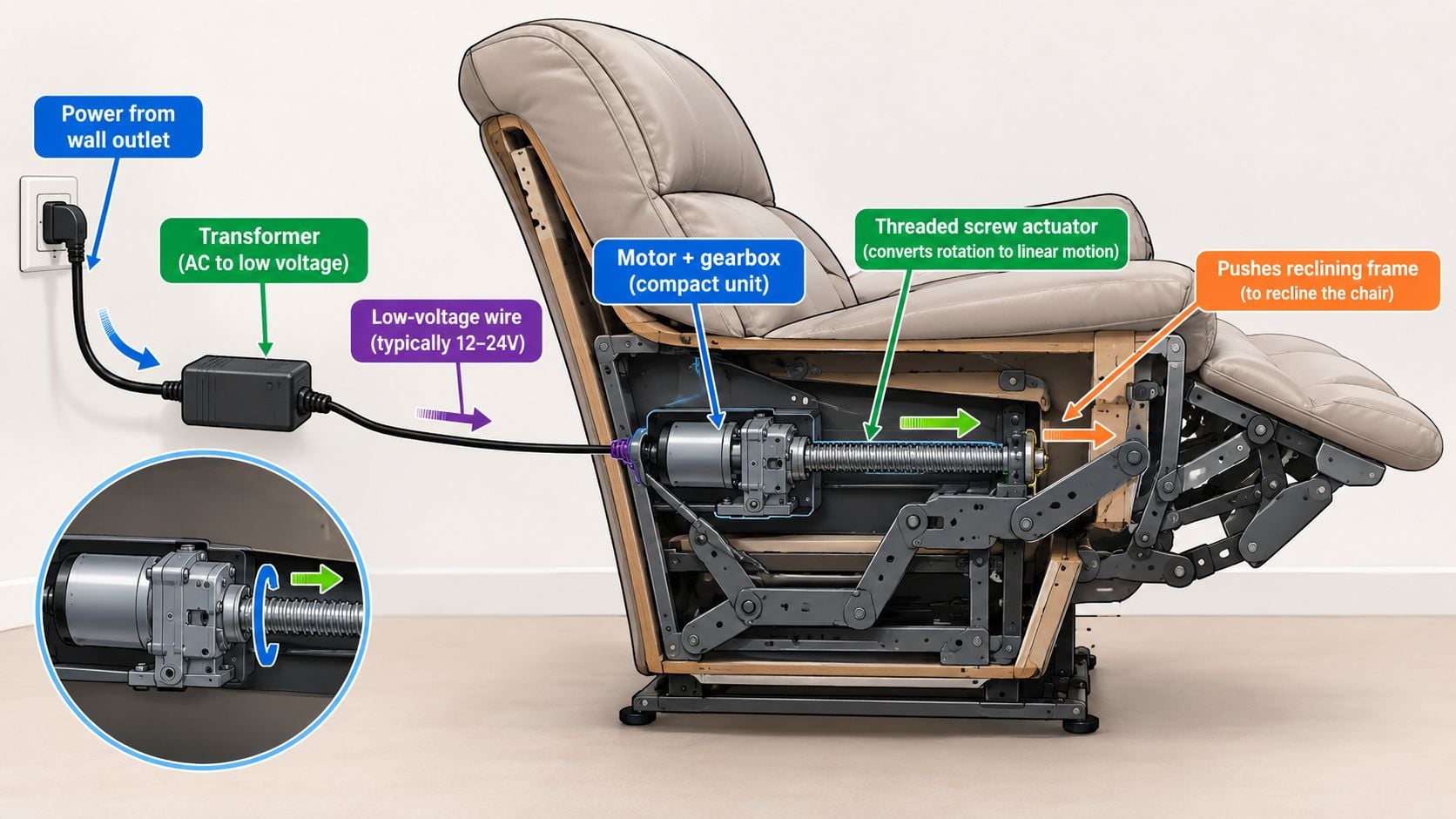
At the Sit-Test in an 88,000 sq ft showroom, a power recliner can look simple from the outside. Press a control, hear a quiet motor, and watch the chair change position. Inside, it works more like a small low-voltage appliance, with a transformer, wiring, motor, gearbox, and actuator sharing one carefully timed movement.
From household power to controlled movement
The power path has three main parts:
- Transformer: Wall power enters the transformer, which changes it to lower-voltage direct current for the chair's motor.
- Control switch: A side button or hand control sends a command through the wiring.
- Actuator: The motor and gearbox convert that electrical command into physical movement.
Common systems use 24 V DC architecture, as shown in documentation for a typical power recliner wiring arrangement. The actuator usually has a two-pin power input and a separate multi-pin control connection. Reversing the electrical direction makes its rod extend or retract, allowing the chair to move toward either endpoint and stop at an intermediate position using the documented low-voltage actuator architecture.
The motor does not push the chair directly. It spins a gearbox, which turns a screw or rod. The screw then creates linear force, much like a powered screwdriver moving a heavy drawer. Gearing reduces speed while increasing torque, so a compact motor can move the seat assembly in a controlled way. This is why it helps to choose the right gear motor for the required load and travel.
Why the chair moves in short bursts
An actuator is built for brief movements, not continuous operation. One documented unit operates at 24 to 30 VDC and 3.7 A, with duty-cycle guidance as short as one minute on and eight minutes off under UL guidance, or two minutes on and five minutes off under CE guidance in the actuator's published operating specifications. Another actuator specification lists a 1000 N load rating, 40 mm/s speed, and 335 mm stroke, showing how force, travel, and speed must be balanced in a compact mechanism as described in actuator documentation.
These limits help manage heat in the motor and gearbox. Stroke length sets the available travel, while an integrated limit switch stops the actuator at full extension or retraction, preventing continued pressure against the mechanical endpoint.
For shoppers, the practical lesson is straightforward. Operate every control during the Sit-Test, listen for uneven sounds, and check whether the movement feels controlled. A recliner designed around a carefully positioned zero-gravity recliner position still needs to fit the person using it.
Types of Power Recliners and What Each One Does
Power recliners share the same basic idea, but their control systems and linkages can vary considerably. The simplest model moves the back and footrest together. More advanced designs separate those movements so the user can tune support with greater precision.
Standard and multi-position recliners
A standard power recliner usually controls the primary recline function. The button extends the footrest and lowers the back, then reverses that movement when the user wants to sit upright. Its strength is simplicity, especially for someone who wants easy operation without extra controls.
A power headrest adds a separate adjustment near the upper back. This helps a tall user support the head while watching television or reading without lowering the entire chair. Power lumbar support changes the lower-back contour, which can help users who need more or less pressure in that area. During a Sit-Test, each control should be operated separately so the shopper can tell whether the adjustment improves posture or adds complexity.
Wall-hugger and wall-away designs
A wall-hugger recliner uses a modified linkage to reduce the backward travel of the chair. The seat may move forward as it reclines, allowing placement closer to a wall than a traditional design. That doesn't eliminate planning. The chair still needs room for the footrest, movement, walking paths, cords, and cleaning access. Stahl's explanation of what a wall-hugger recliner is can help shoppers compare space-saving designs with standard recliners.
Wall-away and zero-wall styles use a related principle. Instead of sending the backrest far behind the chair, the mechanism shifts the seat and back in a coordinated path. The practical question isn't which label sounds most advanced. It's whether the chair can fully recline in the intended room without touching walls, blocking nearby furniture, or creating a tripping point.
Lift-assist recliners
A lift-assist recliner uses powered movement to raise the seat and help the occupant transition toward standing. It serves a different daily need from a conventional comfort recliner, particularly for users with mobility limitations or caregivers arranging supportive seating. The Sit-Test should include the upright position, the lift path, foot placement, control reach, and whether the user feels stable through the transition.
Practical rule: Test every powered function with the intended user sitting in the chair. A feature is useful only if its control, range, and support feel natural.
Safety Features and Standards Behind the Motion
A power recliner is a moving machine inside a home. The most important safety questions concern the spaces beneath the footrest, around the scissor-like linkages, and wherever the seat or foot support moves toward a fixed surface.
Where entrapment can occur
The U.S. Consumer Product Safety Commission has identified two important hazard patterns in reclining furniture. One involves entrapment in the foot-support lift mechanism beneath the recliner, particularly where the support is motorized. The other involves entrapment around the movable foot support. The CPSC also asked ASTM to develop a performance standard because reclining-furniture hazards required dedicated attention in its recliner entrapment meeting documentation.
Modern protections can include limit switches, obstruction sensing, force management, and automatic stopping. The exact feature depends on the model, so a buyer should ask how the chair responds if the footrest meets an object or a person presses a control while the path is blocked. Safety controls reduce risk, but they don't replace supervision or sensible placement.
Electrical standards now matter too
Safety expectations increasingly treat motorized furniture like powered appliances rather than ordinary stationary furniture. IEC 60335-2-116:2025 explicitly covers furniture with electrically motorized parts, including both DC-supplied and battery-operated furniture in the IEC publication. That scope matters for recliners with transformers, wiring, controllers, rechargeable battery packs, or other powered components.
At home, safe habits are straightforward:
- Clear the movement path: Keep hands, toys, pet bedding, and loose objects away from the underside and footrest.
- Watch children and pets: Don't allow them to play beneath or around a moving chair.
- Plan wall clearance: Place the recliner so its back and footrest can travel without crushing nearby objects.
- Protect the wiring: Keep cords away from pinching, sharp bends, heat, and walking paths.
- Ask about certification: Confirm that the chair and replacement electrical parts meet the applicable requirements for the market where it will be used.
For older adults and caregivers, Stahl's guide to recliners for seniors can support a broader evaluation of lift assistance, control access, seating posture, and everyday usability.
Keeping Your Power Recliner Running Smoothly
A power recliner may look like ordinary seating, but underneath it is a low-voltage appliance with a motor, wiring, controls, and moving joints. Good ownership means caring for that working equipment, not using the underside as a storage shelf. Crumbs, toys, blankets, and tangled cords can interfere with the actuator or linkage even when the upholstery looks clean.
A simple care routine
Before moving or cleaning the chair, disconnect power according to the manufacturer's instructions. Check the transformer, plugs, and visible wiring for looseness, crushing, fraying, or other damage. Keep the space beneath the footrest clear, and never force the mechanism by pushing against a moving part.
The actuator also needs time to cool. Short operating bursts followed by rest periods let heat dissipate from the motor and gearbox. Repeatedly cycling the chair against its operating instructions can increase heat buildup and shorten component life. Use the chair's documentation for its specific duty-cycle guidance.
A battery backup can help during an outage, but it provides limited operation rather than unlimited use. One documented setup uses two 9V batteries near the transformer so the chair can return to a seated position after household power is lost in the battery-backup instructions. Battery placement, compatibility, and replacement procedures should always come from the chair's documentation.
The fall furniture maintenance checklist provides a useful seasonal reminder to inspect furniture before heavier daily use.
What to check when movement stops
If the chair is completely unresponsive, check the wall outlet, transformer connection, and power plugs. If it has power but does not move, inspect the side switch or remote, reseat accessible control connections, and look for a visible obstruction. A chair that stops partway may have reached a limit, met resistance, or activated a protective control.
Stop rule: Do not keep pressing the button when the motor hums without movement, the chair binds, or a cord appears damaged. Disconnect power and arrange qualified service.
Avoid opening the motor housing or replacing electrical parts with unapproved substitutes. A service professional can test the transformer, actuator, control switch, wiring harness, and mechanical linkage without turning a small fault into a larger one.
How to Choose the Right Power Recliner With Confidence
A good choice begins with the person who will use the chair. Someone who watches television upright may appreciate a power headrest. A person with lower-back sensitivity may need independent lumbar adjustment. A caregiver may value lift assistance, while a decorator may focus on fabric, silhouette, and custom configuration. Compare control effort and adjustment options in our guide to power recliner vs manual.

The buyer's practical checklist
- Test the motion: Move from upright to reclined and back. Listen for unusual sounds, watch for hesitation, and confirm that the control stops movement precisely.
- Check the fit: Sit fully back, place both feet naturally, and test head, lumbar, and leg support. Short-term comfort may not match comfort during longer sitting.
- Measure the room: Allow for the chair's full movement, walkways, wall clearance, outlets, and cord routing.
- Evaluate the upholstery: Homes with children, pets, or frequent guests may suit performance fabric. Compare texture, color, and seam details in person.
- Ask about service: Review warranty coverage, approved replacement parts, battery access, and repair procedures after purchase.
- Match the feature set: Choose adjustments that address an actual comfort or mobility need instead of paying for controls that will remain unused.
A power recliner is also a low-voltage appliance. The motor, transformer, controls, wiring, and certification details affect how the chair should be used and serviced. A showroom test helps you understand that system in practical terms, from button reach and motor sound to smooth movement and safe cord placement.
The Sit-Test remains a strong reason to visit a physical furniture store. Online images cannot reproduce the actual color, cushion feel, button reach, footrest angle, or sense of scale. In one visit, shoppers can compare power recliners, lift chairs, living room furniture Bloomington options, bedroom sets, mattresses, and other pieces.
Stahl Home Center is Indiana's Largest La-Z-Boy Dealer, with an 88,000+ sq. ft. showroom and thousands of items in stock and ready to take home today. That setting supports a Good-Better-Best comparison, while Rowe Furniture offers custom style and performance options. Design Your Way lets shoppers explore hundreds of fabrics and configurations when a floor model does not match the room.
Locally owned since 1967, the store combines broad selection with neighbor-to-neighbor service. New homeowners and relocators can furnish a whole home over a weekend. Shoppers focused on durability or style can examine custom sofas, performance fabrics, and coordinated room pieces before deciding.
A power recliner should feel easy to operate, and the purchase should fit the room, routine, and household. Visit the Westside Bloomington showroom to test controls, see true colors, compare recliners in stock, and choose immediate pickup or a custom design with scheduled professional delivery.
Visit Stahl Home Center to test power recliners, lift chairs, Rowe Furniture options, custom sofas, and other living room furniture Bloomington shoppers can see in person.