

Recliner Chair Sizes: Find Your Perfect Fit

A recliner can look perfect on a screen and still feel wrong the first night it lands in the living room. That usually shows up in small ways. Feet don't rest comfortably, the back cushion hits the shoulders in the wrong place, or the chair takes over more floor space than expected once it opens fully.
That gap between measurements and comfort is where most shoppers get stuck. Recliner chair sizes aren't just about width and depth on a spec sheet. They're about how a chair fits a real body, a real room, and a real routine. The most useful way to judge that fit is the Sit-Test, because a chair that measures fine can still feel off once someone leans back, reaches for the armrests, or tries to stand up.
Table of Contents
- Why Your Recliner's Fit Matters More Than You Think
- Decoding Recliner Dimensions From Seat to Footrest
- How to Measure Your Space and Yourself for a Perfect Fit
- Matching Recliner Size to Your Lifestyle and Needs
- Design Your Way with Custom Recliner Options
- Find Your Perfect Recliner In Stock Today in Bloomington
Why Your Recliner's Fit Matters More Than You Think
A common mistake happens after someone finally replaces an old chair. The new recliner looks cleaner, feels softer in the store, and seems close enough in size. Then it gets home. The seat is too deep, so the lower back loses contact with the cushion. Or the arms sit too high, so reading or watching television becomes a shoulder workout instead of a break.
That's why “close enough” usually isn't enough with recliner chair sizes. A recliner works best when the body settles into it naturally. Knees bend comfortably, shoulders stay supported, and the headrest meets the body where it should. Good fit affects more than comfort. It shapes posture, ease of getting up, and how often the chair is used.
Practical rule: A recliner should support the body without forcing it to adjust to the chair.
Plenty of online listings focus on color, cupholders, or whether the chair has power features. Those details matter, but they don't solve poor fit. The better starting point is comfort and support, then style and features after that. Helpful guidance on supportive seating principles appears in this look at ergonomic furniture design.
Why one-size-fits-all doesn't work
Two people with the same height can prefer very different chairs. One may want a shallower seat and firmer arm support. Another may need more back height and a longer footrest. That difference is exactly why the Sit-Test matters so much. Sitting fully back in the chair, resting the feet, and trying the recline motion reveals problems that numbers alone can miss.
Where shoppers usually get confused
Most confusion starts with one question: “Does it fit the room?” That's important, but it's only half the job. A recliner has to fit the person first. Then it has to fit the space around it. When those two pieces line up, the chair stops being a gamble and starts becoming the best seat in the house.
Decoding Recliner Dimensions From Seat to Footrest
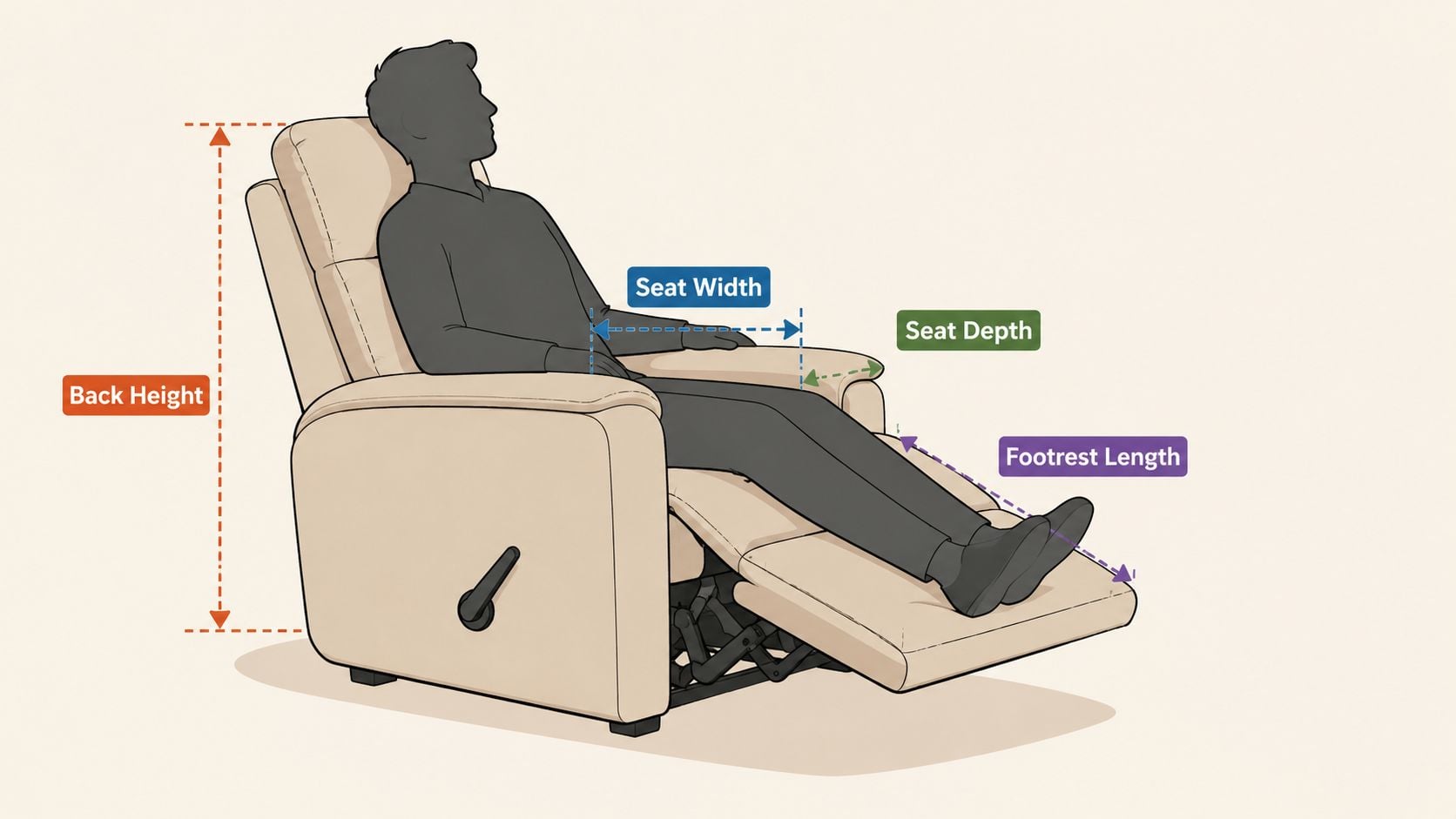
A recliner has more critical measurements than many shoppers realize. Width matters, but it isn't the whole story. Seat depth, back height, reclining length, and clearance all affect how the chair feels once someone uses it.
This visual helps make those parts easier to picture.
The measurements that matter most
Seat width affects personal space and pressure at the hips and thighs. Too narrow feels confining. Too wide can leave the arms sitting too far apart for relaxed support.
Seat depth influences leg support. A seat that's too deep often pushes shorter users forward so their back can't rest where it should. A seat that's too shallow may leave taller users feeling perched rather than supported.
Back height determines where the chair meets the shoulders, neck, and head. If the back is too short, taller users may never feel fully supported. If it's too tall for the person, the proportions can feel awkward.
Fully reclined length matters for leg extension and room planning. This measurement tells shoppers how much space the chair uses when opened, not just when it's upright.
A broader overview of seating features appears in this guide to types of power reclining seating.
Standard size categories in plain language
According to Castlery's recliner measuring guide, standard recliner chairs globally average 33–36 inches in width, 35–39 inches in seated depth, and 40–42 inches in height, forming the foundational size category for users between 5'5" and 6'0".
That gives shoppers a useful baseline. From there, size categories typically work like this:
| Size category | Typical fit |
|---|---|
| Small | Better for shorter users or tighter rooms |
| Medium | Best starting point for many average-height adults |
| Large | Better for taller users who need more leg and back support |
| Oversized | Built for bigger frames and more spacious seating comfort |
What each dimension feels like in real life
A measurement sheet can't tell someone whether the chair cradles the shoulders properly when reading, or whether the footrest supports the calves instead of stopping short. The Sit-Test fills that gap.
Numbers narrow the search. Sitting in the chair confirms the fit.
That's the practical way to think about recliner chair sizes. Measurements help rule models in or out. Comfort testing decides the winner.
How to Measure Your Space and Yourself for a Perfect Fit
The easiest recliner purchase is the one that clears the doorway, fits the room, and feels right the first time someone sits down. That takes two sets of measurements. One belongs to the chair's future owner. The other belongs to the home.
This simple image shows both in action.
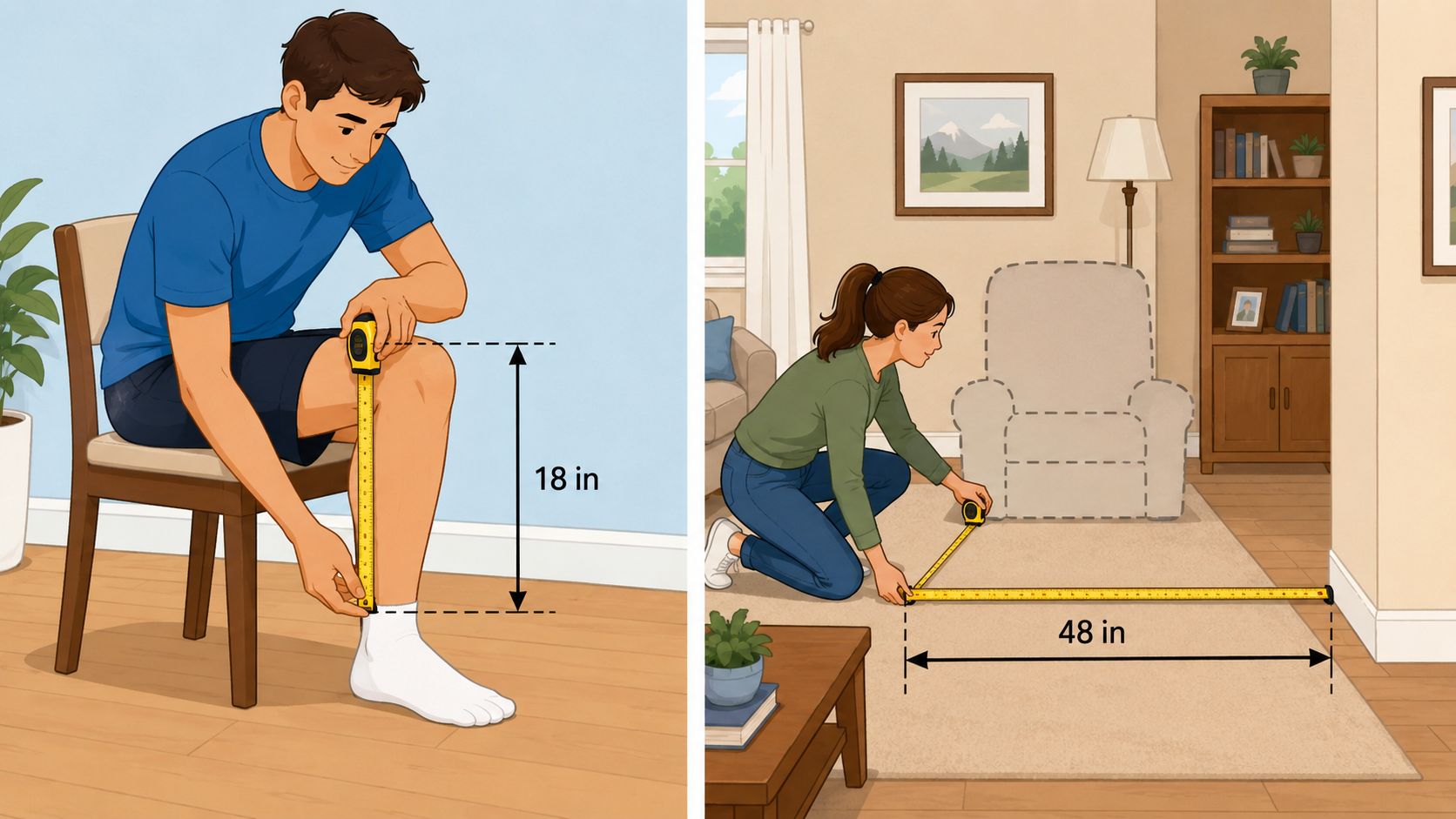
Measure the person first
Start with how the body sits, not with the room.
Sit all the way back
The lower back should rest comfortably against the back cushion. If someone has to scoot forward to keep the feet flat, the seat may be too deep.Check the feet
Feet should rest naturally on the floor when seated upright. Dangling feet usually signal a poor match.Notice the knees
The most useful test is practical, not complicated. There should be a small gap behind the knees instead of the seat pressing hard into the backs of the legs.Use the armrests
Arms should land comfortably without lifting the shoulders. This matters even more for readers, television watchers, and anyone who uses the armrest to help stand.
A recliner can fit a room and still fail the body test. That's why body measurements come first.
Measure the room around the recliner
A recliner needs operating space, not just floor space. According to Living Spaces' measuring guide for recliners, recliner sizing must account for 6–10 inches of wall clearance behind the chair and 5–10 inches between the footrest and any forward-facing coffee table to enable full extension without obstruction.
That means the footprint on the sales tag is only part of the story.
Use this checklist:
- Mark the upright position: Tape the chair's width and depth on the floor so the scale feels real.
- Add reclining clearance: Include the extra space needed behind the back and in front of the footrest.
- Protect the walkway: Keep enough room for people to move through the space without weaving around an open footrest.
- Check nearby pieces: Side tables, lamps, and coffee tables shouldn't interfere with the recline path.
Shoppers who want a room-planning refresher can review this guide on how to measure a room.
Don't skip the path into the house
A surprising number of furniture problems happen before the chair ever reaches its spot. Doorways, entry halls, stairwells, corners, and elevator openings all matter. A recliner that fits the living room but won't make the turn at the front hall is still the wrong choice.
Measure the narrowest points on the route in. Then compare them with the chair's width, depth, and shape. That extra step saves time, frustration, and return headaches.
The Sit-Test completes the measuring process
Once the tape measure work is done, the last step is still the most revealing. Sit fully back. Place both feet naturally. Recline fully. Then return upright and stand up. If any part of that sequence feels strained, the chair may be the wrong size even if the numbers look acceptable.
Matching Recliner Size to Your Lifestyle and Needs
The right recliner depends on more than body size. Daily habits matter just as much. Someone furnishing a den for evening television use has different needs than someone recovering from a procedure, downsizing to a smaller home, or replacing a worn-out chair used for hours every day.
For taller users and long-leg comfort
Taller adults usually notice poor fit quickly. Short back cushions can leave the head unsupported, and short footrests can make the legs feel unfinished in a reclined position. Large and oversized recliners tend to work better because they offer more room for shoulders, thighs, and full-body extension.
A practical guide focused on height-specific comfort appears in this roundup of the best recliners for tall people.
For right-sizers and smaller rooms
Empty-nesters and relocators often want a chair that feels generous without swallowing the room. In those homes, smaller or medium-scale recliners usually make more sense than oversized models. The goal encompasses more than saving space. It's keeping the room balanced so traffic flows and the chair still feels easy to use every day.
For caregivers and aging adults
Fit becomes even more important when standing up isn't as easy as it used to be. According to Vivid Care's discussion of riser recliner measurements, emerging trends show a 22% increase in demand for "right-size" recliners suited for aging adults (65+), yet most size guides still categorize by body height alone, ignoring biomechanical needs like knee-to-seat depth matching.
That's a useful reminder. A chair for an older adult or someone with mobility concerns shouldn't be chosen on height alone. Knee position, armrest support, seat depth, and ease of transition all matter. In these situations, lift chairs and well-fitted power recliners often become practical solutions rather than luxury upgrades.
Good fit supports comfort. Better fit supports comfort and easier movement.
For quality seekers furnishing for the long haul
Some shoppers aren't just replacing a chair. They're trying to buy better this time. A good-better-best approach helps. Start with proper size. Then evaluate support, durability, and the way the mechanism feels in motion. Brands such as La-Z-Boy Indiana shoppers already know for long-term comfort often attract buyers who want dependable seating, while Rowe Furniture tends to appeal to those balancing comfort with a more distinct style.
That same logic works for new homeowners trying to furnish quickly. A recliner shouldn't be treated as a filler piece. It's usually one of the most-used seats in the house.
Design Your Way with Custom Recliner Options
Sometimes the right size exists, but the wrong fabric, arm shape, or seat depth keeps the chair from feeling complete. That's where customization becomes valuable. A custom recliner isn't only about style. It can solve fit problems that standard floor models don't always address cleanly.
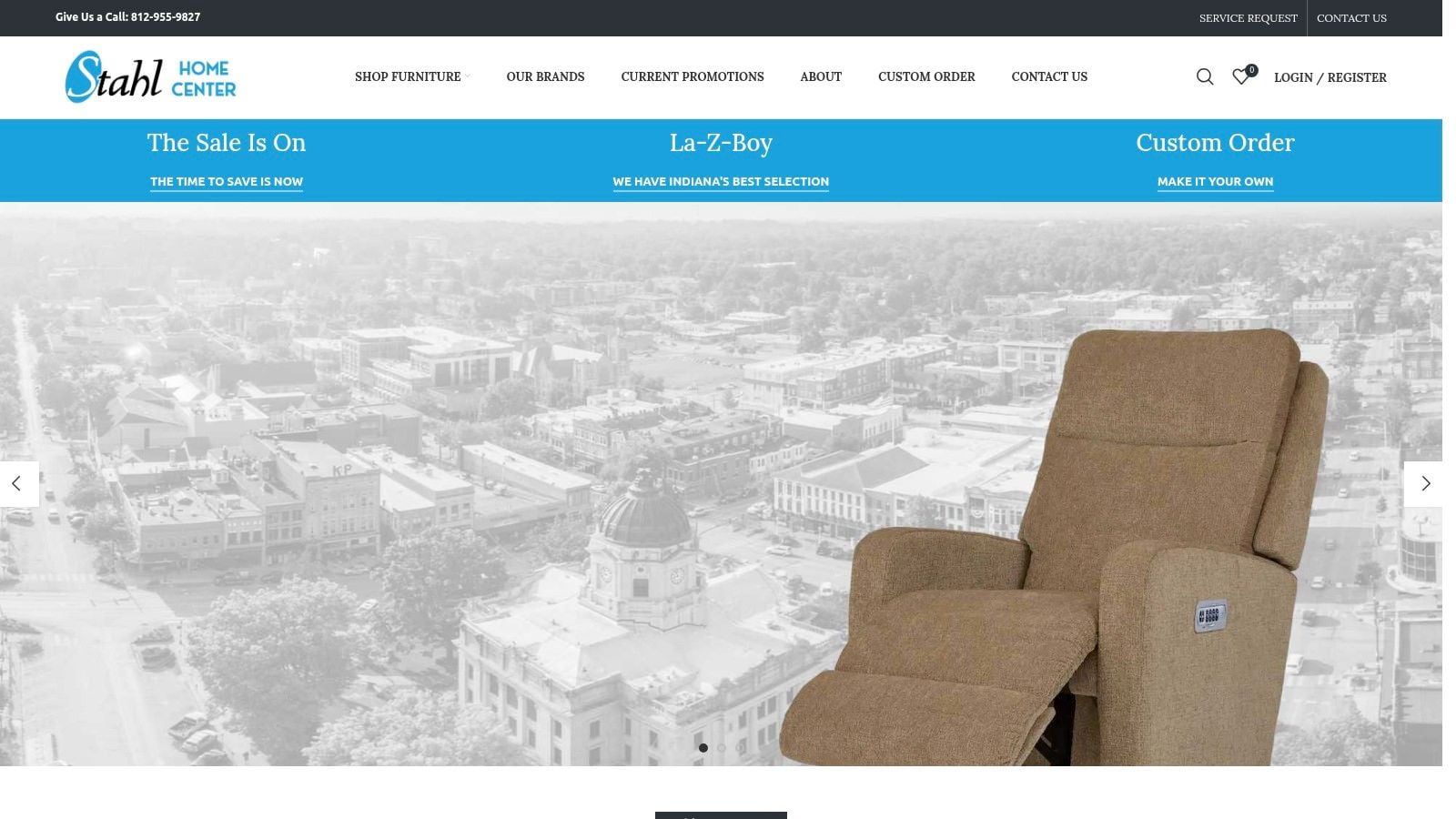
This view shows how custom recliner shopping can start with a real model and build from there.
When custom makes more sense than compromise
According to Stahl Home Center's About Us page, through its "Design Your Way" custom ordering program, customers can select from hundreds of fabric types and configure recliner dimensions, seat depths, and arm styles to match specific household needs.
That matters for several kinds of shoppers:
- Style-focused decorators: They may want performance fabrics that handle busy family life without giving up a polished look.
- Quality seekers: They often care about how the chair is built and how it will hold up over time, not just how it looks on day one.
- Households with specific fit needs: They may need a different seat depth, a certain arm style, or a proportion that better suits the person using it most.
Where custom options help most
Custom choices are especially useful when someone likes the feel of one chair but wants a different visual profile, or when the room calls for a specific color and texture. This is also where Rowe Furniture and custom seating conversations tend to stand out for design-minded shoppers.
A customized recliner can also coordinate with custom sofas, living room furniture Bloomington homeowners are selecting for a full-room update, or even nearby pieces such as bedroom sets and accent seating. Instead of settling for “almost right,” customization lets the fit and the finish work together.
Find Your Perfect Recliner In Stock Today in Bloomington
Most guides stop at measurements. Real life doesn't. A chair may check every box on paper and still feel wrong once someone leans back for ten minutes. That's why the Sit-Test remains the best final step. It answers the questions a dimension chart can't.
A showroom visit makes that difference obvious fast.
According to Stahl Home Center, Stahl Home Center operates an 88,000-square-foot showroom in Bloomington, Indiana, enabling customers to see and compare over 88,000 sq. ft. of furniture styles in person before purchase. That scale matters because recliner comfort is comparative. One chair may feel acceptable until the next one fits the legs better, supports the shoulders more naturally, and makes standing easier.
Why seeing recliners in person still matters
For shoppers searching Furniture store Bloomington IN, the biggest advantage of an in-person visit isn't just selection. It's certainty.
- The Sit-Test reveals fit fast: Seat depth, back height, and arm placement become clear within minutes.
- Color looks different in real light: Fabric tone, texture, and finish often read differently in person than they do on a screen.
- Movement can be tested: Manual, power recliners, and lift chairs each feel different in use.
- Whole-room shopping gets easier: A recliner can be matched with living room furniture Bloomington shoppers need now, plus mattresses, bedroom sets, and other pieces for a faster home setup.
Why local scale changes the experience
A family-owned store with deep inventory offers something many shoppers want but rarely find together. It combines neighbor-to-neighbor service with broad selection and practical speed. For relocators and new homeowners, that means a real chance to furnish a whole home this weekend. For quality seekers, it supports a good-better-best decision process without guesswork. For decorators, it creates options that range from recliners in stock to custom looks with Rowe Furniture and La-Z-Boy Indiana favorites.
As Indiana's Largest La-Z-Boy Dealer, Stahl also gives shoppers a strong place to compare comfort levels, styles, and scale in one stop. Those wanting a coordinated reclining setup can also preview options like the Stoneland reclining sofa.
Thousands of items are in stock and ready to take home today, which is a major advantage for anyone tired of long lead times. For those not in a rush, Design Your Way opens the door to hundreds of fabrics and custom configurations. Either way, the process starts the same way. Sit down, lean back, and judge the chair by how it feels.
Stahl Home Center combines local service, large-scale selection, and practical speed in one stop. Shoppers can explore an 88,000+ sq. ft. showroom, compare recliners in stock, browse La-Z-Boy Indiana favorites, and explore Rowe Furniture and custom options without the usual pressure. Visit the Westside Bloomington showroom at Stahl Home Center today to see the massive selection in person.