
High Back Loveseats: How to Choose the Right Fit

The most popular advice for high back loveseats is also the most misleading. Shoppers are told to pick the tallest back available, as if more inches automatically mean more comfort and easier standing. A tall back is a silhouette, not a fit guarantee.
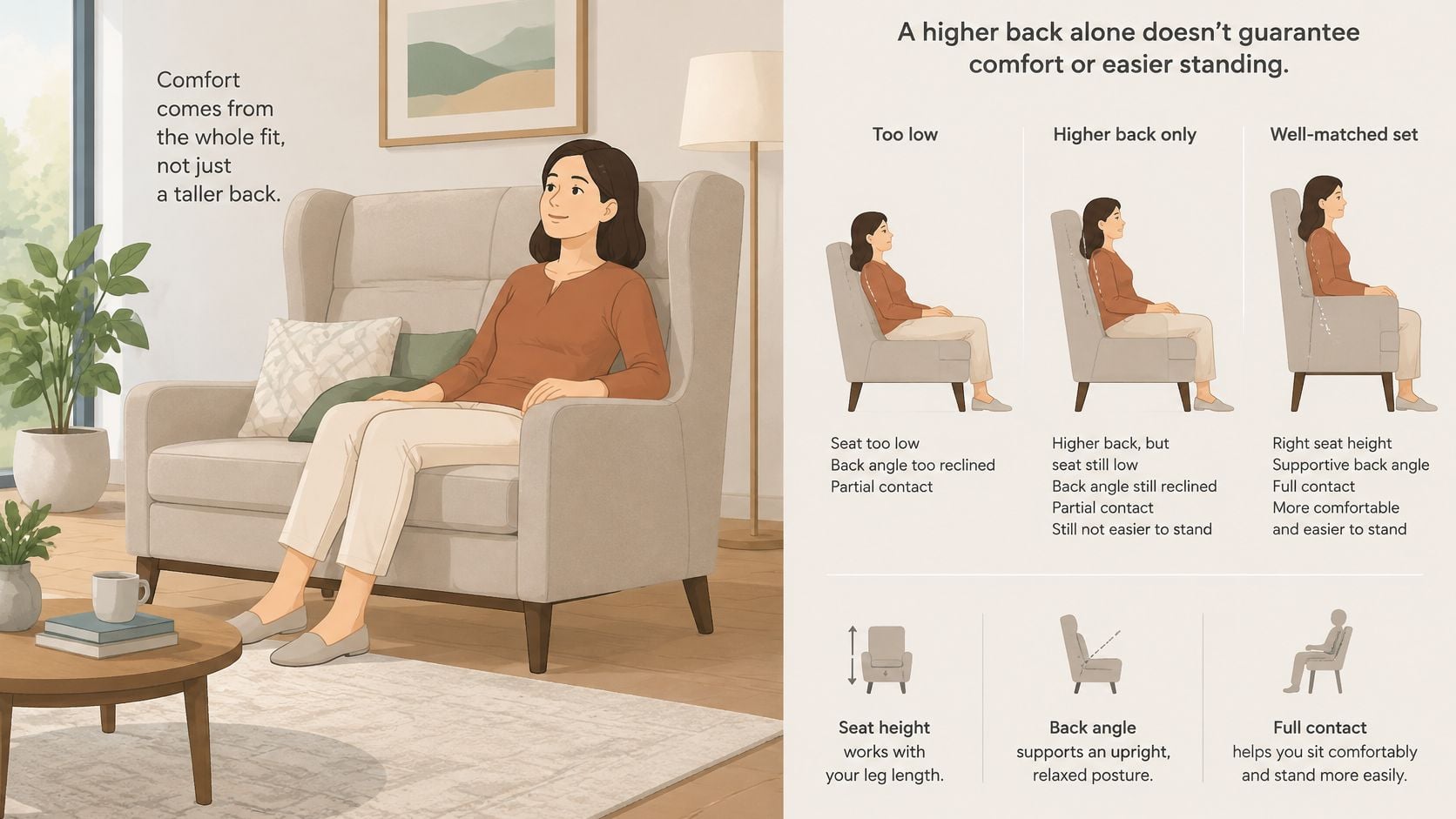
Fit comes from three measurements working together. Seat height decides whether feet rest flat. Seat depth decides whether the lower back reaches the cushion. Back angle decides whether shoulders and head meet support without the chin being pushed forward. Get one of those wrong and a high back towers over an uncomfortable seat.
That's why a tape measure matters more than a product photo. Bring numbers for the room, numbers for both people who will share the seat, and a willingness to sit for several minutes. The right piece feels right at the feet first, then at the lower back, then at the shoulders.
High Back Loveseat Sizes You Can Measure
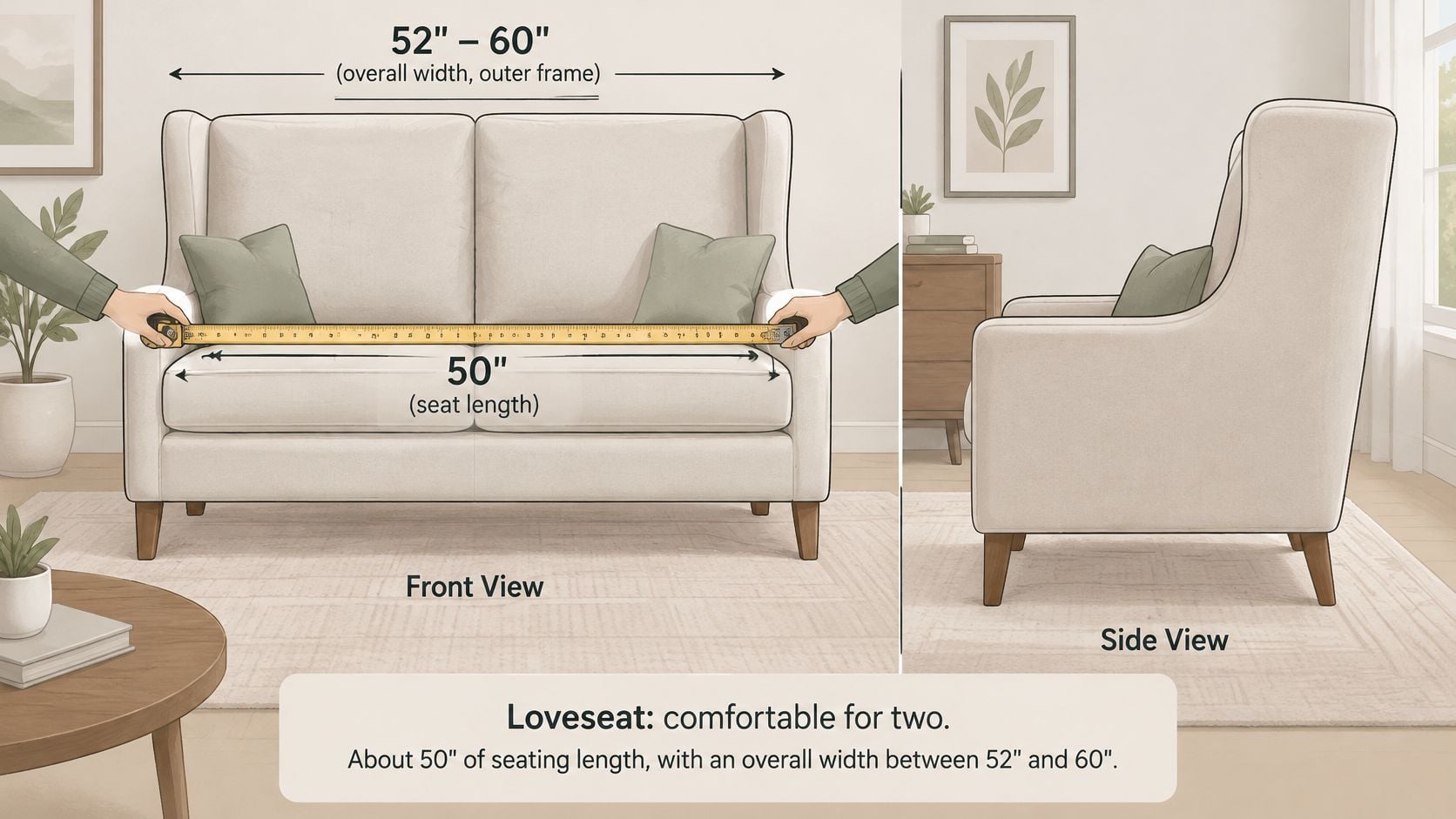
Start with the basic scale. Reference descriptions commonly identify a loveseat as a two-seat couch with approximately 50 inches of seating length, materially shorter than a standard three-seat sofa, as the Wikipedia entry on the loveseat describes it. That seating length is the inside space between the arms, not the full outer width.
The outer frame is wider than the sitting space. For most shopping comparisons, overall width commonly lands between 52 and 72 inches, seat height between 17 and 19 inches, and seat depth between 20 and 24 inches. A high back commonly runs 40 to 48 inches from the floor to the top of the back, while a low back stops nearer the shoulder blades at 30 to 36 inches.
The numbers to check in person
Use the table as a showroom checklist. Measure the room width, each sitter's knee-to-floor height, and the distance from the front of the cushion to the point where the back should land. Both people who will share the loveseat should sit down together, because one person's comfortable depth can leave the other person's feet dangling.
High back loveseat measurements to check in person
| Measurement | Common range | What goes wrong if it is off |
|---|---|---|
| Overall width | 52 to 72 inches | Blocks a walkway or looks lost on a long wall |
| Seating length | About 50 inches | Not truly two comfortable seats |
| Seat height | 17 to 19 inches | Feet dangle or knees sit too high |
| Seat depth | 20 to 24 inches | Lumbar gap or too little thigh support |
| Floor to top of back | 40 to 48 inches | Low back stops at the shoulders |
| Arm height | 23 to 26 inches | Hard to push off when standing |
| Recline clearance | Extra inches behind, unless wall-away | Back or mechanism hits the wall |
Recline clearance deserves its own note. A stationary back can sit close to a wall. A reclining back travels, and it needs the extra inches stated in its specification unless the design is sold as wall-away, meaning the seat moves forward as the back opens. Shoppers comparing two-seat and three-seat footprints can also review how long a 3 cushion couch typically measures before deciding whether the shorter format suits the wall.
Where the format came from
The loveseat name carries a long history, even though fitting one is a present-day measuring job. As the Encyclopaedia Britannica entry on the love seat recounts, early wide chairs appeared in the late 17th and 18th centuries largely to accommodate the volume of fashionable women's dresses, and chairs of this size were increasingly produced from the beginning of the 19th century under the names "love seat" and "courting chair." One clause of history explains the rest. Today's version keeps the compact two-person capacity and adds a taller, more enclosing back.
That tall back adds visual presence and a sense of privacy. It can also block a sightline across an open room and make a modest piece read larger than its footprint suggests. The tag "high back" by itself doesn't say whether feet reach the floor, whether the lower back makes contact, or whether two adults have honest shoulder room.
Measure first: A high back defines the silhouette. The numbers define whether it fits the room and the people.
Bring three figures to the store: the clear wall width, the depth available from the wall to the nearest table or walkway, and each sitter's floor-to-underside-of-knee measurement. With those in hand, the table turns from general guidance into a personal pass or fail test for every floor model.
Why a Tall Back Is Not Automatic Comfort
The failed showroom habit is judging by back height alone. A shopper presses a hand into the top cushion, notes that it reaches the head, and assumes support is solved. Comfort doesn't work that way. Seat height, seat depth, back angle, and leg length interact, and the weakest link decides how the loveseat feels after ten minutes.
A 2025 study of 20 adults aged 61 to 70 found the strongest comfort and pressure-distribution results when seat height was equal to, or up to 25 mm below, the user's popliteal height, with a backrest angle of about 105 degrees, as reported in the MDPI Applied Sciences study on seat height and backrest angle. Popliteal height is the distance from the floor to the underside of the knee. Seats 50 mm above that height reduced foot support and increased calf-muscle demand in that same study group.
A four part sit test
Measure knee-to-floor height at home before the visit, in the shoes usually worn indoors. Then run four checks in order, for each person who will use the loveseat.
- Feet flat: Both feet rest fully on the floor without pressure digging into the underside of the thighs. Dangling feet or only toes touching means the seat is too high or too deep.
- Pelvis stays put: The sitter doesn't slide forward to find the back. Sliding is a sign the seat is too deep, too soft at the front, or angled in a way that pushes the hips out.
- Lower back makes contact: The lumbar region meets the cushion naturally. A gap behind the lower back means the depth beats the leg length. Anyone unsure how that measurement works can review what seat depth means and how to measure it before shopping.
- Head stays neutral: The upper back or headrest meets the body without forcing the head forward. A tall back that shoves the chin down is worse than a shorter back that leaves the head free.
Armrests complete the test. A natural push-off matters for anyone who stands often during the day: empty nesters, active retirees, and caregivers moving between seats. Hands should land on the arms at a height that lets the elbows work without shrugging the shoulders up to the ears.
Sit longer than feels polite
Thirty seconds reveals softness. Several minutes reveal fit. Sit upright in the intended position, then recline if the piece moves, and compare both postures. Pressure that builds slowly at the back of the knees or the tailbone only shows up with time.
Treat adjustability as a fit option, not proof of ergonomics. A powered headrest or an adjustable angle can help two different bodies share one loveseat. It doesn't certify that either body lands in a supported position. Durability ratings and seating standards likewise describe structure, not comfort. The sit test is the only ergonomic evidence that counts for a particular household.
A tall back can support the shoulders and head and still be hard to use if the seat beneath it is too deep, too high, or too soft.
The same leg-length math applies to every adult, young or old. It's easiest to notice in households where standing up has become deliberate. Choose high back loveseats as complete seating systems, with the back height judged last rather than first.
Frames Cushions Motion and Fabrics to Compare
Judge the build apart from the first minute of softness. Cushions decide the first impression, but the frame decides year five. A high back puts more load on the back frame and head area than a low back does, because sitters lean their full upper weight against a taller lever. A recliner adds mechanism stress on top of that.
Recognized seating standards help, within limits. ISO 7173:2023 evaluates frame and load-bearing structure through strength and durability methods, and the ISO standard for seating strength and durability explicitly excludes upholstery aging, ergonomics, and electrical functions. That split matters. A loveseat can pass structural tests for seat and back loading, front-edge loading, arm strength, impact, and stability, yet still need separate evidence for foam recovery, fabric abrasion, or recliner-cycle life.
Front-edge strength deserves attention in multigenerational homes. People push off the front lip of the seat to stand, concentrating force on the frame, joints, and leg attachments. Ask what the manufacturer states for intended user weight and whether testing covers the frame, mechanism, and upholstery independently. Those answers compare better than squeeze tests. Shoppers who want a broader checklist before narrowing down can start with what to look for when buying a sofa and then apply the high back questions here.
One decision per row
Feature choices for a high back loveseat
| Choice | What to ask | Prefer it when |
|---|---|---|
| Stationary high back | Does the back stay fixed against a wall? | The room is tight or the seat is mainly for reading |
| Manual recline | Can the people who use it pull the handle? | Lounging is occasional and no cord is wanted |
| Power recline | Is there an outlet and clearance for the moving back? | Grip is limited or someone reclines daily |
| Supportive seat core | Do two adults sink into a hammock? | The seat is used for hours, not just looks |
| Performance fabric | Will spills, pets, or kids hit a tall light-colored back? | The room is busy and the color should stay pale |
| Custom fabric or configuration | Is the floor model's build right but the cover wrong? | Timing allows a made-to-order piece |
The row shoppers most often misread is power recline versus wall clearance. Power motion sounds effortless, and it is for the sitter with limited grip. The trade-off sits behind the furniture. The back needs room to travel, the cord needs an outlet that doesn't cross a walkway, and the mechanism needs clearance from baseboards and side tables. A manual recline avoids the cord but asks for handle strength and a firm push to close the footrest. Neither wins outright. The honest answer depends on hands, habits, and inches.
Seat cores should hold two adults without a hammock sag in the middle. Reversible or replaceable cushions favor longevity because the worn surface can be rotated or renewed. Households nursing an older seat along while they shop can look at practical ways to firm up a sagging loveseat from Meliusly, with the understanding that support fixes buy time rather than restore a tired frame.
Fabric choice is partly a light choice. A tall back shows more yardage than any other part of the piece, so performance fabric protects a pale color on a large visual mass, while leather or performance leather suits rooms where wipe-down cleaning matters most. Confirm the true color under showroom light and again with a swatch at home. Phone screens shift both color and texture, and a custom order in the wrong shade is a long wait in the wrong direction.
Match the row to daily use, then stop. A reading household doesn't need power. A daily recliner doesn't need a delicate cover. Clarity about the main job makes every other feature choice easier.
How to Measure Your Room Before You Buy
Measure the room as it will be lived in, not as it looks when it's empty. Six steps cover the mistakes that send furniture back or leave it crowding a doorway.
- Tape the footprint: Mark the outer width and depth on the floor with painter's tape. Add the recline path if the back moves, since the occupied footprint is bigger than the closed one. This step prevents the classic error of fitting the closed loveseat and discovering the open one hits the wall.
- Protect the walking route: Keep a clear path for people, walkers, and anyone carrying laundry or a tray. A high back is visually bulky and easy to clip with a hip. If the taped outline narrows the route to a sideways squeeze, the piece is too big for that spot.
- Clear exits and heat: Leave doors, vents, radiators, and heaters unblocked. Don't force a gap behind the frame that traps heat or pinches a cord. Comfort never justifies covering a heat source.
- Check the sightline: Sit where others will sit and look toward the television, window, and play area. A tall back can hide a child playing on the far side or cut off conversation in an open plan. Households measuring a full layout can follow the step-by-step method for how to measure a room for furniture and then apply the sightline check to each seat.
- Test the mechanism in place: Open and close the recline where the piece will sit, not in an open showroom aisle. Read the published clearance and confirm the moving back misses the wall, shelves, and window trim.
- Separate two kinds of safety: Tip-over prevention and fall prevention are related but distinct jobs, and a loveseat raises different questions than tall storage furniture.
Tip over versus fall prevention
The U.S. Consumer Product Safety Commission's guidance emphasizes that furniture tip-overs can occur regardless of an item's cost, quality, or intended purpose and recommends anchoring applicable furniture, as set out in the CPSC Anchor It resources. A conventional upholstered loveseat isn't the same risk category as a dresser or bookcase. Still, people pull and push on a high back when standing, and children can climb where they shouldn't.
Renters face an extra wrinkle, because anchoring can be difficult where tenants face restrictions on wall modifications. In a care-oriented home, ask whether the model can be secured or stabilized without drilling. Don't promise a wall anchor that a tenant can't install.
Fall prevention basics: Supportive dimensions, feet flat on the floor, and an open path do more to prevent falls than a tall back alone.
Placement near televisions, windows, walkways, and play areas is where these checks come together. The safest layout keeps the loveseat stable, the route around it open, and the sitter able to rise without hauling on the frame. A high back supports that plan. It doesn't replace it.
Care and Maintenance for High Back Loveseats
Care starts with the tag. The manufacturer's cleaning code sets the rules: W for water-based cleaners, S for solvent-only, WS for either, and X for vacuum only. Test any cleaner on a hidden spot first, low on the back or under a cushion, before touching the tall visible surface.
Performance fabrics resist spills and pet stains and are often rated for abrasion. Compare the abrasion score when choosing a cover for a busy room, since sleeves, pet paws, and bag straps all rub the same few places. Households weighing cleanup effort against daily mess can compare options for easy to clean furniture for busy homes before committing to a delicate weave.
Rotate or flip reversible seat cushions every few months so both seats wear evenly. Fluff loose-fiber back cushions after heavy use, working the fill back into the corners. Two seats rarely get equal use, and rotation is the cheapest way to keep the loveseat from developing one tired side.
Sun and heat age upholstery. Keep high back loveseats out of direct sun from a west-facing window to slow fading, and keep the back a few inches clear of heaters and fireplaces. For leather or performance leather, wipe spills at once and condition on the schedule the maker lists.
Two handling habits protect the frame. Check that a manual handle or power cord isn't pinched under the base or stressed at full recline. Lift the piece by its base when moving it, never dragging it by the tall back, which strains frame joints. Keep the cover code and fabric name on file so a replacement cushion or repair matches the original.
Styling Ideas for Real Living Rooms
Style the height instead of fighting it. A high back is the tallest shape in most seating groups, and a room looks calmer when its layout admits that early.
Small room, one tall shape
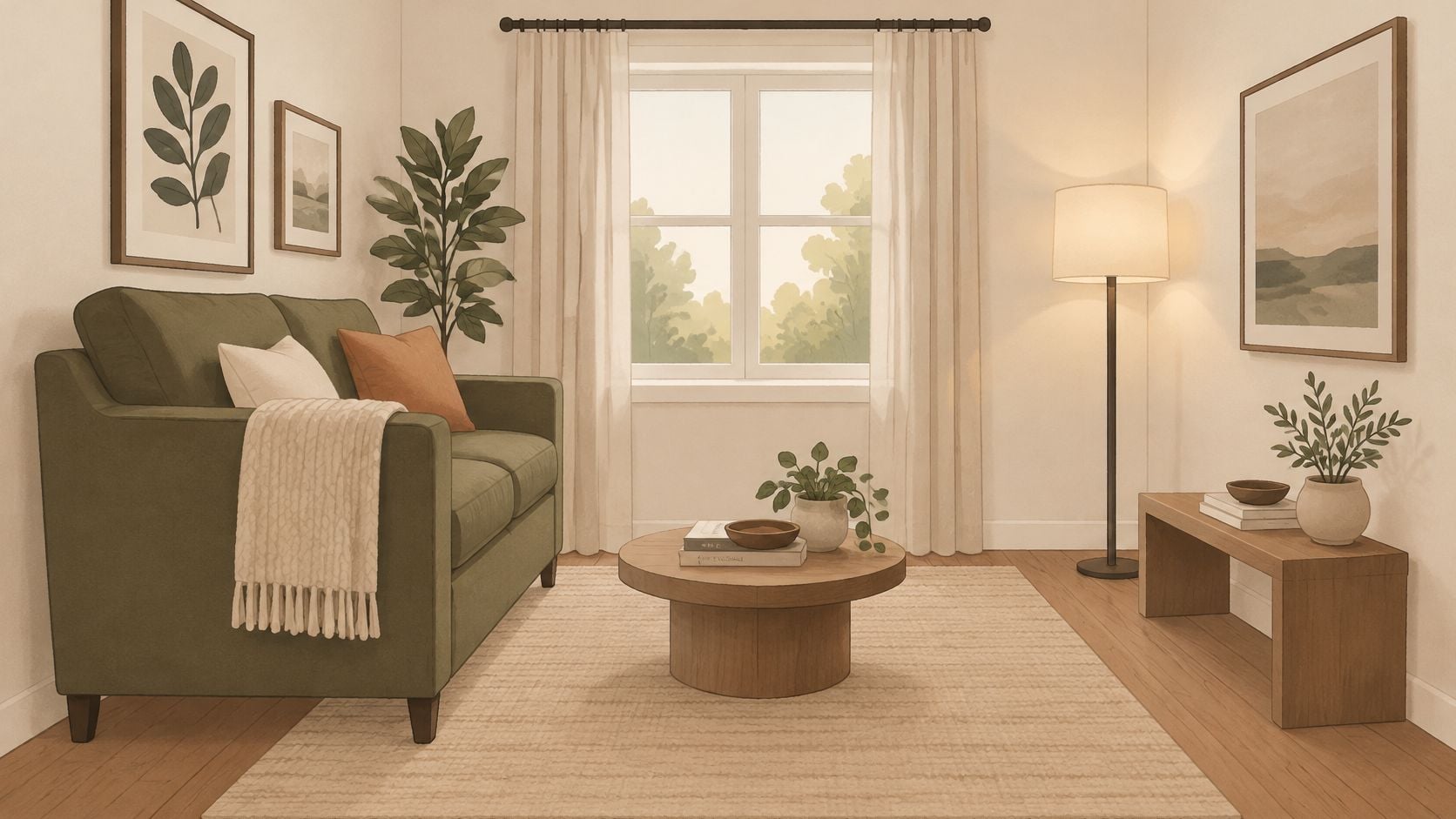
Say a compact living room gets a high back loveseat as its main seat. Let it be the tallest piece, and keep the opposite wall quiet: one lamp, a low table, and a rug that runs past the front legs so the loveseat doesn't look perched on an island. Low neighbors make the back height read as intentional rather than overwhelming.
Beside a window
Placed near a window, the back works as a partial screen, giving privacy without closing the room down. Pair it with a slim side table rather than a bookcase, which would double the vertical mass on the same wall. Light spills over the table, the seat stays sheltered, and the room keeps one clear focal height instead of two competing ones.
Bedroom, office, and the reading corner
In a bedroom or home office, treat the loveseat as the reading seat. Keep the cover in the same color family as the drapery so the height recedes into the background. A floor lamp arcing over one shoulder and a small table for a book finish the arrangement. Nothing else needs to be tall.
Scale the lamp and table to the back
The furniture beside a high back matters as much as the back itself. Next to a 40-to-48-inch back, a table lamp whose shade top lands close to the top of the frame keeps light at reading height without pulling the eye upward. A shade that finishes well above the back adds a second tall shape on the same wall, which is what makes these rooms feel cramped even when the floor plan is generous.
The side table follows the same logic as the seat: about arm height, so a mug or a book lands within reach. Measure the arm at the front corner, add an inch for a coaster and a lamp base, and stop there. A table that rises past the arm turns into a shelf and starts competing with the silhouette you were trying to calm.
Performance fabric holds a pale or textured look in a busy house, and a custom cover is the right move when the silhouette is right but the floor model's color isn't. Pillow scale is the practical limit. A lumbar pillow shouldn't shove the sitter forward off the back that was so carefully fitted, and one textured pillow reads cleaner than a stack that hides the headrest.
One arrangement keeps showing up when the room is smaller than the furniture plan. Take a 12-by-14-foot living room where a sectional would crowd the walking route: a loveseat against the long wall, a single chair across a narrow table, and the tall back as the only vertical mass. Conversation stays close, the path from door to kitchen stays open, and the loveseat has one clear job. A room furnished that way can also start from an in-stock silhouette and add pillows after, rather than waiting on every custom detail before anyone can sit down.
Sit Test a Loveseat and Take It Home
Numbers get you to the right aisle. Only sitting gets you to the right piece. A high back that photographs as generous can push your feet off the floor once your hips are against the cushion, and a fabric that reads warm gray on a phone can read green under your own lamp. The sit test settles both questions in a single visit.
Give it four stops and five unhurried minutes per candidate. Bring your knee-to-floor measurement and the width of your walking path, then run the same sequence on every loveseat so a soft seat doesn't flatter one piece over another.
Feet. Sit back until your hips touch the cushion. Heels should rest flat with your thighs roughly level. If your toes float or your knees ride higher than your hips, the seat is too tall for you, whatever the back height promises.
Pelvis. Slide a hand behind your lower back. A gap you could flatten with a small pillow is normal. A gap wide enough for a folded throw means the seat is too deep, and you will slide forward to reach the floor, which defeats the tall back entirely.
Lower back and head. The lumbar curve should meet the back cushion without a fight, and the top of the back should land at your head or just above it. If the crown presses into your shoulder blades, the loveseat is sized for someone else's torso.
Five minutes. Sit the way you live: feet tucked, one leg crossed, leaning into the arm. A small pressure point at minute one becomes a reason to stand up at minute four. Check the arm height too, since a low arm is hard to push up from.
Once a piece passes, decide how you want to buy it.
In stock today. Floor pieces can go home the same day by pickup or on a scheduled delivery, which suits a relocating household or a room that needs to be usable this weekend. You accept the fabric and depth that already exist.
Custom Order. Choosing fabrics and finishes made specifically for you provides the exact depth, cover, and configuration, but it requires waiting time. La-Z-Boy recliners and sofas can be customized with hundreds of fabrics and options, and Rowe Furniture offers a similar range in style and performance fabric choices. Designers present customers with a variety of fabric designs for upholstered pieces, turning the decision into a comparison rather than guesswork.
The Good-Better-Best collections are curated groups rather than a single ladder, which lets you compare a frame and cover at each level instead of guessing what the next tier adds.
One showroom visit turns that comparison physical. Stahl Home Center's Bloomington showroom holds 88,000 square feet of in-stock furniture across living room, bedroom, dining, mattress, and decor, so several high back loveseats in different depths and covers can be tried in one afternoon with the tape measure still in your pocket.
Bring your knee-to-floor and walkway measurements to Stahl Home Center and run the four-stop sit test on high back loveseats in person. Thousands of pieces are ready to take home today, and custom fabric options are there for shoppers who want a specific cover.