

Glider Recliner Leather: Buying Guide for 2026


You're halfway through unpacking in a new place, the baby wakes again at 2 a.m., or a parent needs a seat they can leave without a struggle. The photo looked right. The chair you sat in does not. A glider recliner leather cover can feel smooth in a thumbnail and still stain, squeak, or make standing up harder than the old sofa.
The fix is a floor check, not another scroll. Motion, seat size, leather grade, room air, and whether the piece is In-Stock Today decide if the chair works for night feeds, a living room, or a household where someone needs help getting up.
What a Leather Glider Recliner Actually Is
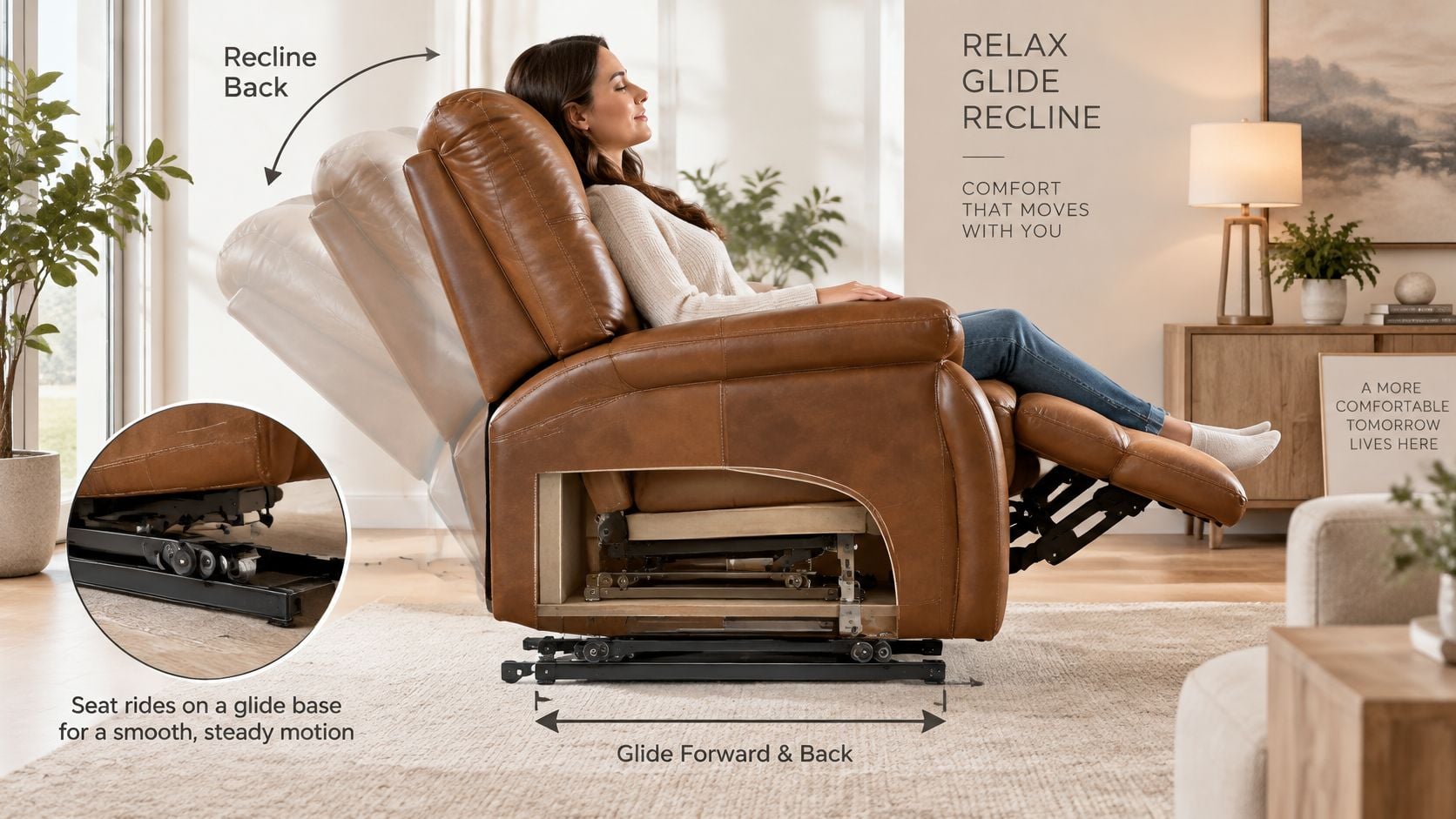
Sit in the chair, recline it, and try to stand without pushing off the arms. That one move exposes more about a leather glider recliner than the showroom tag does. It is a reclining chair whose seat rides on a glide base, so the whole chair travels forward and back on a track while the backrest reclines and the footrest extends. Leather is the upholstery: real hide cured and finished over a frame and mechanism. The ride is close to a porch swing with a reclined back, but the parts underneath run on a straight track.
Inspect three parts before you talk price.
- The glide base or track. The seat should travel in a straight line and stop cleanly.
- The recline mechanism. Back and footrest should hold the angle you set.
- The leather covering. Grain, finish, and seams flex every time the chair moves.
The glide runs smoothly, which is why families use it for night feeds. Gliders usually need less floor movement than rockers, so they fit tight rooms. Some bases also turn. A swivel glider chair adds a turn on a fixed base; the glide itself is a separate function. Ask about leather finish and smell before a chair goes into a small nursery, and leave enough clearance for a caregiver to reach the handle.
Choosing the Right Motion
| Motion | How It Moves | Space Needed | Best For | Watch For |
|---|---|---|---|---|
| Glide | Seat slides straight back and forth on a track; back reclines | About 36 to 40 inches front to back from the wall | Nurseries and quiet living rooms | Glide travel can bump walls and shift rugs |
| Rock | Curved base rocks forward and back | Arc clearance front and back | Traditional rooms and rhythmic relaxing | Rockers tip more easily; check the base |
| Swivel | Seat turns on a fixed base | Circular clearance across the chair | Open-plan rooms and conversation groups | Swivel does not glide; test the lock |
| Recline only | Back and footrest move; seat stays fixed | Recline clearance only | Maximum stability for standing and transfers | No rocking or gliding |
| Power glider | Motorized recline, some models add lift | Recline clearance plus outlet access | Mobility needs and daily use | Remote misuse risk; test the controls in store |
Read the table left to right. Motion names the mechanism, space is the clearance you must leave, and the last column is the failure people miss on a showroom floor.
Glide, rock, or a fixed seat
A glide keeps the seat level while it slides. In a nursery beside a crib, that steady line is easier to control with a baby in your arms than a chair that tips on an arc. In a narrow living room, the same track lets you sit closer to a wall than a rocker, as long as the full slide doesn't shove a rug.
A rock suits a traditional room with open floor in front and behind. The curved base feels familiar, and it also tips more readily if a child climbs the back or a dog jumps up. Push the empty chair through a full rock before you commit.
Recline only, with no motion base, is the steadier choice when standing and transfers matter more than a soothing slide. Power recliners and some lift chairs add a motor. They need an outlet and a remote someone can understand. Compare power and manual recliners on the floor, not from a spec sheet alone.
Practical rule: If the person who will use the chair can't explain the remote in one sentence, don't send that chair home with them.
On the floor, check these before you like the color:
- Wall clearance: Recline and glide at full travel with the chair where it will live.
- Rug and cord paths: A sliding base can bunch a rug or drag a cord.
- Reach of children and pets: Fingers, paws, and tails shouldn't meet the track, the footrest, or a moving lift arm.
Sizing and Comfort for Every Body
Fit starts with five measurements, and the sixth tells you whether the chair can live where you want it.
| Measurement | Why It Matters | Check In Store |
|---|---|---|
| Seat height | Sets how easily you stand up | Stand up without using the arms |
| Seat depth | Supports thighs and back | Two fingers should fit behind the knees |
| Seat width | Room for hips and layered clothing | Sit with arms relaxed |
| Overall width | Fits corners and doorways | Measure the delivery path first |
| Recline clearance | Chair must recline without hitting the wall | Recline fully before you commit |
| Footrest extension | Supports legs without blocking walkways | Extend and check the walking path |
Measure at home first, then match the chair. I treat these as general rules of thumb from floor experience, not a spec: seat height about 17 to 20 inches, seat depth about 20 to 22 inches, seat width about 22 to 26 inches, overall width about 32 to 40 inches, and recline clearance of roughly 36 to 42 inches from the wall. Check the model's spec sheet for final numbers, and use recliner chair sizes as the tape-measure list rather than a guess from a photo.
Run the sit-test as a transfer, not a nap
Sit all the way back. Two fingers behind the knees means the depth isn't cutting circulation or leaving you perched. Stand without using the armrests. If you can't, try once with the arms, then once with a helper at your side. Glide and recline through full travel while your feet are on the floor at the start and on the footrest at the end.
Plush seating can make standing up harder. Research on chair design found that lower seat height, greater backward seat tilt, more reclined backrests, and highly compressible cushions can make standing slower, harder, and less stable, even when those features feel better while you sit, as described in the Journal of the American Geriatrics Society. That discussion also describes a Canadian coroners' review of people with cognitive decline who used power lift-recliner remotes to stand before unwitnessed falls and later injuries.
Maximum plushness and maximum recline can fight functional independence. Test standing and transferring, not only relaxing.
For a multigenerational house, ask:
- Can they enter and exit alone? Seat height and cushion firmness decide that more than padding depth.
- Do the armrests give support? Wide, firm arms help a push-off. Soft arms collapse under a hand.
- Is the remote simple, and are pinch points covered? One clear button beats a cluster nobody remembers.
- Can a caregiver reach the side? Footrest clearance and chair width have to leave a path for help.
Leather Grades, Finishes and Durability
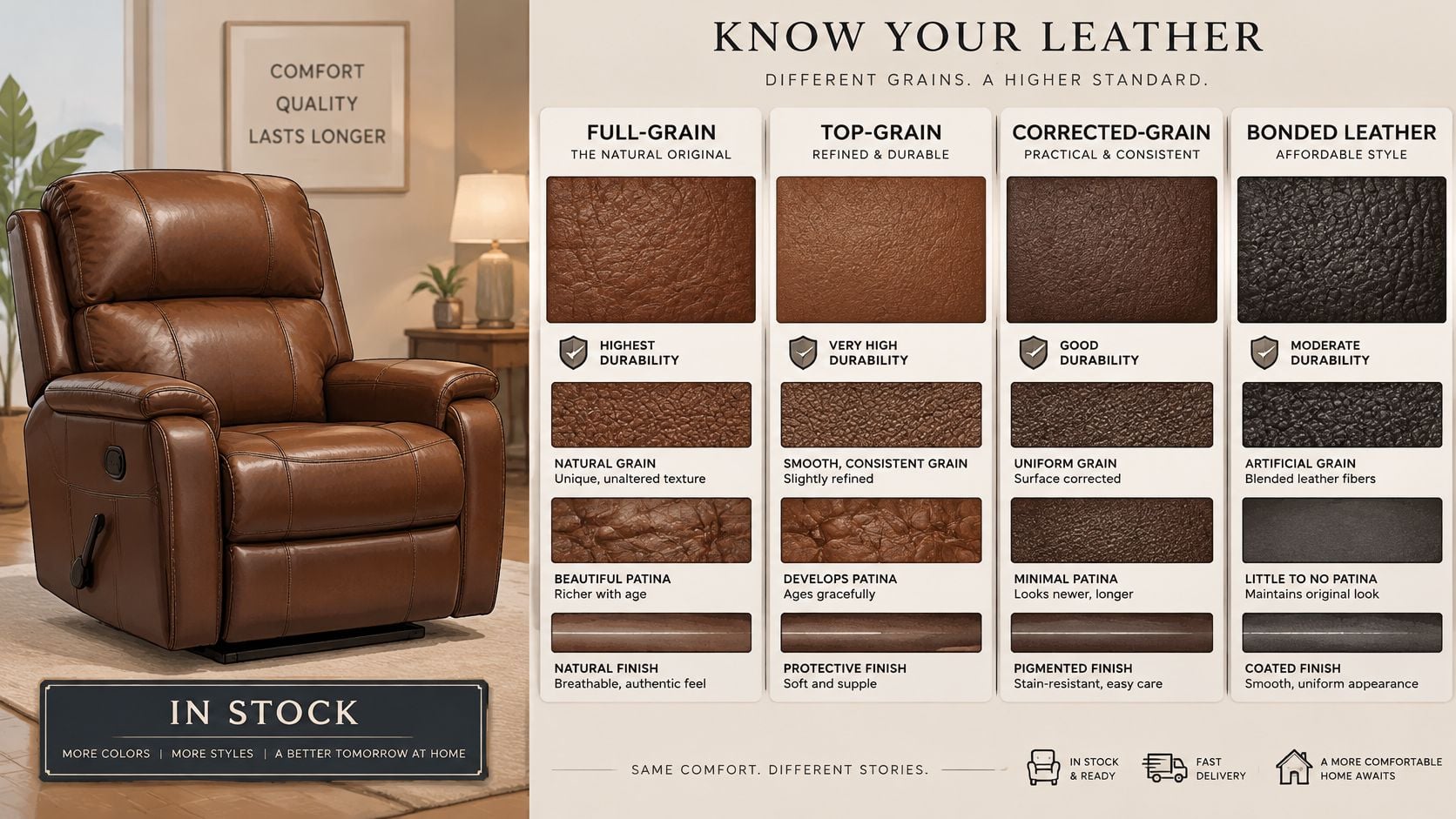
Leather isn't one material. Grade and finish decide how glider recliner leather wears where the hide bends at the seat edge, the arms, and the footrest.
| Grade or Finish | What It Is | Durability Notes | Care Level | Best Fit |
|---|---|---|---|---|
| Full-grain | Outer layer with natural grain kept | Strongest; develops patina over time | Moderate; use only approved cleaners | Long-term family seating |
| Top-grain | Sanded, finished surface for even look | Good; protected finish resists stains | Low to moderate | Most daily-use recliners |
| Corrected grain (pigmented) | Surface sanded and coated with pigment | Even colour; coating resists wear | Low | Households with children or pets |
| Aniline | Dyed with minimal surface coating | Soft and natural; stains easily | High; strict spill control | Low-traffic rooms |
| Bonded | Shredded leather fibers on a backing | Shorter life; can peel over time | Low | Value-focused buyers who accept a shorter life |
| Synthetic (faux) | Polymer coating over fabric backing | Consistent surface; varies by coating | Low | Budget-friendly options; ask about emissions |
How to read a cycle count
A high number from one lab test isn't comparable to a lower number from another. A technical upholstery guide reports residential-to-contract abrasion of approximately 25,000–40,000 Martindale cycles, with heavier-duty protected leathers reaching 50,000 or more cycles, and flex benchmarks of 5,000 cycles for light residential use, 10,000 for residential or contract use, and 20,000 or more for heavy commercial use, according to Biltrite Furniture's leather guide. A separate specification in that guide lists 20,000 dry-flex cycles for aniline leather and 50,000 cycles for protected finishes without finish damage or cracking under the stated conditions.
Those figures rank materials in a lab. They don't promise a number of years in your house. Body friction, soil, seams, and how often the footrest cycles all change the result. Ask for the leather type, the finish classification, the test method, the load, and the endpoint, and whether the number is for the grade on the chair. For a side-by-side of covers, see microfiber and leather and then feel both on the same style of chair.
Good-Better-Best is a practical sort, not a slogan. A bonded or synthetic cover can be the value path for light use if the label is honest about what it is. Top-grain or pigmented leather is the usual daily family seat. Full-grain, or a performance fabric through a custom program, is the long-stay piece when you want grain and you're willing to follow a care schedule.
Quality seekers should also look at seam construction and whether cushions can be serviced. Arms, seat fronts, headrests, and footrests take localized rubbing, not even wear across the back.
Matching the Glider to Nurseries and Living Rooms
Nursery
Say the chair sits an arm's length from the crib for cluster feeds that run long into the night. A cluster feeding guide for caregivers is worth reading before you pick a motion, because those sessions keep an adult in the seat far longer than a single bottle.
- Pinch and trap points. Confirm the glide base can't catch fingers and the footrest can't close on a small hand. Cycle it empty, then with a folded blanket on the seat.
- Milk and spit-up. Keep a washable throw on the leather and lift it clear of the mechanism. Blot a spill the moment it lands. A throw that rides into the track is a new problem.
- What the chair is made of. Don't treat the word leather as an air-quality claim. Research on synthetic-leather upholstery found measurable emissions of compounds including toluene, 1,2-propanediol, and limonene, with emissions and odor varying by material and declining over a 28-day test period, reported in a materials study on upholstery emissions. Separate research on leather sofa samples in that same paper found that medium- and low-grade leather produced more aldehyde and ketone emissions associated with off-odors, while the modeled non-carcinogenic and carcinogenic risks were low.
Ventilate for several days after the chair arrives. Households with asthma, chemical sensitivities, infants, or older adults should ask what the surface, backing, and adhesives are before they buy. Lower odor can't be assumed from a hide label.
Living room
Here the glider is often the main seat for television or reading, so recline travel, footrest clearance, and the path behind the coffee table matter more than a nursery-quiet slide. Pull it off the window, leave a free outlet if it's powered, and keep it away from radiators and direct sun. Living room furniture Bloomington shoppers can do that check in the showroom with the lights they live under, not a phone screen.
Caring for Leather So the Motion Stays Smooth
Every glide and every recline bends the finish. Grit and a harsh cleaner dry that film, and the next hundred cycles turn a dull spot into a crack at the arm or the footrest hinge.
- Vacuum weekly. Use a soft brush on seams, arm edges, and the glide track so grit isn't ground into the hide.
- Blot spills at once. A soft, dry cloth, press, don't rub, so you don't drive the spill into the finish.
- Clean only with an approved product. The American Home Furnishings Alliance leather guidelines describe suitable agents as gentle, water-based, pH-balanced products that lift routine dust and soil without altering the finish.
- Test first. Try any product on a hidden spot. A change in gloss there is cheaper than a change across the seat.
- Skip alcohol, degreasers, abrasive pads, and heat. Those strip lubricants, weaken pigment, and speed cracking, and flex makes the damage show sooner. Keep the chair off radiators, heat registers, and prolonged sun.
- Condition only when the maker says so, and then only every few months. Extra conditioner can soften a coated finish you were trying to protect.
- Listen once a month. A new squeak or a stiff glide is a service issue, not something to oil with a household product. Stahl Home Center customers can submit a furniture service request online and have the team help.
Protected and pigmented leather forgives more daily use. Aniline and nubuck can build a real patina and still need stricter spill control, because they drink stains that a coated hide would bead. More on placement and everyday protection is in this guide to protecting leather furniture.
Choose In-Stock or Custom Order Before You Visit
Two decisions decide your visit: whether the chair is on the floor or built for you, and what evidence you leave with. Run the fit and stand-up checks from earlier in this guide before you commit to either path. Then use the visit to settle what a photo cannot show: leather finish, motion feel, and how the chair fits the room and the people who will use it.
Get four answers in writing before you say yes:
- The leather finish classification and the maker's cleaning code, read from the care label before you pay and checked again at pickup.
- Whether the piece is floor stock or custom, with the pickup or delivery window stated plainly.
- The exact motion type, glider, recliner, or lift, and the clearance it needs behind the chair.
- The care schedule and approved cleaner names for that finish.
In-stock is the fast path. Stahl Home Center has 88,000 square feet of in-stock furniture across living room, bedroom, dining, mattress, and home decor categories listed on the in-stock furniture page. That matters when a nursery is weeks away or a household is relocating and needs seating this weekend. You can check the piece in person, confirm the leather, and arrange pickup or delivery without guessing at a backorder date. Bedroom sets and mattresses on the same floor let you finish more than one room.
Custom order is the patient path. Custom Order and Design Your Way let you choose fabrics and finishes made for you, including hundreds of options for La-Z-Boy recliners and sofas and Rowe Furniture pieces. Choose it when you need a performance fabric for a busy house, a specific sectional layout, or a leather that will take daily family use. Ask whether the finish is protected or aniline; that answer sets both the cleaning routine and how visibly the chair will wear. Sort the choice with the Good-Better-Best collections: a labeled value option for light use, top-grain for daily family seating, or full-grain when the chair has to last.
The showroom visit earns its keep because leather color shifts under store lighting. Pull the hide to a window or ask for a sample you can take to the room where the chair will live. Sit in the exact motion unit you are considering, and if a caregiver will help with transfers, bring that person. The sit-test here is a safety check as much as a comfort check.
The Bloomington store is family-owned and is Indiana's largest La-Z-Boy dealer. The in-stock and custom paths sit side by side. Walk the floor with the care label question in hand, then choose the path that gets the right leather and the right motion into your room. Visit Stahl Home Center and walk the selection with the person who will use the chair.


