

Living Room Sectionals with Recliners Guide


A new home can feel unfinished when the living room has nothing comfortable in it. The sectional arrives after the boxes are unpacked, the television is mounted, and the household has already spent weeks sitting on borrowed chairs. For relocating families and homeowners replacing worn furniture, living room sectionals with recliners solve that problem only when comfort and availability receive equal attention.
The right sectional should fit the room, support the way people relax, and arrive without an unpleasant surprise at the doorway. In Bloomington, Stahl Home Center combines an 88,000+ square foot showroom with thousands of items available to take home today, giving shoppers a practical alternative to long online lead times.
Why Immediate Comfort Matters for Your Living Room
Furniture shopping often begins with urgency. A household moves into a new home, discovers that the old sofa no longer fits, or decides that a tired family room needs a serious upgrade. The preferred sectional looks right online, but the delivery estimate stretches into an uncertain future. Meanwhile, movie nights happen on folding chairs and guests balance drinks on moving boxes.
That delay changes the buying decision. A shopper who needs a usable living room now shouldn't have to choose between immediate availability and quality construction. Stahl Home Center's local showroom model addresses both needs, with a broad selection of sofas, sectionals, recliners, bedroom sets, mattresses, and other home furnishings available for immediate purchase or scheduled professional delivery.
A large showroom changes the search
An 88,000+ square foot showroom provides room to compare real seating rather than judging a sectional from a small screen image. The scale makes it easier to compare cushion firmness, arm height, seat depth, fabric texture, reclining angles, and sectional layouts in one visit. It also gives relocating households a realistic chance to furnish a whole home this weekend instead of coordinating separate orders from multiple sources. Stahl Home Center's sectional collection gives shoppers another starting point for evaluating supportive seating before visiting.
The no-wait advantage matters most when an in-stock piece already suits the room. Thousands of items are ready to take home today, while custom orders remain available for households with a specific design vision. That combination supports two sensible paths: immediate comfort for a move-in deadline, or a carefully selected custom piece for a room that can wait.
Quality still comes first
Immediate availability doesn't mean settling for disposable furniture. As Indiana's Largest La-Z-Boy Dealer, Stahl Home Center offers access to a major motion-seating range, while Rowe Furniture adds custom style and performance for shoppers who want a look that suits their own taste. A Good-Better-Best approach lets households match construction, upholstery, mechanisms, and budget to actual use.
The global recliner sofa market was valued at US$6.9 billion in 2020 and is projected to reach US$10.4 billion in 2026 and US$17.4 billion by 2033, with a 7.6% CAGR, according to Persistence Market Research's recliner sofa market overview. The same source reports that two-seater configurations hold 36% of the market and manual mechanisms account for 58%, a useful reminder that reclining furniture includes practical living-room formats, not only oversized theater seating.
Mastering the Spatial Math of Reclining Sectionals
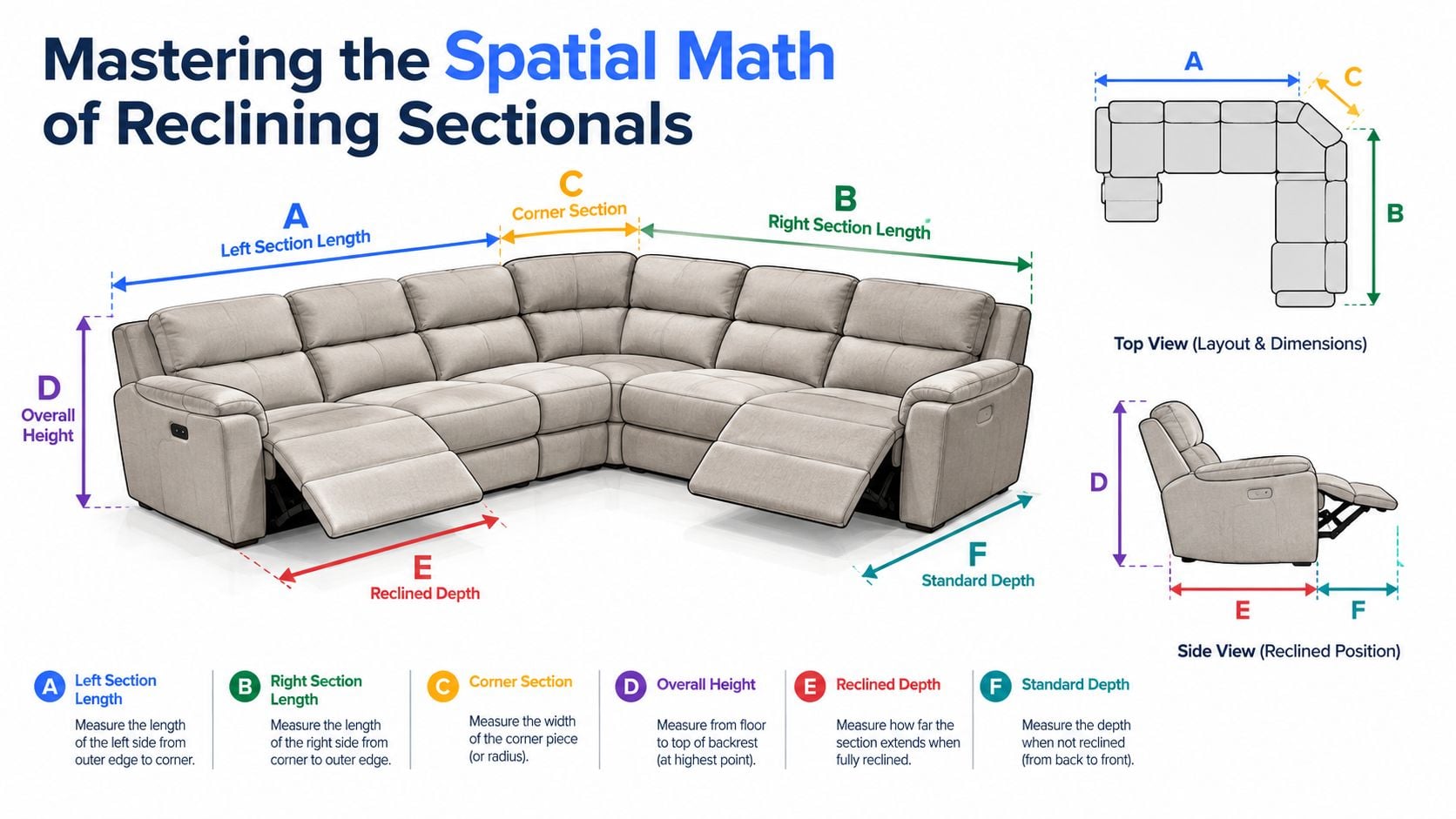
A reclining sectional has to fit in two positions: closed for circulation and fully extended for comfort. Measure only the wall length and you can end up with a frame that fits while its footrests block the walkway or crowd the coffee table. An in-stock model gives you a practical advantage because you can confirm its actual dimensions before purchase, while an online custom order may leave you waiting longer before discovering that the room cannot handle the operating space.
Measure the full operating envelope
Reclining sectionals occupy more usable space than stationary designs because their backrests and footrests extend beyond the frame. Standard mechanisms often need roughly 12 or more inches of rear wall clearance, while wall-hugger designs can reduce that requirement to about 3 to 6 inches. Leave about 20 to 30 inches of open space in front so the footrest can deploy fully, as explained in this reclining sectional space-planning guide.
Use this measurement sequence before choosing a configuration:
- Record the closed footprint. Measure the sectional's full width, depth, and height, including the arms and corner wedges.
- Mark the reclined depth. Use painter's tape to show the furthest position of every footrest and backrest.
- Protect the walkway. Keep a clear route between the sectional, doorway, coffee table, and other frequently used furniture.
- Check the wall relationship. Standard mechanisms need more room behind them. Wall-hugger designs move differently and suit tighter layouts.
- Measure the viewing position. Confirm that the television remains comfortable to watch from both upright and reclined positions.
Many models reach a fully reclined length of around 60 to 72 inches. Check that measurement against the room's usable depth with this furniture measurement guide from Stahl Home Center. The closed footprint is only the starting point.
Plan the delivery route before ordering
Room fit and delivery fit are separate tests. Doorways, hallway turns, stairwells, elevator openings, and low ceilings can stop a sectional before it reaches the living room. Use the TLC Moving & Storage doorway guide to identify tight turns and entry restrictions before delivery is scheduled.
Mark narrow passages, removable doors, fragile flooring, and the intended placement area in advance. That preparation helps the delivery team work efficiently and prevents rushed improvisation.
Practical rule: Choose the largest sectional that operates freely, preserves circulation, and reaches the room without improvised maneuvering.
Comparing Recliner Mechanisms and Configurations
Manual and power reclining mechanisms serve different households. Manual seating keeps operation simple and often suits buyers who want fewer components to maintain. Power seating provides controlled movement, which can be valuable for households that prioritize precise positioning, adjustable headrests, lumbar support, USB charging, or easier operation.
Market coverage identifies power motion as the dominant direction in higher-priced motion upholstery, while manual recliners remain important in the under-$500 segment, according to Living Spaces' coverage of recliner trends. The useful conclusion isn't that one mechanism wins for everyone. It's that the mechanism should match the household's room, budget, and daily habits.
Recliner mechanism comparison
| Mechanism Type | Wall Clearance Needed | Key Features | Best For |
|---|---|---|---|
| Manual recliner | Model-dependent, often more rear room than a wall-hugger | Pull tab or lever operation, straightforward design, no motor | Buyers who prefer simple operation and lower technical complexity |
| Power recliner | Model-dependent, with electrical components and controlled movement | Adjustable positions, power headrests, lumbar support, USB charging on selected models | Households seeking fine comfort adjustments and easy operation |
| Wall-hugger mechanism | About 3 to 6 inches on suitable designs | Reduced rear clearance, forward-operating motion | Smaller living rooms where wall space is limited |
| Reclining modular sectional | Depends on the selected modules and mechanism | Configurable seats, chaise options, wedge corners, multiple reclining positions | Families needing flexible seating for a particular room shape |
Manual seating is a strong choice when reliability, straightforward controls, and repair simplicity matter most. Power seating makes more sense when several people need different positions or when a household values gradual movement over a single pull-tab action. For an older adult or anyone dealing with mobility limitations, a recliner with standing assist can help frame the broader seating decision around getting up as well as sitting down.
Configuration determines how the room works
A chaise creates a dedicated lounging zone, but it also occupies more continuous floor space. A double-recliner sofa gives two people personal adjustment while preserving a more conventional outline. A modular arrangement with a wedge corner can use an L-shaped room efficiently, provided the footrests don't interrupt the main path through the space.
Power features deserve practical scrutiny. USB charging and power headrests are worthwhile when they will be used daily. Heating, massage, and extra controls may add appeal, but they also add components, so buyers should ask about warranty coverage, service access, and replacement parts before choosing the most feature-heavy model. How power recliners work provides useful background for shoppers comparing manual and powered seating.
Selecting Fabrics and Finishes for Real Life
The upholstery decision should begin with household behavior, not a color board. A quiet formal room can accommodate a delicate-feeling fabric that receives light use. A family room with pets, children, frequent snacks, or daily television viewing needs a surface selected for recovery, cleaning, and repeated contact.
Performance fabrics make sense for active homes because they are designed with everyday use in mind. They still require prompt spill treatment and routine care, but the right upholstery can make normal household messes less stressful. Mid-tone colors and textured weaves can also disguise minor marks better than very pale, smooth surfaces.
Match the finish to the room
- Busy family rooms: Performance fabric should be the first material considered, especially where food, pets, and frequent sitting are part of normal life.
- Design-led spaces: A fabric, leather, or distinctive weave can support a more intentional look when the sectional is a major visual feature.
- Multigenerational homes: Softer cushions, supportive seat heights, and easy-clean upholstery often matter more than a delicate finish.
- Rental or second-home settings: Durable, versatile materials reduce maintenance demands between occupants or visits.
A reclining sectional also needs upholstery that works around moving components. The fabric should remain comfortable at the seat, back, arms, and footrest while maintaining a clean appearance in both upright and extended positions. Texture, seam placement, and cushion shape affect how substantial or sleek the piece looks.
Design Your Way
Custom ordering is the right path when a room needs a specific scale, color, seat arrangement, or fabric performance. Stahl Home Center's Design Your Way service offers hundreds of fabrics and configurations for brands including La-Z-Boy and Rowe, allowing shoppers to create custom sofas and sectional layouts rather than accepting a standard showroom combination.
Custom design also creates a useful discipline. The household can decide whether the sectional needs a left-arm chaise, a right-arm chaise, separate reclining seats, a particular corner shape, or a more open arrangement. Sectional sofa fabric guidance can help shoppers compare upholstery characteristics before narrowing the final selection.
Custom ordering isn't the fastest route, and it shouldn't be presented as one. For an immediate move-in, an in-stock sectional provides comfort now. For a design-focused decorator with time to plan, hundreds of fabric and configuration choices make a custom order worthwhile.
The Undeniable Value of the In-Store Sit-Test
A sectional can look perfect on a screen and still feel wrong after ten minutes of sitting. Cushion firmness, seat pitch, arm height, lumbar support, and headrest position affect comfort in ways photographs can't communicate. The Sit-Test remains the most reliable way to decide whether living room sectionals with recliners suit the people who will use them.
Each household should test more than the first impression. A shopper can sit upright, recline fully, adjust the headrest, place both feet on the footrest, and remain in the position long enough to notice pressure at the lower back, knees, neck, or shoulders. The result should feel supported rather than merely soft.
What shoppers should test
- Seat depth: Feet should rest naturally without forcing the knees upward or leaving the lower back unsupported.
- Recline transition: The mechanism should move smoothly and stop where the user expects.
- Head and lumbar support: The backrest should support the body in both upright and reclined positions.
- Arm position: Arms should remain relaxed rather than lifted or compressed.
- Shared comfort: Each person should test the seat they would most often use, especially on a multi-seat sectional.
The physical visit also reveals the true color and texture of upholstery. Screen settings can distort shades, while showroom lighting lets shoppers compare fabrics, leathers, wood finishes, and neighboring pieces in person. That direct comparison reduces the risk of ordering a sectional that clashes with flooring, wall color, rugs, or existing furniture.
Local service has practical value
Stahl Home Center has been locally owned since 1967, providing a neighbor-to-neighbor shopping experience rather than forcing every buyer through an impersonal online process. The showroom visit gives households access to personal guidance without relying on pressure-driven decisions, and in-stock pieces can be selected for take-home convenience instead of waiting through an open-ended backorder.
The broader sectional market reflects the importance of the format. Sectional sofas held a 28.76% share of the sofa market in 2025, while recliner sofas were forecast to grow at a 6.11% CAGR through 2031, according to Global Growth Insights' recliner sofa market coverage. Those figures support a straightforward shopping recommendation: buyers should test both the sectional layout and the reclining function, because each affects how the living room will be used.
Delivery Logistics and Long-Term Maintenance
A successful purchase ends with more than a sales receipt. The sectional must reach the room safely, operate without obstruction, and receive enough care to protect its upholstery and moving parts. Good preparation makes scheduled professional delivery smoother and prevents avoidable damage to walls, floors, door frames, and the furniture itself.
Prepare the route
Before delivery, the household should remove small tables, lamps, rugs, toys, and decorative objects from the entry route. Measurements should include the front door opening, hallway width, interior doorways, ceiling height near turns, and the final placement area. Doors may need to open fully, and fragile wall décor should be removed before the delivery team arrives.
A delivery appointment is also the right time to confirm the final orientation. The household should know which side holds the chaise, where electrical outlets sit, and whether the power cord can reach without crossing a walkway. Stahl Home Center's furniture assembly and delivery service provides a useful point of reference for planning the move from showroom selection to room placement.
Keep the mechanism clear
Reclining furniture lasts longer when the operating area stays free of toys, pet items, blankets, and charging cables. Small objects can fall into moving gaps or interfere with the footrest. A narrow vacuum attachment can remove dust from accessible crevices, but household members should never reach into a mechanism while it operates.
For routine care:
- Follow the upholstery label: Use only the cleaning method recommended for the selected fabric or leather.
- Treat spills promptly: Blot rather than scrub, then use an approved cleaner when the care instructions allow it.
- Inspect power connections: Keep plugs and cords accessible, dry, and free from crushing beneath the frame.
- Listen for changes: New grinding, clicking, or uneven movement deserves service attention instead of repeated use.
- Avoid improvised lubricant: Moving parts should receive only manufacturer-approved maintenance, if any is required.
Manual mechanisms may appeal to buyers who want fewer electrical components. Power mechanisms offer more controlled adjustment but make warranty terms and service support especially important. The best long-term value comes from matching the mechanism to actual use, maintaining it consistently, and selecting construction that suits the household rather than paying for features that will rarely be used.
Answers to Common Sectional Shopping Questions
Can an in-stock sectional be taken home today?
Yes, thousands of items are in stock and ready for customer pickup today. That includes living room furniture, recliners in stock, bedroom sets, mattresses, and other furnishings selected for immediate availability. Scheduled professional delivery is another option for households that want trained help bringing the sectional into the home.
Is custom ordering better than buying from the floor?
Neither path is automatically better. An in-stock sectional makes sense for a move, a replacement need, or a household that wants immediate comfort. Design Your Way suits a shopper who needs a specific fabric, configuration, scale, or finish and can allow time for a custom order.
Should buyers choose manual or power reclining?
Manual mechanisms suit buyers who value simplicity and straightforward operation. Power recliners make sense when precise positioning, power headrests, lumbar support, or easier adjustments matter to the household. Warranty coverage can differ by frame, upholstery, mechanism, and motor, so shoppers should review the specific model's terms rather than assume every recliner receives identical coverage.
How can shoppers navigate such a large showroom?
An 88,000+ square foot showroom can feel overwhelming without a plan. Households should bring room measurements, doorway details, preferred seating positions, fabric preferences, and a realistic budget. Starting with the room's operating envelope narrows the search quickly, then the Sit-Test can eliminate models that fail on comfort or function.
What brands and furniture options are available?
The showroom includes La-Z-Boy motion seating and Rowe Furniture for custom style and performance, along with options across the Good-Better-Best range. Shoppers can also evaluate custom sofas, power recliners, lift chairs, bedroom sets, mattresses, and immediate delivery furniture during the same visit.
For Bloomington homeowners, relocators, right-sizers, and multigenerational households, the sensible approach is clear. Measure the room in both upright and reclined positions, test the actual seating, choose upholstery for real household use, and decide whether immediate pickup or custom ordering better fits the timeline.
Stahl Home Center offers an 88,000+ square foot showroom, thousands of in-stock pieces ready to take home today, Indiana's largest La-Z-Boy selection, and Rowe custom options for living room sectionals with recliners. Readers can visit Stahl Home Center at the Westside Bloomington showroom today to see the massive selection in person and find seating that fits the room, the household, and the schedule.