Soften Your Space: Sofas and Sectionals Reviews Guide


Shopping for a sofa or sectional often starts the same way. A shopper opens a dozen tabs, compares photos that all look polished, reads glowing praise beside angry complaints, and ends up less certain than when the search began.
That confusion makes sense. Most online feedback tells only part of the story. One review talks about color. Another focuses on delivery. A third says the seat felt too firm, without saying whether that firmness improved support or felt stiff. For a purchase this important, star ratings alone don't give enough information.
The smarter approach is to read sofas and sectionals reviews like a furniture buyer would. That means looking past surface impressions and focusing on construction, comfort over time, room fit, and the practical details that affect daily use. The strongest reviews don't stop at first impressions. They pay attention to what happens after repeated sitting, lounging, and family traffic.
A useful benchmark comes from review methods that moved beyond opinion and into multi-week observation. In one example, reviewers tested sofas in a real living-room setting and tracked details such as seat depth, seat height, cushion response, frame stability, leg wobble, off-gassing, cushion sag in high-use spots, new creaks, and looseness in hardware over time, while also checking visible construction details like staples, seams, zippers, and corner blocks in their multi-week sofa testing process. That kind of review is much closer to how furniture performs in an actual home.
Table of Contents
- Beyond the Star Rating an Introduction
- The Anatomy of a Great Sofa or Sectional
- How to Spot Helpful Reviews and Avoid Red Flags
- Your In-Store Sofa and Sectional Sit-Test Checklist
- Putting Your Knowledge to the Test at Stahl Home Center
- From Shopper to Confident Owner This Weekend
Beyond the Star Rating an Introduction
Most sofa disappointment starts before the order is placed. A shopper sees a beautiful photo, skims the top reviews, guesses at comfort from a screen, and hopes the piece will feel right once it arrives. Sometimes it works. Often it doesn't.
The problem isn't that reviews are useless. The problem is that many shoppers read them as verdicts instead of clues. A review that says "comfortable" doesn't help much unless it explains who found it comfortable, how the seat supports the body, and whether that feel held up after regular use. A review that says "poor quality" may describe a real issue, or it may reflect a delivery problem, assembly mistake, or mismatch between the buyer's expectations and the sofa's design.
Helpful sofas and sectionals reviews answer practical questions. Does the frame stay rigid when people shift their weight? Do the cushions keep their shape in favorite seats? Do the sections stay connected? Does the piece fit the room without blocking traffic flow?
Practical rule: A review becomes useful when it describes what the furniture did, not just how the buyer felt about it.
That shift in thinking changes the whole shopping process. Instead of hunting for a perfect average rating, shoppers can look for repeat patterns tied to real performance. If several reviewers mention strong support, stable seating, and well-finished seams, that's valuable. If comments repeatedly mention shifting sections, uneven cushions, or awkward room fit, that's valuable too.
This also explains why in-person testing still matters so much. A sofa isn't only a visual purchase. It's a posture purchase, a comfort purchase, and a use-every-day purchase. The body notices things a product page can't communicate, including seat height, back angle, arm position, and cushion pushback.
For shoppers who want a stronger buying framework, it helps to start with the construction basics. Once those are understood, reviews become much easier to interpret and much harder to be misled by.
The Anatomy of a Great Sofa or Sectional
A shopper reads glowing reviews online, then sits on the sofa in person and feels the front rail through the cushion in ten seconds. That disconnect happens all the time. Reviews can point you in the right direction, but construction tells you whether the comfort will still be there after a year of real use.
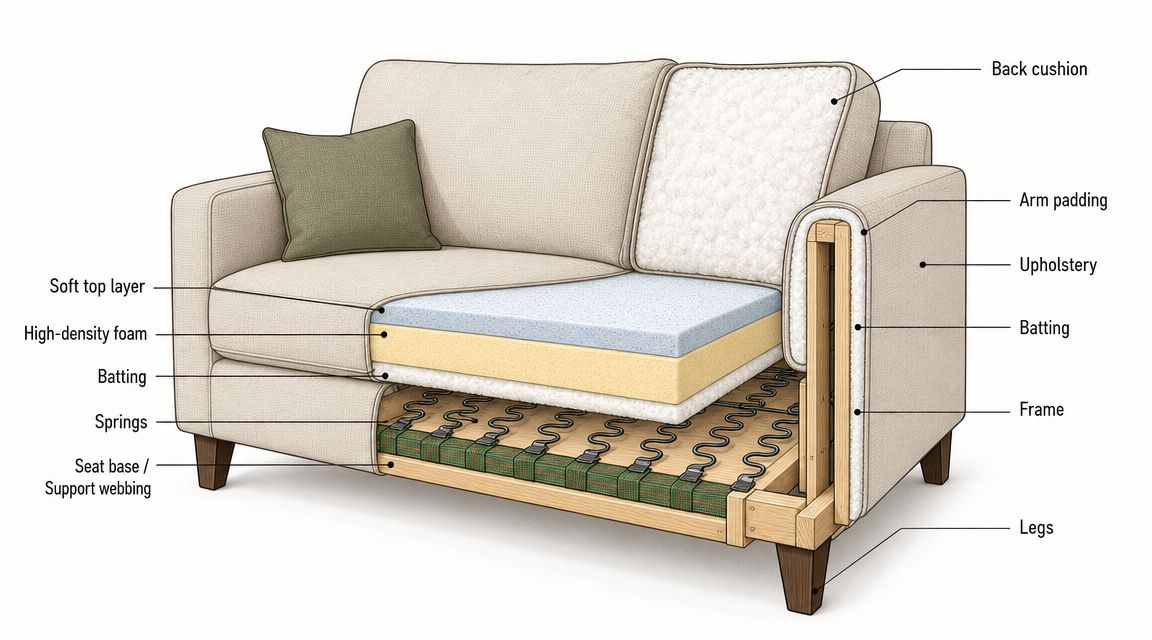
The best way to judge a sofa or sectional is to connect what you read online with what you can feel in the showroom. Marketing terms such as "deep seat," "performance fabric," and "plush comfort" only become useful once you know what sits underneath them. For a practical starting point, this guide to sofa and sectional features worth checking helps put those labels into plain English.
Start with the frame
The frame carries everything. If it flexes, twists, or loosens over time, the rest of the piece usually follows.
Kiln-dried solid hardwood remains a strong sign of better construction because reducing moisture helps limit warping and joint movement. In sectionals, frame quality matters even more because longer spans, corner pieces, and connecting brackets create extra stress points. A weak frame may look fine on day one and still develop movement, noise, or misalignment once the piece gets regular use.
This is one place where in-store testing reveals a lot. Sit in one seat, then shift your weight hard to one side. On a well-built sectional, the frame should stay composed. You should not feel the whole unit rack, wobble, or send movement across every seat.
Support lives underneath the cushions
Suspension decides whether a sofa feels supportive or tired after a short sit. Shoppers often focus on fabric and color first, but support is what your body notices after movie night, Sunday naps, and ordinary weekday use.
Better-built sofas often use stronger suspension systems and reinforced joinery to spread weight evenly and keep the seat consistent over time. The exact method matters less than the result. The seat should hold you up without feeling stiff, and it should recover without sagging into a hammock shape.
Different rooms call for different support.
- For daily family use: Look for steady support that feels controlled in every seat.
- For a formal sitting room: A slightly more upright sit usually keeps the piece looking neater and feeling easier to get out of.
- For lounging or TV rooms: A deeper seat can work well, but it still needs enough pushback to support your lower back and thighs.
A beautiful silhouette can hide weak suspension for a while. Repeated use exposes it.
Cushions decide whether comfort lasts
Many online reviews say a sofa is soft, firm, or comfy. Those words are a starting point, not a conclusion. The better question is how the cushion behaves after pressure.
Good cushions compress in a controlled way and recover well when you stand up. Lower-grade cushions often feel plush on first sit, then lose shape in the favorite spot. In the showroom, I tell shoppers to sit in the same seat for a few minutes, stand up, and look back. If the cushion stays collapsed or looks uneven right away, that tells you something useful.
Seat depth matters too. A tall shopper may love a deep, low sectional that lets them stretch out. A shorter shopper may feel forced to perch forward unless there are supportive back cushions or a shallower configuration. This is why a five-star review from another buyer should never replace your own sit-test.
Fabric shapes day-to-day ownership
Fabric is where style meets maintenance. A sofa can be built well and still become frustrating if the upholstery does not fit the household.
Homes with kids, pets, frequent guests, or heavy daily use usually do better with fabrics designed for easier cleaning and stronger wear resistance. Texture also matters. Some woven fabrics hide use well. Some smooth fabrics show every wrinkle, paw mark, or seat impression. Leather brings its own trade-offs too. It can age beautifully, but the feel, temperature, and scratch visibility are very different from fabric upholstery.
Ask practical questions while you shop. Does the material feel comfortable against bare skin? Will it catch pet hair? Does the color help hide daily life or highlight every mark? Those are ownership questions, not decorating questions.
The best pieces balance all four layers
A great sofa does not rely on one selling point. It combines a stable frame, supportive suspension, resilient cushions, and upholstery that fits the way the room will be used.
That is also why strong review language becomes easier to interpret once you know what to check in person. If reviewers praise support, shape retention, and durability, you can walk into a showroom, test those claims yourself, and decide whether the piece earns its price. At Stahl, that usually means comparing how different builds feel side by side, including brands such as La-Z-Boy and Rowe, until the difference stops being theoretical and becomes obvious the moment you sit down.
How to Spot Helpful Reviews and Avoid Red Flags
A shopper reads fifty glowing reviews, orders the sectional, and then realizes the seat feels too deep after twenty minutes and the corner piece eats up more walking space than expected. That usually happens because the reviews sounded positive but did not answer the right questions.

Good review reading starts with one simple rule. Look for evidence, not emotion.
A practical next step is learning how product copy and buyer feedback work together. This guide on reading furniture product descriptions with confidence helps shoppers connect those dots before they ever set foot on the sales floor.
What useful reviews usually include
Helpful reviews describe ownership after the delivery crew leaves. They explain how the sofa feels during a movie, whether the back cushions stay in place, how the fabric looks after repeated use, and whether the seat still feels supportive after a few weeks. Those details matter because many pieces make a strong first impression and then lose comfort fast.
The strongest reviews usually include a few specific things:
- How the piece is used: Daily family seating, occasional formal-room use, naps, guests, or work-from-home lounging.
- What changed over time: Cushion flattening, fabric pilling, frame noise, shifting modules, or loose legs.
- Who is sitting on it: Taller adults, shorter adults, kids, pet owners, or a mixed household with different comfort preferences.
- How the size worked in real life: Whether the seat depth felt relaxing or awkward, whether the arm height supported the body well, and whether the sectional fit the room the way the buyer expected.
- Trade-offs: A reviewer who says, "beautiful fabric, firmer than I expected," is usually more useful than someone who calls the piece perfect.
That kind of review gives a shopper something to verify in person. If several owners mention firm seats that hold their shape well, test for that. If multiple reviewers mention deep seats that shorter people may not love, sit all the way back and see what your legs and lower back tell you.
What should make a shopper pause
Some reviews create heat without shedding much light. Five stars for color alone does not say much about support. One star because the sofa felt "hard" on day one also needs context, since some cushions are designed to break in and some buyers prefer a softer sit.
Use caution when reviews have these patterns:
- No ownership timeline: The reviewer posted immediately after delivery and says nothing about wear.
- No body or room context: Comfort is personal. A deep, low sectional can feel excellent to one household and tiring to another.
- Vague complaints: "Uncomfortable" is too broad to trust. Seat height, back angle, arm position, and cushion firmness all affect comfort differently.
- All praise, no detail: Real owners usually mention at least one compromise.
- A problem with no location attached: If a review says cushions sag, squeak, or slide, it should say where.
I tell shoppers to read reviews like service notes. Specific ones carry weight. General ones mostly reflect mood.
One more green flag gets overlooked. Reviews that mention cleaning, rearranging, removable covers, sleeper use, or modular reconfiguration often tell you more about long-term satisfaction than reviews focused only on first impressions. Those are the comments that connect online research to the showroom visit.
That is where the process becomes practical at Stahl. A review might say a Rowe sectional has a relaxed, sink-in feel, or that a La-Z-Boy sofa offers more upright support. Useful shoppers do not stop at reading that claim. They walk in, sit in both, stay there for a few minutes, and find out which one fits their body, room, and routine.
The goal is not to find the most positive review. The goal is to find the reviews that give you clear claims you can test for yourself.
Your In-Store Sofa and Sectional Sit-Test Checklist
A shopper reads glowing reviews, picks a sectional that looks perfect online, and then sits on it in person for the first time. The seat feels lower than expected. The back lands at the wrong angle. Getting out of the corner takes effort. That is why the showroom visit matters. It turns review claims into something you can verify with your own body, in your own sitting positions, before you commit.
Come in with a short plan. Bring room measurements, delivery-path dimensions, and a list of the comfort points you want to confirm. If you want a quick primer before you shop, this guide on what to look for in a new sofa or chair gives a solid starting point.
Measure before the shopping trip
A sectional can fit your room on paper and still create problems at home. I have seen shoppers fall in love with the right style in the wrong scale. The piece may crowd a walkway, block a swing door, or make the room feel tight once a coffee table and side tables are back in place.
Check three things before you leave home:
- Delivery path: Measure entry doors, stair turns, hallway pinch points, and elevator clearance if needed.
- Room footprint: Mark the size on the floor with tape so you can judge traffic flow, not just wall-to-wall fit.
- Daily use: Decide how the room will function. Upright conversation seating feels different from movie-night lounging or afternoon napping.
A sectional has to fit twice. It has to fit the room, and it has to fit the route into the home.
The Ultimate Sit-Test Checklist
| Component | What to Check | Why It Matters |
|---|---|---|
| Frame | Lift one front corner slightly and notice whether the piece stays square or twists | Twisting can point to weaker construction |
| Seat support | Sit normally, then shift weight side to side and toward the edge | Good support should feel steady across the seat, not uneven |
| Cushions | Stand up after a few minutes and watch how the seat recovers | Recovery gives a useful clue about resilience and day-to-day appearance |
| Seat depth | Sit all the way back with your feet on the floor if possible | Depth affects posture, leg support, and who will find it comfortable |
| Seat height | Sit down and stand up several times | Low seats can feel relaxed but harder to live with every day |
| Arms and back | Rest an elbow, lean back fully, and try your normal lounging position | Arm height and back angle shape comfort more than photos suggest |
| Fabric | Touch it with dry hands and slide your hand across the surface | Texture, heat, and drag change how the piece feels in daily use |
| Section connections | On modular pieces, ask how the sections attach and then sit near the seam | Connector quality affects alignment and whether pieces drift apart |
| Seams and finishing | Check stitching, welting, zippers, corners, and pattern matching | Clean tailoring usually reflects better attention to detail |
| Room fit | Compare the dimensions to the open space you need around it | A comfortable sofa can still overwhelm the room |
Take your time with the sit-test. Sit upright if that is how you read or talk with guests. Lean sideways if that is how you watch a game. Tuck your feet up if that is your evening habit. If two people will use it every night, test it with two people. A five-minute sit tells you more than a quick bounce on the edge.
This is also the moment to test the claims you found in reviews. If a review says one model has a deeper, sink-in seat and another offers more upright support, go confirm that difference yourself. Sit in both. Stay there long enough to notice where your lower back lands, whether your feet plant comfortably, and how the cushion pushes back. That is how online research becomes a smart in-store decision.
Putting Your Knowledge to the Test at Stahl Home Center
You can do all the right research at home, narrow the field to two or three promising sectionals, and still end up unsure once you are ready to buy. That last bit of uncertainty usually comes from the gap between what reviews say and what your body feels in the seat. A showroom closes that gap fast.
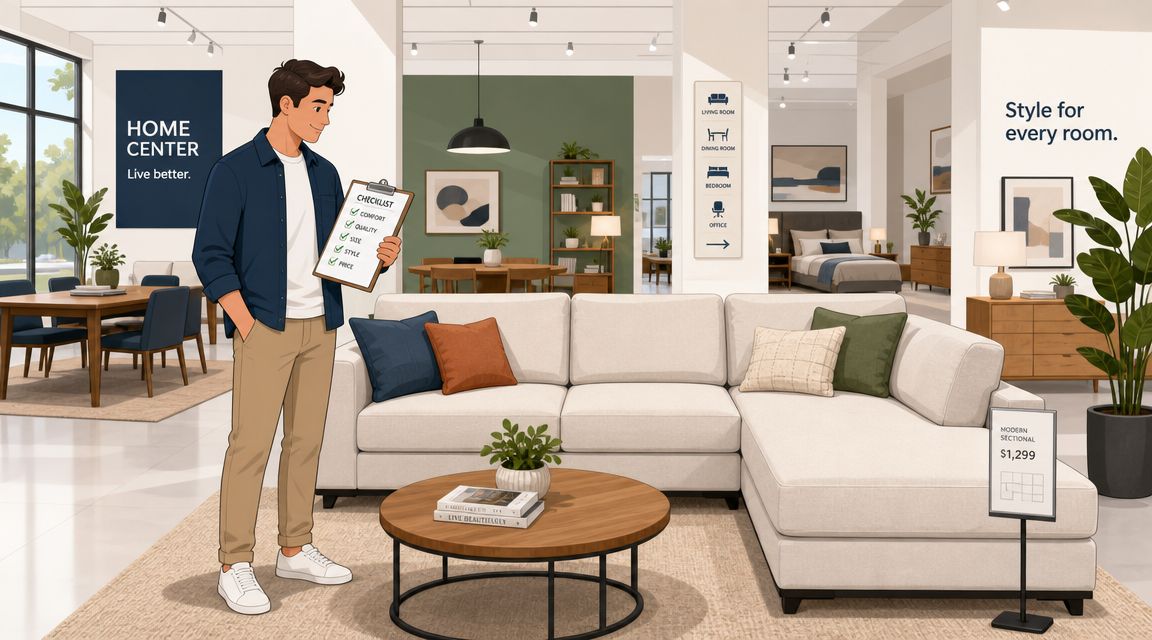
Why in-person testing still matters
Online reviews are useful for spotting patterns. The showroom is where you confirm whether those patterns matter for your home. A review might praise a sectional for deep, loungey comfort, but that same depth can frustrate someone who prefers upright support or wants feet flat on the floor.
Modular sectionals are a good example. Shoppers often focus on size and layout first, then overlook how the individual pieces connect. In the store, ask how the sections attach, sit near the seam, shift your weight, and stand up from the corner. If the connection feels loose or the alignment changes easily, that tells you more than polished product copy ever will.
Fabric needs the same kind of reality check. A screen can suggest color. It cannot tell you how warm the fabric feels, whether it has drag when you slide across it, or how much texture you will notice every day. Shoppers comparing family-friendly upholstery usually get better clarity after spending a few minutes with a performance fabric sectional instead of relying on a close-up photo.
Where selection changes the experience
At Stahl Home Center, a key advantage is comparison. Shoppers can move from one comfort profile to another, test different scales side by side, and notice the trade-offs that reviews only hint at, all inside an 88,000+ sq. ft. showroom.
That helps different buyers in different ways:
- New homeowners and relocators: They can compare enough options in one trip to make coordinated decisions for the main living spaces.
- Quality-focused shoppers: They can feel the difference between entry-level seating, stronger support, and more refined tailoring without guessing from product photos.
- Style-conscious buyers: They can view upholstery colors in person and sort through custom possibilities with much more confidence than a digital swatch allows.
Brand comparison also becomes more useful in person. As Indiana's Largest La-Z-Boy Dealer, Stahl Home Center gives shoppers a broad look at reclining comfort, supportive seating, and sectional layouts from a brand known for dependable everyday use. Rowe Furniture gives shoppers a different path, with more design flexibility, custom order options, and fabric choices that suit homes where style matters as much as durability.
Speed matters too. Thousands of items are In-Stock Today, ready for customer pickup or scheduled professional delivery. For living room furniture Bloomington shoppers, that means the piece you test and approve does not have to stay theoretical for long. If timing is less urgent, the Design Your Way approach opens up hundreds of fabric and configuration choices without giving up the benefit of an in-person trial.
The best showroom helps shoppers test comfort, inspect construction, and judge timing in the same visit. That makes the final decision clearer, because the review research has already done its job.
From Shopper to Confident Owner This Weekend
A good furniture decision doesn't come from guessing which star rating is most honest. It comes from knowing what to inspect, what to ask, and how to test a sofa or sectional in a way that reflects real life.
A shopper who understands sofas and sectionals reviews differently starts noticing stronger signals. Frame quality matters more than flashy wording. Support matters more than staged photography. Connector strength, cushion recovery, room fit, and fabric practicality all deserve a place in the decision.
That knowledge makes the shopping process faster, not harder. Weak options can be ruled out quickly. Strong options stand out sooner. The final choice feels less like a gamble and more like a decision backed by evidence.
That matters for every type of household. A new homeowner may need to furnish several rooms without waiting through long lead times. A family may want a sectional that can handle everyday traffic and still look sharp. A style-conscious shopper may want custom sofas with performance fabric and a very specific silhouette. A right-sizing household may care most about seat height, support, and easy maintenance. Different goals, same framework.
For shoppers in Bloomington, the practical advantage is being able to move from research to reality in one stop. Stahl Home Center offers an 88,000+ sq. ft. showroom, thousands of pieces In-Stock Today, and the chance to compare major comfort and style categories in person. That includes La-Z-Boy Indiana favorites, Rowe Furniture, recliners in stock, power recliners, lift chairs, bedroom sets, mattresses, and more.
If the right piece is on the floor, it can often go home the same day by customer pickup. If scheduled help is preferred, shoppers can review available support for furniture assembly and delivery. If the goal is a custom look instead of immediate availability, the showroom team can help build it through fabric and configuration options.
The strongest furniture purchase is the one a shopper has tested, measured, and understood before committing. That's how a browser becomes an owner who feels good about the choice long after delivery day.
Visit Stahl Home Center on Bloomington's west side to shop the massive 88,000+ sq. ft. showroom, compare comfort in person, and explore thousands of pieces In-Stock Today. Whether the goal is to furnish a whole home this weekend, find living room furniture Bloomington families will use every day, or design a custom piece through La-Z-Boy or Rowe Furniture, the team is ready to help with friendly, local service and scheduled professional delivery options.