

Ergonomic Furniture Design: A Buyer’s Comfort Guide


You notice bad furniture slowly.
It starts with the dining chair you've been using as a work chair for “just a few weeks.” Then the sofa that looks great in the room but leaves you shifting around halfway through a movie. Then the recliner that feels soft for five minutes and unsupportive for the next hour. None of it seems like a big problem until your neck is tight, your lower back is cranky, and sitting down no longer feels like rest.
That's why ergonomic furniture design matters in real life. It isn't a clinical buzzword, and it isn't only for corporate offices. It's furniture designed around the human body, how we move, and how long we use a piece. Good ergonomic design supports you where you need it, lets you change position, and fits your proportions instead of forcing you to fit the furniture.
As someone who's spent years helping people try seating in person, I can tell you this. Most comfort problems don't come from buying the “wrong style.” They come from buying furniture that looks right but doesn't fit the body using it every day. The fix is usually more practical than people expect. Better seat depth. Better recline. Better arm position. Better support through the lower back and thighs.
The good news is that you don't need a design degree to shop smarter. You just need to know what to look for, what trade-offs matter, and how to test a piece before you bring it home.
Table of Contents
- Your Guide to Lasting Comfort and Style
- The Core Principles of Ergonomic Furniture Design
- The Real-World Benefits of Investing in Your Comfort
- An Ergonomic Makeover for Every Room in Your Home
- How to Find Your Perfect Fit with the In-Person Sit-Test
- Finding Your Solution at Indiana's Largest Showroom
- Your Journey to a More Comfortable Home Starts Today
Your Guide to Lasting Comfort and Style
The furniture that gives people trouble is rarely the piece they expected to regret. It's often the handsome sofa with extra-deep seats that forces shorter sitters to perch forward. Or the office chair with plenty of padding but no meaningful adjustment. Or the recliner that feels plush in the footrest position but leaves the shoulders reaching for the armrests.
A well-designed piece feels different in a quiet way. Your feet land naturally. Your shoulders drop instead of hunching. Your back stays in contact with the chair instead of searching for support. You don't spend the evening correcting your posture because the furniture is already doing part of the work for you.
That's the heart of ergonomic furniture design. It's not about making every room look medical or overly technical. It's about choosing furniture that supports daily living, whether that means working from home, reading in the den, watching a ballgame, recovering after a long day, or getting in and out of a chair without effort.
Good furniture should disappear beneath you. If you're constantly fidgeting, bracing, or scooting, the piece isn't doing its job.
The practical side matters just as much as the science. A supportive chair that doesn't suit your room or your habits won't get used the way it should. A beautiful sectional with the wrong seat depth won't become more comfortable because the fabric is gorgeous. Lasting comfort comes from matching the right construction to the right body and the right home.
That's why trying furniture in person still matters. You can learn the principles online, and you should. But the final decision comes down to fit, and fit is something your body notices faster than any product description ever will.
The Core Principles of Ergonomic Furniture Design
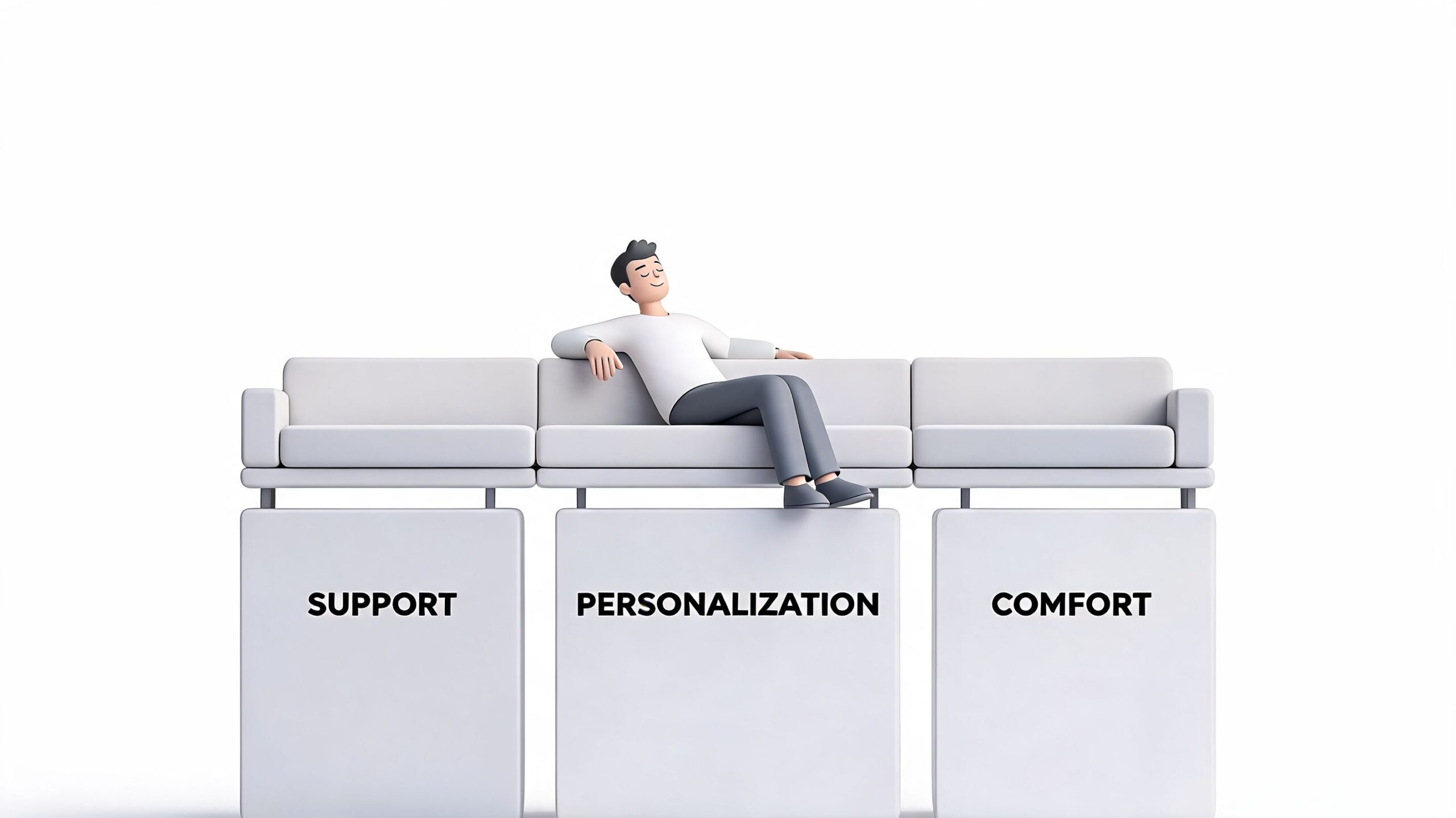
Most people hear “ergonomic” and think of one thing. Lumbar support. That's part of it, but it's not the whole story. Strong ergonomic furniture design usually comes down to three working principles: support, adjustability, and dimensions that fit real bodies.
Support comes first
Support means the furniture helps carry your body in a stable, natural way. In a chair, that includes the lower back, the pelvis, and the thighs. In a sofa or recliner, it also means the cushioning and suspension are doing enough work that you aren't collapsing into the frame or rolling into awkward positions.
Cheaper construction often shows itself in the seat cushion. A chair can feel soft at first touch and still fail as support. If the foam gives way too quickly, your hips drop, your spine rounds, and the chair stops helping.
Adjustability beats the average user myth
A technically sound ergonomic chair is designed around human anthropometry, not a single “average” person. Guidance summarized in this ergonomic chair specification overview highlights adjustable seat height so feet stay flat and knees remain near a right angle, adjustable seat depth to preserve clearance behind the knees, and adjustable armrests so the shoulders can stay relaxed.
That matters because no two people use the same chair the same way. One person needs more seat depth. Another needs less. One needs arm support higher and closer in. Another needs a freer shoulder position.
A quick checklist helps:
- Seat height: Your feet should rest flat without pressure building under the thighs.
- Seat depth: You should feel thigh support without the front edge pushing into the backs of the knees.
- Arm position: Armrests should support the forearms without lifting the shoulders.
- Back movement: Recline and tilt should let you change posture during the day.
For upholstered pieces, material choice matters too. If you're comparing coverings, this guide to upholstery materials and how they perform is worth reviewing because the right fabric affects heat, grip, cleanup, and long-term feel.
Dimensions matter more than people think
Ergonomic furniture design is really about proportion. A chair can be beautifully made and still be wrong for you if the seat is too long, the arms are too high, or the back shape hits in the wrong place.
The simplest way to view the situation is:
| Furniture element | What good fit feels like | What poor fit feels like |
|---|---|---|
| Seat height | Feet planted, thighs supported | Feet dangling or knees pushed too high |
| Seat depth | Full support without knee-edge pressure | Perching forward or pressure behind knees |
| Armrests | Shoulders relaxed | Shoulders lifted or arms unsupported |
| Backrest | Contact through the back, especially lower back | Gap at the back or pressure in one spot |
When those basics are right, comfort lasts longer. When they're wrong, even a stylish piece becomes work.
The Real-World Benefits of Investing in Your Comfort
People often treat comfort as a bonus feature. In practice, it shapes how well a room works every day. If a chair supports you properly, you stay put longer, shift less, and finish the task or enjoy the downtime you sat down for in the first place.
Comfort changes how you use your home
A supportive desk chair helps you stop borrowing the dining chair for work. A well-fitted recliner can make evening relaxation feel restorative instead of restless. A mattress and adjustable base setup can turn bedtime from “good enough” into genuine recovery, especially if you're someone who reads, watches TV, or needs flexible support positions. If that's relevant in your bedroom, it's worth looking at how an adjustable base can enhance comfort and daily use.
Different households notice different wins:
- New homeowners: Better foundational pieces mean you don't have to replace a rushed purchase a year later.
- Remote workers: Supportive seating helps the home office feel like a workspace instead of a temporary setup.
- Empty nesters and right-sizers: Ease of sitting, reclining, and standing up becomes more important than trend-driven styling alone.
- Busy families: Furniture that supports posture and stands up to daily use earns its place fast.
Practical rule: Buy for the position you use most, not the pose that looks best in the showroom.
Why the market has shifted this direction
This isn't a niche trend. The global ergonomic furniture market grew from USD 16.3191 billion in 2019 to USD 20.8366 billion in 2023, according to Future Market Insights on the ergonomic furniture market. That same report says the category is projected to keep expanding, with smart ergonomic furniture accounting for 15% of total sales in 2023 and expected to grow faster as connected features become more common.
The deeper point isn't just market size. It's what the growth represents. Manufacturers are designing more furniture around long-duration use, posture support, and real body movement instead of treating comfort as an afterthought. That's why you now see more memory settings in desks, more adaptive seating concepts, and more attention paid to how people sit in offices and hybrid homes.
The return on that investment is practical. You feel better when your work is finished. Your furniture stays useful longer because it suits your routine. And your home becomes easier to live in, not just nicer to photograph.
An Ergonomic Makeover for Every Room in Your Home
Ergonomic furniture design isn't limited to one office chair in one corner. It affects the rooms where you spend the most time. If you apply the same fit-first thinking throughout the house, the whole place works better.
Living room seating that actually supports you
Start with the sofa, sectional, or recliner because that's where comfort problems often hide. Seat depth matters more than shoppers expect. Guidance from this ergonomic furniture design reference notes a commonly used target of about a 2 to 4 inch gap between the seat edge and the back of the knee. That gap helps support the thighs without pressing into the knees.
That same guidance points out another useful trade-off. Firm, high-density foam tends to work better where posture retention and durability matter. Softer, layered cushioning is often better for lounge use where pressure distribution and sink-in comfort are the goal. Neither is universally better. The better choice depends on how you'll use the piece.
If you're shopping living room furniture in Bloomington, keep this in mind:
- For TV rooms: A power recliner or reclining sofa often gives better leg support and easier position changes than a fixed sofa.
- For conversation rooms: A sofa with a slightly more upright sit usually works better than a deep, slouchy profile.
- For multi-user households: Adjustable headrests, chaise options, and different seat widths can solve a lot of fit issues.
- For quality seekers: La-Z-Boy Indiana shoppers often gravitate toward recliners because the category is built around seated comfort, not just silhouette.
If room flow is part of the challenge, this guide on living room furniture layout can help you think through placement as well as comfort.
Home office pieces that earn their keep
The office is where small fit errors become big irritation. A task chair should let you plant your feet, support your forearms, and keep your back in contact with the chair as you work. If the seat is too deep, you'll slide forward. If the arms are too high, your neck and shoulders will tell you.
A desk setup also needs enough flexibility that the chair can work with it. Good ergonomic design isn't only about one product. It's about the relationship between chair height, desk height, and how you reach your tools.
Bedroom comfort is part of the same equation
People don't always think of the bedroom as an ergonomic space, but it is. Mattresses, supportive bed frames, and adjustable bases all influence how well your body rests. If getting in and out of bed is difficult, or if you spend time sitting up to read or watch television, support angles matter.
The same applies to secondary bedroom pieces. A bedroom bench that's too low or too deep may look handsome but be awkward to use. A reading chair in the corner should support you for more than ten minutes.
Soft isn't the same as supportive. The best piece is the one that matches the job you need it to do.
Across the house, the shopping question stays the same. Where does your body need support, and for how long?
How to Find Your Perfect Fit with the In-Person Sit-Test
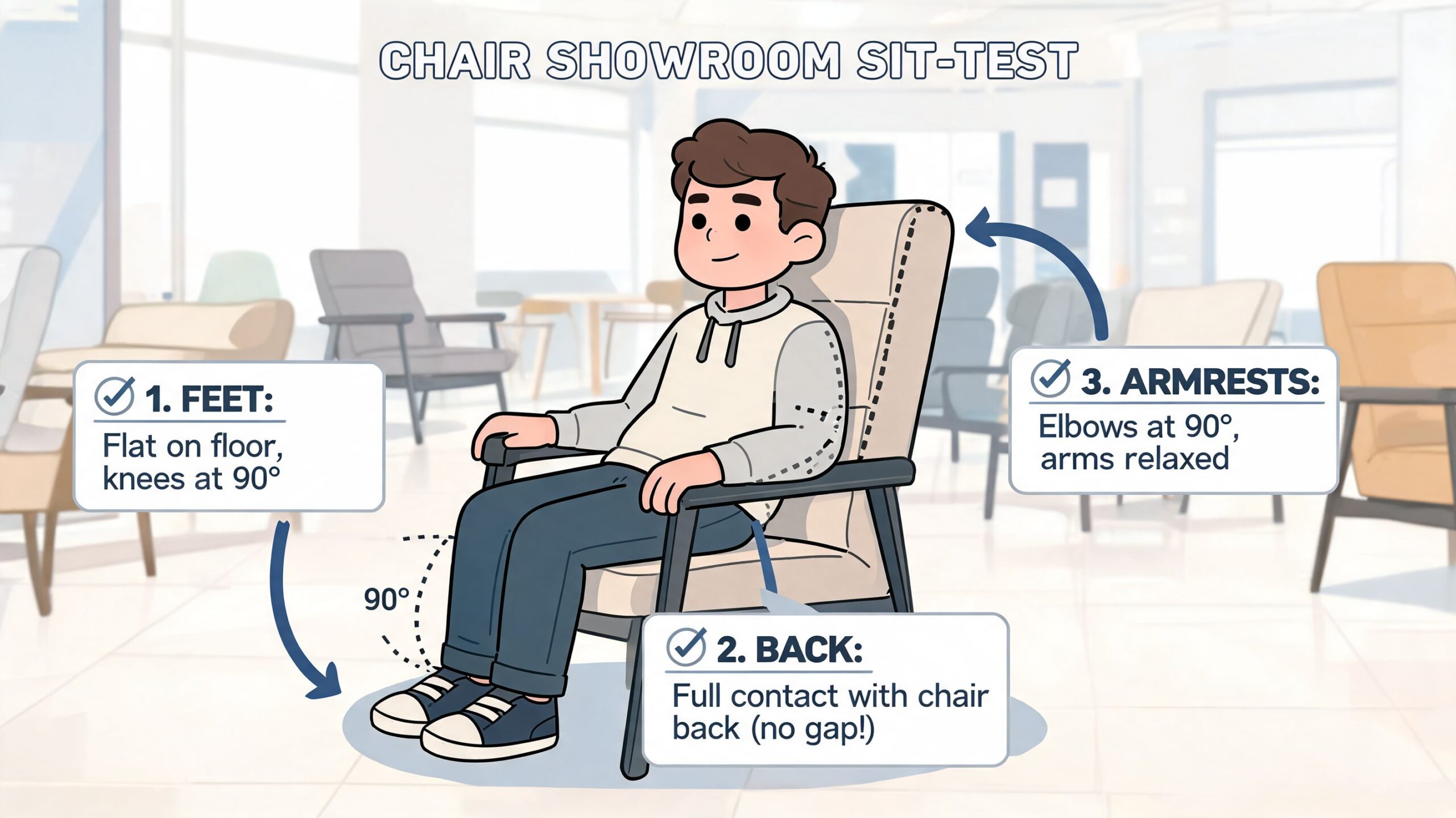
This is the part online shopping can't do for you. Product photos can show shape. Descriptions can list features. Reviews can tell you whether someone liked a piece. None of that tells you whether the chair fits your hips, whether the arm height suits your shoulders, or whether the recline lands where your body relaxes.
What to check in the first two minutes
When you sit down, don't judge the chair in the first three seconds. Give it a minute. Then check the basics.
Feet and legs
Your feet should touch comfortably. Your thighs should feel supported, not pinched.Seat depth
You shouldn't be forced to perch forward, and the front edge shouldn't crowd the back of your knees.Back contact
Notice whether your lower back meets the chair naturally or whether there's a hollow gap.Armrest position
Let your shoulders soften. If they rise to meet the arms, the fit is off.Ease of entry and exit
Stand up without using momentum. A good chair shouldn't trap you in it.
A useful comparison table makes this easier in the showroom:
| Sit-Test check | Good sign | Warning sign |
|---|---|---|
| First contact | You settle in quickly | You start adjusting right away |
| After one minute | Pressure feels distributed | One area starts to ache or pinch |
| Arm position | Elbows rest naturally | Shoulders creep upward |
| Standing up | Smooth and controlled | You push hard or lean awkwardly |
Test the chair in motion, not just at rest
A chair isn't static in real life, so don't test it statically. Lean back. Scoot slightly. Reach to the side. If it reclines, use the recline. If it's a power unit, run through the positions. Good support should still feel good when you change posture.
This matters even more for recliners, lift chairs, and motion seating. The best recliners in stock are usually the ones that support you in transition as well as in the fully reclined position.
Sit how you actually live. If you read with one elbow up, watch TV reclined, or work with a laptop on occasion, test those positions.
If you're shopping sleep-related comfort, even a simple product page like this full-size 8-inch mattress option can remind you that dimensions and support level have to match the person using the bed, not just the room size.
A better approach for asymmetric bodies and one-sided pain
Generic advice often falls short for individuals with unique postural needs. People with scoliosis, pelvic tilt, leg-length differences, or one-sided pain often find that standard lumbar support doesn't feel supportive at all. In some cases, it creates a pressure point instead of relief.
Cornell ergonomics guidance notes that a torso-to-thigh angle of about 95 to 135 degrees can reduce spinal disc pressure, as described in Cornell's sitting and posture notes. For shoppers with asymmetry, that means recline range and tunable support matter more than a fixed “ergonomic” label.
Try this approach instead:
- Start with neutrality: Sit squarely first and note where pressure builds.
- Adjust one variable at a time: Recline slightly, then reassess. Change arm support next.
- Watch for one-sided loading: If one hip or rib area takes the pressure, the back shape may be too fixed.
- Favor chairs with more independent adjustment: Separate control over recline, head support, and arm placement usually helps more than a single lumbar bump.
For these shoppers, the Sit-Test isn't optional. It's the only reliable way to know whether a piece supports your body or fights it.
Finding Your Solution at Indiana's Largest Showroom

Once you understand fit, support, and seat geometry, the next step is simple. You need enough real options in one place to compare them properly. That's what makes a large showroom useful. You can test a firmer seat against a softer one, a shallower sofa against a deeper one, and a manual recliner against a power model without guessing.
For shoppers in southern Indiana, that matters because one store visit can answer questions that weeks of online research can't. You can compare upholstery feel, check how arm height changes from model to model, and see whether the scale of a piece suits your room. If you need to plan around doorways and room layout first, this guide on how to measure furniture before you buy is a smart place to start.
For buyers who want it now
Some shoppers need a whole-room solution fast. New homeowners, relocators, rental property owners, and families replacing worn-out seating often don't want to wait through a long ordering cycle.
That's where a large, stocked showroom changes the experience:
- Immediate choices: You can compare recliners in stock, sofas, sectionals, bedroom sets, and mattresses in one trip.
- Whole-home planning: It's much easier to furnish the living room, bedroom, and office in the same weekend when the options are physically there.
- Less guesswork: Color, scale, sit, and support are all easier to judge in person than on a screen.
An 88,000+ sq. ft. showroom gives you room to make those comparisons without settling for the one decent option on the floor.
For buyers who want to customize
Other shoppers know exactly what they want. Maybe it's a Rowe Furniture sofa in a performance fabric that suits a busy household. Maybe it's a La-Z-Boy sectional with the right configuration for a tricky room. Maybe it's a custom chair that needs to hit both style and comfort notes.
That's where Design Your Way becomes useful. Custom ordering hundreds of fabrics and configurations gives style-focused buyers more control, while still letting them start from a frame or sit they've already tested in person.
A few practical paths stand out:
| Shopper type | Best path |
|---|---|
| New homeowner | Choose In-Stock Today pieces for fast setup |
| Quality seeker | Compare good-better-best construction in person |
| Style-focused decorator | Test the frame, then custom order fabric and configuration |
| Care-focused household | Prioritize ease of use, support, and motion features |
Local ownership matters here too. A family business that's served Bloomington since 1967 can combine broad selection with neighbor-to-neighbor guidance. That's a different experience from staring at a product page and hoping the comfort translates.
Your Journey to a More Comfortable Home Starts Today
Comfort doesn't happen by accident. It comes from furniture that respects how your body sits, reclines, works, and rests. That's what ergonomic furniture design really means. Better support, better proportions, and better choices for the way you live.
The smartest shoppers I meet usually stop focusing on labels alone. They start paying attention to fit. They test seat depth. They notice arm height. They compare support in motion, not just at first touch. And they give themselves permission to choose the piece that feels right, even if it isn't the one they first clicked on online.
That approach works in every room. It helps with custom sofas, power recliners, lift chairs, bedroom sets, and mattresses. It helps new homeowners furnish quickly, and it helps careful buyers invest in pieces they'll still appreciate years from now.
The biggest advantage of shopping in person is simple. You can feel the difference immediately. No review, rendering, or swatch photo can replace that.
Visit Stahl Home Center if you want to put these ideas into practice in one place. Their Westside Bloomington location offers an 88,000+ sq. ft. showroom, thousands of items In-Stock Today, and the benefit of shopping with a local family business that's served the community since 1967. As Indiana's Largest La-Z-Boy Dealer, with Rowe Furniture and other trusted brands, they make it easy to compare support, style, and construction in person. If you want something specific, their Design Your Way program offers hundreds of fabrics and configurations. Visit our Westside Bloomington showroom today to see our massive selection in person and feel the difference for yourself.