
Shop Expandable Counter Height Tables | Stahl Home Center

Some evenings, you need a small table that keeps the kitchen open and easy to move through. Other times, you need room for family dinner, game night, or extra guests who decided to stay. That's where an expandable counter height table earns its place. It solves a real problem in everyday homes. You get a compact footprint most of the week, then a larger dining surface when the house gets busy.
That flexibility matters even more in homes where one space has to do several jobs. Breakfast nook. homework spot. laptop station. dinner table. The right table can support all of it, but only if you choose with daily comfort in mind, not just the marketing line that says it “seats more.”
A lot of shopping guides stop at style and dimensions. The practical questions are usually the ones that matter most once the table is in your home. Does it feel comfortable for a full meal? Does the mechanism stay aligned after repeated use? Will the expanded top feel solid, or slightly shaky every time someone leans on it? Those are the trade-offs worth understanding before you buy.
Table of Contents
- Introduction The Smart Solution for Flexible Dining
- What Is an Expandable Counter Height Table
- Finding Your Perfect Fit with Sizing and Measurements
- Understanding Extension Mechanisms and Materials
- Weighing the Pros and Cons for Your Home
- How to Choose Matching Seating and Style Your Set
- The Stahl Advantage Finding Your Table Today
Introduction The Smart Solution for Flexible Dining
An expandable counter height table works because it matches how people live. Most households don't need a large dining surface all day, every day. They need something compact and useful most of the time, with the option to open it up when friends visit or the whole family gathers.
That's why this category has become so practical for open kitchens, smaller dining zones, and multi-use spaces. The higher profile feels casual and social, and the expandable top gives you flexibility without forcing a big permanent footprint into the room. For many homes, that's a better answer than a fixed dining table that always takes up full size whether you need it or not.
There's also a big difference between a table that looks clever online and one that works in daily life. Height affects comfort. Extension hardware affects stability. Stool choice affects whether people want to sit there for a full meal.
A smart purchase isn't just about how far a table opens. It's about how well it lives closed, open, and somewhere in between.
Buyers who take a little time to think through room layout, seating height, and mechanism quality usually end up much happier with the result. Buyers who focus only on finish color or max seating often run into the same frustrations later. Tight walkways, awkward stool height, seams that annoy them, or a table that feels less steady than expected when fully extended.
That's the true value of shopping this category carefully. When you get it right, an expandable counter height table can make a compact home feel more useful without making it feel crowded.
What Is an Expandable Counter Height Table
An expandable counter height table is built for two jobs. It stands taller than a standard dining table, and it changes size as the room asks more of it.
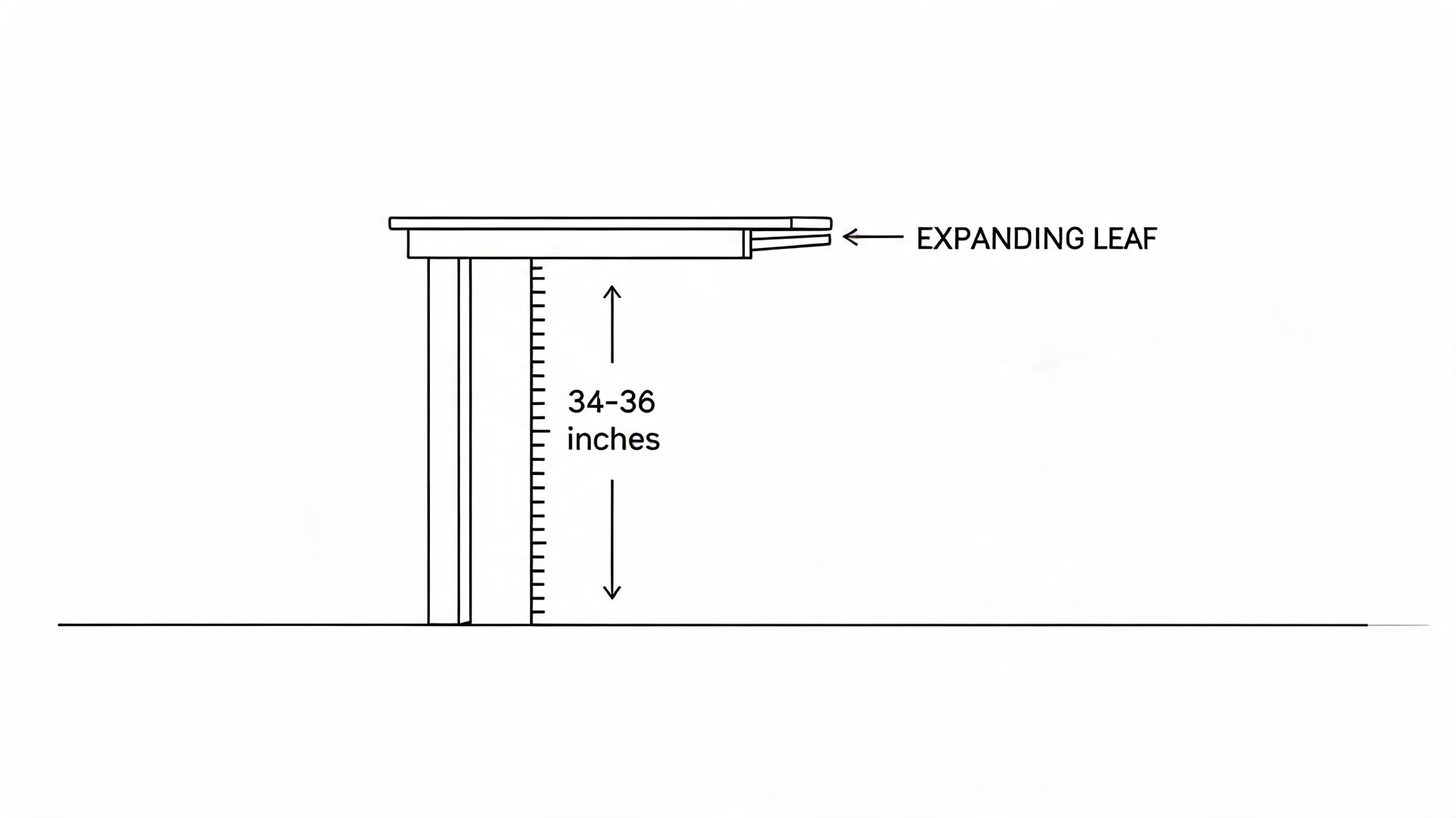
Counter height means a specific range
Counter-height tables typically fall in the 34 to 36 inch range. That puts them closer to kitchen counter height than standard dining height, which changes how the table looks, how people sit, and which seats feel comfortable for a full meal.
The height is part of the appeal, but it also creates trade-offs. A counter-height table can feel more social in an open kitchen because sightlines stay a little higher and the table relates well to nearby cabinetry. At the same time, the wrong stool height or a seat with no back support can make that same table tiring faster than a standard dining setup. This is one reason I always recommend a sit-test before buying, especially for households that linger over dinner.
Common places where this height works well:
- Open kitchens: The table usually feels visually tied to the counters instead of looking like a separate zone.
- Breakfast areas: The taller profile gives a casual, everyday feel that suits quick meals and coffee.
- Smaller dining spaces: The scale can look lighter and more current than a bulky traditional dining set, depending on the base design.
Expandable means the table has two working sizes
The expandable part matters just as much as the height. These tables stay compact for daily use, then open up for guests, projects, or holiday meals. In real homes, that flexibility is less about novelty and more about keeping floor space usable on ordinary days.
A good expandable counter height table should work well in both positions. Closed, it should feel proportional to the room and easy to move around. Open, it should stay stable, give each person reasonable elbow room, and avoid the wobble that shows up on weaker extension systems after a year or two of use.
Practical rule: Buy for the way the table lives closed first, then confirm the open size solves a real need.
This category tends to suit a few types of households especially well:
| Home situation | Why it fits |
|---|---|
| New homeowners | You get flexibility while learning how the room is actually used |
| Right-sizers | The table stays compact day to day without giving up hosting options |
| Townhome or condo living | You can seat more people without dedicating the whole room to a large fixed top |
| Multi-use rooms | The table can shift between dining, homework, games, and household tasks |
It also fills a different role than a built-in island. An island stays put and serves the kitchen. An expandable counter height table can move with the room, change size when needed, and adapt more easily as routines change.
Finding Your Perfect Fit with Sizing and Measurements
A table that looks right on a product page can still feel wrong in daily use. I see that most often when a shopper measures the tabletop but not the room, the seat pull-back, or the walkway that disappears once the leaf is in place.
Expandable counter height tables need to fit two real-life conditions. The closed size has to support ordinary mornings, quick meals, and easy movement through the room. The open size has to handle guests without forcing everyone to squeeze past each other or bump into cabinets.
Measure the room in two modes
Start with the way the room works on a normal day. Measure the area where the table will sit, then subtract the space you already know you need for door swings, cabinet doors, traffic paths, and nearby furniture. Wall-to-wall dimensions rarely tell the full story.
Next, check the room in both table positions.
Everyday footprint
Measure the table closed. Then ask a practical question. Can someone walk through with a laundry basket, grocery bag, or serving dish without turning sideways?Guest footprint
Measure the table fully open. Include the space people need to pull a stool back, sit down, and get up comfortably. A table can technically fit a room and still feel cramped every time you use the extension.
That last part matters. If opening the table blocks the pantry, crowds the refrigerator, or traps someone in a corner seat, the feature will go unused.
Tape the outline on the floor
Painter's tape is one of the best planning tools in the store and at home. Mark the closed dimensions first and live with that outline for a few minutes. Walk the path you normally use. Open doors. Stand where someone would sit. Then tape the expanded size and repeat the test.
This quick check usually reveals problems faster than spec sheets do.
Use these checkpoints as you go:
- Traffic flow: Leave enough room for people to pass without brushing the table edge or another seated person.
- Seat clearance: Counter-height stools need room to slide back farther than many shoppers expect.
- Cabinet and appliance access: Test buffet doors, drawers, ovens, and the refrigerator while the table is both closed and open.
- Sightlines: A taller table can make a compact kitchen feel more crowded, especially if the top is bulky or the base is heavy.
One more tip from the showroom floor. Do the sit-test before you buy. Counter height changes posture, and comfort depends on more than the listed dimensions. Footrest placement, apron clearance, stool height, and how your knees fit under the top all affect whether the table feels good after twenty minutes, not just two.
A visit to Stahl Home Center can help once you have your measurements in hand, because seeing proportions in person makes it much easier to judge clearance, seating comfort, and whether a table feels right for the way you live.
A good fit is not only about getting the table into the room. It is about keeping the room usable after the table is there.
Understanding Extension Mechanisms and Materials
An expandable counter height table earns its keep in the hardware. The top can look great on a sales floor and still become a nuisance at home if the extension system sticks, wobbles, or takes two people to line up.
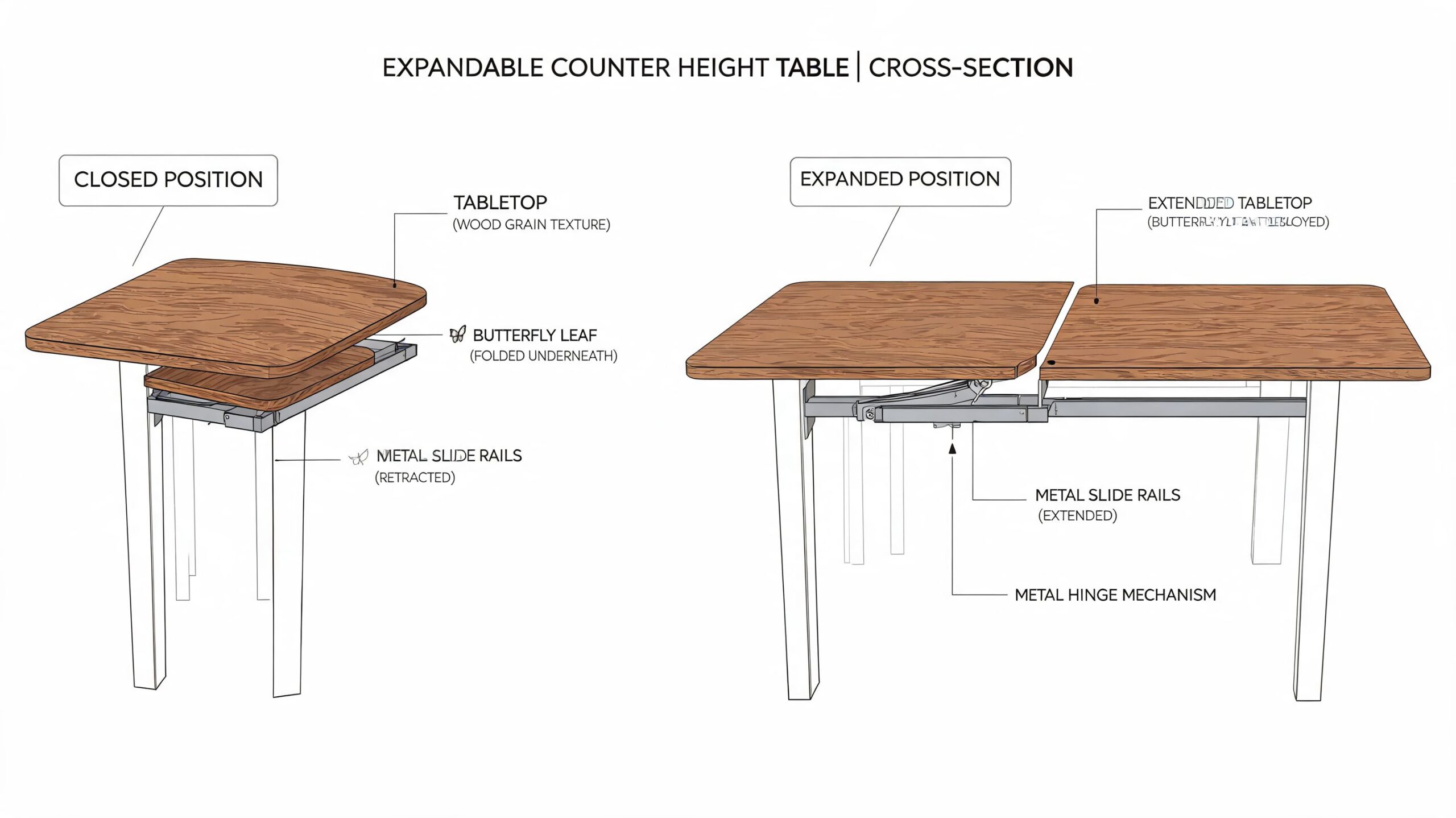
Mechanisms change how the table behaves
The mechanism affects more than size. It changes setup time, stability, storage, and how willing you are to use the feature on a normal weeknight.
Compact transforming tops usually suit smaller spaces and lighter use. They open quickly, and that convenience matters if the table shifts between daily meals and occasional guests. The trade-off is usually a shorter expanded length and, in some designs, more visible seams or moving parts near the center of the top.
Leaf systems are a better fit for buyers who expect to host often or seat a larger group. One high-capacity extendable table example shows why. It uses multiple extension leaves and a center support leg to help carry the load across a longer span. That support matters in real life because a long top without enough reinforcement can flex over time, especially if people lean on the edge or rest serving dishes in the middle.
I tell shoppers to pay attention to the opening motion. If the table feels awkward in the showroom, it rarely feels better after a year of use.
Materials affect maintenance, sound, and wear
Material choice changes how the table ages, how much care it needs, and even how it feels during everyday use. A counter-height table gets more hand contact, more stool bumps, and often more kitchen spillover than a formal dining table.
- Solid wood: Warmer look, more weight, and easier to refinish in some cases. It can also show seasonal movement, especially around leaves and seams.
- Veneer over engineered wood: More consistent across wide surfaces and often a practical value. The quality difference shows up at the edges, corners, and seam alignment.
- Metal in the base or frame: Useful for a cleaner profile and added rigidity. It can feel colder and harder visually, so the finish matters if the room already has a lot of stone, stainless, or tile.
The best choice depends on how the mechanism and material work together, not on one feature in isolation.
| Priority | Usually works better |
|---|---|
| Fast setup for occasional guests | Compact extension design |
| Larger gatherings and heavier use | Leaf system with center support |
| Busy family use | Durable finish, tight seams, and easy-clean surfaces |
| Lighter visual look near a kitchen | Mixed materials or a less bulky base |
A strong mechanism is only half the story. The contact points matter just as much. Check the slides, the locks, the hinge action, and where the finish may rub when the top opens and closes.
At Stahl, I recommend a full sit-test with the table both closed and extended. Open it yourself. Close it yourself. Rest your forearms on the leaf joint. Give the expanded section a light push. Look along the seam in natural light. Those small checks usually reveal more about long-term durability than a product card ever will.
Weighing the Pros and Cons for Your Home
This table style solves real problems, but it isn't automatically right for every household. The strongest buying decisions happen when people are honest about how they eat, gather, and move around the space.
Where this table style works well
The biggest advantage is flexibility. A compact table can preserve floor space during normal days, then open when company comes over. That's useful in kitchens, condos, townhomes, and homes where one area has to serve multiple purposes.
Counter height also changes the atmosphere. It tends to feel more casual than a formal dining table. For many buyers, that's exactly the appeal. The room feels active and social, and the table often blends nicely with nearby cabinetry.
A few strong upsides stand out:
- Space efficiency: Smaller footprint when closed.
- Casual everyday use: Good fit for coffee, quick meals, homework, and conversation.
- Better fit for open layouts: The taller profile often looks natural near kitchen counters.
- Hosting flexibility: Expansion gives you options without dedicating the room to a large table full-time.
Where buyers should slow down
The downsides usually show up in daily comfort and long-term wear. Retail descriptions often highlight expansion and seating but don't say much about what happens after repeated use. That gap matters. As noted by this collection of extending table products, many listings don't address long-term concerns like load stability, wobble over time, leaf alignment, or finish wear at the seams.
That's where the practical trade-offs come in.
- Mobility considerations: Counter-height seating can be harder for some people to get in and out of, especially compared with standard dining height.
- Young children: Families may find taller seating less convenient for daily meals.
- Mechanism fatigue: If you'll expand the table constantly, ease of operation matters more than buyers often expect.
- Surface seams: Expanded tops can show wear differently than fixed tops, especially at connection points.
Some buyers love the versatility for entertaining but end up using the table closed almost all the time. That's fine, as long as the closed version still feels excellent every day.
A simple decision test helps. If your home needs flexibility but not daily large-scale expansion, this category can be a smart fit. If accessibility, very frequent heavy use, or maximum long-meal comfort is the top priority, you should inspect carefully and compare against standard-height options before deciding.
How to Choose Matching Seating and Style Your Set
A good table can still feel wrong with the wrong stool. Many buyers get tripped up by this common oversight. They focus on finish, leg shape, or upholstery color, then discover the seating height makes the whole setup uncomfortable.

Start with comfort, not looks
Ergonomics guidance recommends about 10 to 12 inches of clearance between the top of the seat and the bottom of the tabletop, according to this counter-height seating guide. For a 36-inch tall counter-height table, that means looking for stools with a 24 to 26 inch seat height.
Those numbers matter because they translate directly into comfort. Too tall, and knees feel cramped. Too short, and diners feel like they're reaching up at the table.
Don't buy stools and table separately without checking the actual seat-to-table relationship. That mismatch is one of the most common comfort problems in this category.
If possible, sit for longer than a minute. Lean in as if you're eating. Rest your feet. Shift position. A setup that looks good in a photo can feel tiring fast if the foot support or seat height is off.
Pick seating that fits your routine
The right seating style depends on how long people will stay at the table.
- Stools with backs: Better when the table is used for dinner, conversation, or working on a laptop.
- Backless stools: Easier to tuck away. Good for tighter rooms where clean lines matter.
- Swivel seating: Helpful for social spaces and easier entry in some layouts.
- Stationary seating: Often feels simpler and more grounded.
A quick comparison helps:
| Seating type | Best for | Watch for |
|---|---|---|
| With backs | Longer meals and daily comfort | Takes more visual space |
| Backless | Tight footprints and easy tucking | Less support for lingering |
| Upholstered | Softer feel and a dressed-up look | More maintenance depending on fabric |
| Wood seat | Easy wipe-down use | Comfort may depend on seat shape and footrest |
For styling, keep the tabletop usable. A low centerpiece, a narrow tray, or a simple bowl usually works better than tall decor that interrupts conversation. In smaller rooms, matching every finish perfectly can make the set feel stiff. A little contrast between table and stools often feels more relaxed and current.
The Stahl Advantage Finding Your Table Today
A counter-height table can look right in a photo and still feel wrong at dinner. The final decision usually comes down to what happens when you sit down, rest your feet, and use the extension the way you would at home on a normal weeknight.
Why the sit-test matters
This is one category where a quick showroom test saves people from expensive mistakes. Sit all the way in. Put your feet on the support bar. Lean forward like you're eating, then stay there a few minutes. If the seat height is slightly off or the footrest hits awkwardly, you'll feel it fast.
The extension deserves the same kind of hands-on check. Open it. Close it. Look at how the leaves line up, whether the top stays steady, and how much effort the mechanism takes. In our experience, those small details separate a table that works well for years from one that becomes annoying after the first few holiday meals.
Finish is easier to judge in person too. Wood tones and painted finishes often read differently under house lighting than they do on a screen, especially if you're trying to coordinate with cabinets, flooring, or nearby seating.
What local shopping adds
At Stahl Home Center, shoppers can compare multiple counter-height sets side by side in one visit. That helps with the practical trade-offs this category brings. One table may give you a cleaner extension mechanism. Another may offer a thicker top or a sturdier base. A third may fit the room better but leave less knee space when fully seated. Those are easier choices to make when you can test them back to back.
There's also value in seeing the broader mix of furniture while you're there. If the dining area connects to the family room or open kitchen, it helps to compare the table with living room furniture available in Bloomington, see which recliners are in stock, and look at options such as custom sofas, power recliners, lift chairs, bedroom sets, and mattresses during the same trip. Buyers who want more control over fabric and finish can also ask about Rowe Furniture and Stahl's Design Your Way program for custom configurations.
For shoppers on a tighter timeline, ready-to-take-home pieces can simplify the process. For shoppers with a very specific look in mind, a custom order may be the better call. A good store visit helps you sort out which path fits your home, your schedule, and how often the table will need to expand.
Visit Stahl Home Center to shop expandable counter height tables in person, test seating comfort for yourself, and see what's available in stock in a local showroom built for real comparison. If you're furnishing a new home, updating a kitchen dining area, or replacing a table that never felt quite right, stop by the Westside Bloomington showroom and try the options firsthand.