
Power Lift Recliners Reviews: Compare Models and Fit


A parent gets stuck halfway out of a favorite chair after dinner, rocks forward twice, and grabs a side table to steady up. Nothing dramatic happens, but the family notices, and the search for power lift recliners reviews starts that night on a phone at the kitchen table. Most reviews lead with softness, motor noise, cup holders, and star ratings. Those details matter less than two harder questions. Can the person stay balanced after the chair lifts them, and can the chair move safely inside the room where it'll live every day?
Comparing La-Z-Boy, Rowe, and Jackson Lift Recliners
A shortlist works only when every model gets measured the same way. Capacity, lift style, and price band come first, before fabric swatches or extra features. A chair that looks right in a photo can still fail the two tests that matter: whether the user stays balanced once the lift completes, and whether the chair clears the doorway and traffic path it will live in.
How to Read the Shortlist
The table below puts the three lines carried locally side by side. Price on each is set by the fabric, configuration, and options chosen, so the honest figure is the one quoted on the floor for the exact build under consideration. Capacity works the same way: the rating on the manufacturer's documentation for that specific model is the number to trust, not a range printed for the line as a whole.
La-Z-Boy, Rowe, and Jackson lift recliners at a glance
| Brand or Model | Weight Capacity | Reference Price | Best Fit |
|---|---|---|---|
| La-Z-Boy power lift recliners | Rated on the model tag for the specific build | Quoted on the floor by fabric and configuration | Quality-focused buyers who want a proven motion-seating line |
| Rowe power lift recliners | Rated on the model tag for the specific build | Quoted on the floor by fabric and configuration | Style-focused buyers who want custom fabrics and performance upholstery |
| Jackson power lift recliners | Rated on the model tag for the specific build | Quoted on the floor by fabric and configuration | Buyers who want a chair that matches a coordinated room set |
Shoppers who want a broader orientation on lift chair types before narrowing a shortlist can start with Top Mobility's lift chair guide, then return to measured comparisons. Outside context helps with vocabulary, but it cannot settle fit.
What Each Line Does Best
La-Z-Boy is the motion-seating specialist here, the line quality-focused buyers test first when mechanism feel and long-term support top the list. Rowe suits shoppers who care most about custom style and performance upholstery that holds up in a busy living room. Jackson fits buyers building a coordinated room, where the lift chair needs to match a sofa and loveseat grouping rather than read as medical equipment.
Narrow the list to the models that fit the budget band and required capacity, then judge those finalists on how steadily the user stands after the lift finishes and how the chair sits in the room's traffic path, before comparing fabrics.
Floor stock marked In-Stock Today lets a shopper sit-test finalists back to back in one visit instead of guessing from product photos. Seat depth and lift feel reveal themselves within the first minute of sitting down, and that single session usually eliminates one or two chairs. Measure the doorway and the walking path beside the chair before the visit, and bring those numbers to the floor.
Lift Mechanism Tiers and What Each Adds
A power recliner adjusts the backrest and footrest. A power lift recliner adds an elevator motion that raises seat height and tilts the seat forward, so the user finishes the stand on their own legs rather than being pushed out of the chair. The patent record for a modular power reclining and lifting chair traces this category back through an early motor-operated reclining-chair design published in 1971 and dedicated reclining lift-chair designs by the late 1990s, which is why two chairs that look identical on a showroom floor can lift in very different ways.
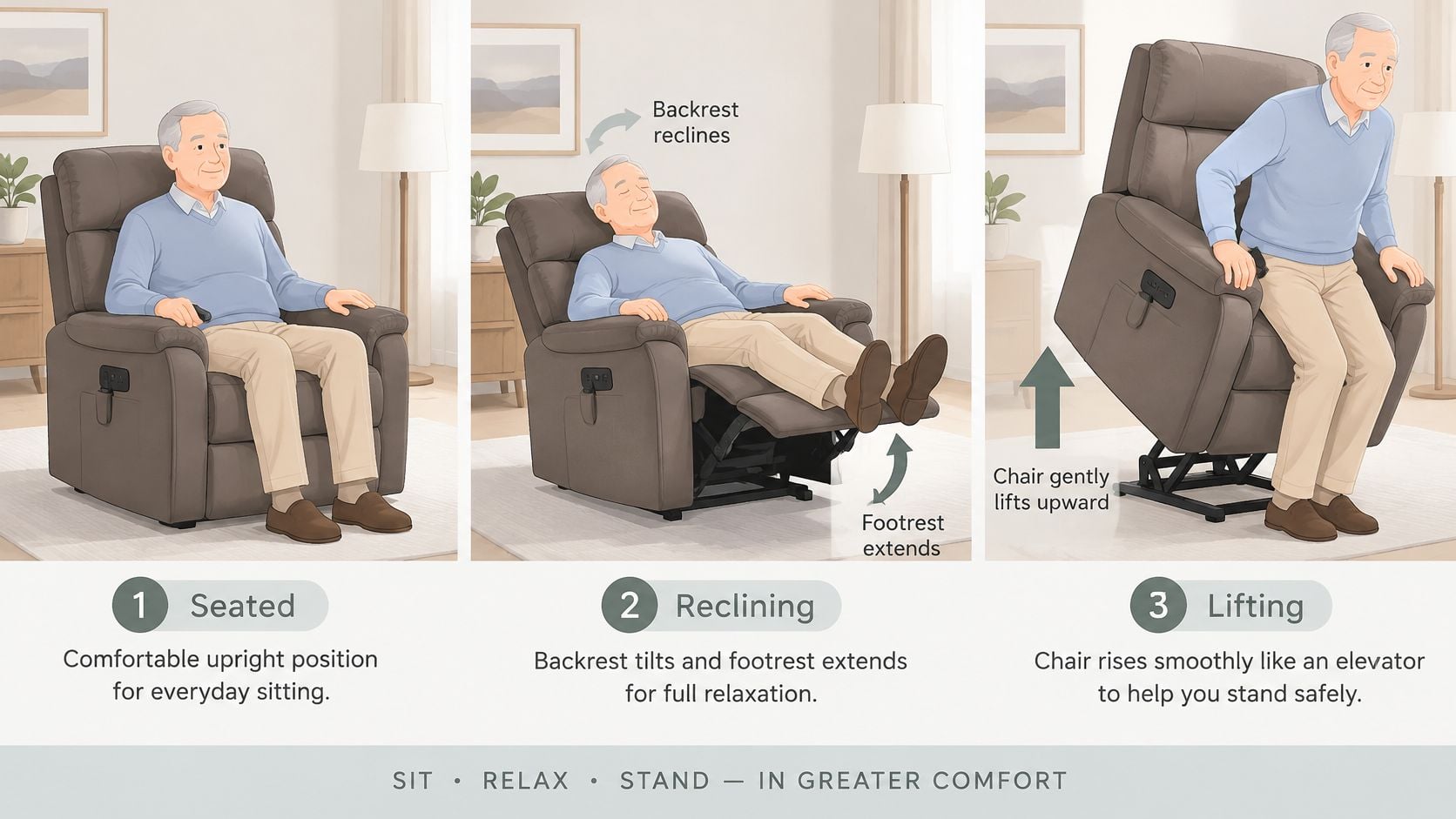
Manufacturers vary in wall clearance, lifting geometry, motor control, ottoman deployment, and chair-to-standing assistance. Those differences decide whether a lift feels steady or abrupt, and whether the user can plant both feet and step away once the motion finishes. Shoppers comparing power recliners with true lift models can review the mechanics in this guide to how power recliners work before testing chairs in person.
Lift mechanism tiers
| Category | Weight Rating | Typical Positions | Best For | Watch For |
|---|---|---|---|---|
| Standard power lift | Sized for average-build adults; confirm the rating on the model tag | Two or three | Adults who lounge daily | Stability at full lift height |
| Heavy-duty power lift | Reinforced rating for larger users; confirm the rating on the model tag | Two or three | Larger-frame users who need reinforced construction | Certification and warranty documentation |
| Infinite-position or zero-gravity lift | Model-specific rating; confirm on the tag before purchase | Infinite or zero-gravity | Long hours of reclining with frequent repositioning | Lift-path smoothness at extreme angles |
Standard lifts cover most households and keep controls simple. Heavy-duty construction adds reinforced framing for larger users, though a stronger rating alone says nothing about whether the chair fits the person's hip-to-knee geometry. Reinforced frames also take up more floor space, so measure the walking path with the chair at full lift rather than parked against the wall. Infinite-position designs separate backrest and footrest movement, which suits long sitting sessions but adds control complexity some users don't want.
The label on the box matters less than three measured behaviors. A useful lift moves smoothly, stops where the user stops it, and stays stable at full height without rocking or creeping on the floor. If the user can't step away from a flat, planted stance when the motor finishes, the tier doesn't matter.
Criteria Worth Testing Before You Compare Models
A showroom demo usually shows the chair rising once with nobody in it. That proves the motor works and nothing else. Put the intended user in the seat, run a complete lift cycle under their full weight, and judge the chair by two questions: can they stand steadily once the lift stops, and can they walk away from it without sidestepping around furniture.
Movement and Controls
- Lift-path smoothness: The seat should rise in one steady motion without jerking, tilting sideways, or speeding up near the top. Any shudder at full height is a reason to eliminate the model.
- Stop-and-start control: Releasing the button should halt movement immediately, and the chair should hold that position without drifting. Test this at three points in the lift cycle, not just at the ends.
- Operating speed: A very slow chair frustrates daily use, while a fast one can unsettle a user with weak balance. The right speed feels unhurried but purposeful.
- Remote simplicity: Buttons should be large, distinct by touch, and understandable without reading a manual each time.
Buyer question: Can the intended user start, stop, and reverse the chair without help, every time, including in low light?
Fit at the Seat
- Seat height and depth: Feet should rest flat with knees comfortable, and the lower back should contact the backrest without a pillow filling a gap. Measure the user seated, floor to the back of the knee, and compare that number against the seat height before anything else. A seat that's too deep pulls the user into a slide that makes standing harder.
- Recline range: Two-position, three-position, infinite-position, and zero-gravity geometry serve different routines. More positions only help if the user will reposition during the day.
- Ease of transfer: Armrests should sit at a height where hands can press down naturally during the final phase of standing. Watch the user push up for real. If they have to grab the seat or lean far forward to stand, the arm height is wrong for them.
Fit logic extends past one chair. Shoppers thinking about posture across the whole room can apply the same ergonomic furniture design principles to sofas and side chairs.
Documentation and Testing
Feature counts prove little without paperwork behind them. Ask the retailer for the manufacturer's testing summary and look for static-load and stability tests, strength and fatigue verification, misuse and abuse testing, and ergonomic validation on the complete chair. On the electrical side, look for compliance with standards such as IEC 60601-1, IEC 60335-1, and UL 962, the standard covering motorized household furnishings.
Three questions sort strong documentation from marketing copy. Does the testing cover the complete chair or only the actuator? Does the rated capacity match the intended user with room to spare? Does the warranty cover both the mechanism and the electronics, since a lift chair fails as a system, not as a single part?
Upholstery and add-ons close the evaluation. Performance fabrics suit households with pets and daily spills, leather ages with a different patina and care routine, and heat or massage features add electrical components whose warranty terms deserve a careful read before anyone pays for them.
Safety and Transfer Fit for Every Household
Most reviews stop when the chair stops moving. Lifting someone toward standing isn't the same as keeping them safely standing once the motor rests, and that second is where households get hurt. A chair can perform perfectly as a machine and still be wrong for a person who cannot balance at the top of the lift.
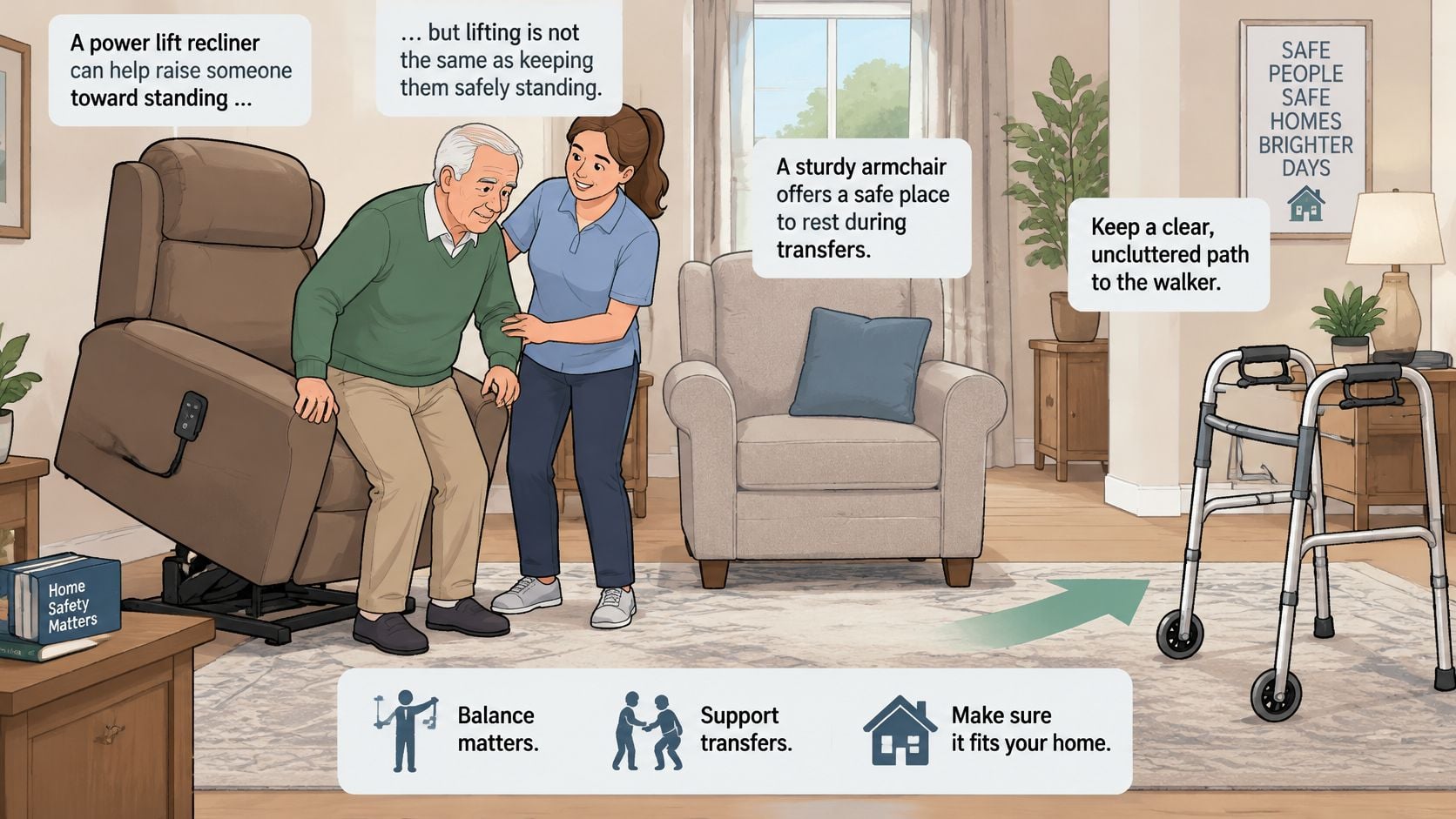
The Ontario Geriatric and Long-Term Care Review Committee report documented three cases from 2018 involving elderly people with cognitive decline who used the remote to raise their lift chairs toward standing, then experienced unwitnessed falls, suffered injuries and complications, and subsequently died. Those are three documented cases, not a population-wide failure rate, and they don't establish that lift recliners are generally unsafe. They do set a concrete review standard: judge the chair by what the user can do after the motion ends.
Household situations and recommended setup
| User Situation | Suitability | Supervision or Setup | Review Check |
|---|---|---|---|
| Independent adult with steady balance and full cognition | Suitable | Standard use with the remote within reach | Test stop control and stability at full lift |
| Adult with mild mobility limits who stands unaided | Usually suitable after a transfer assessment | Confirm the routine with a clinician or therapist | Verify the lift stops and holds smoothly |
| Person with cognitive decline or dementia | Requires assessment before use | Caregiver controls remote access | Confirm remote lock-out options with the manufacturer |
| Person who cannot bear weight or lacks leg strength | Not a substitute for a transfer aid | Caregiver or transfer aid required | Confirm the lift is not the only support |
| Frail older adult living alone | Requires assessment | Consider monitoring and a documented fall plan | Confirm stability at full lift height |
The middle rows describe most of the buyers who walk in undecided, and for them a clinician or therapist should set the transfer routine before the chair arrives.
The Distinction Reviews Miss
A user who rises easily but sways during the first seconds after standing needs transfer support built into the plan. Medicare's coverage rules draw a similar line. Under the Medicare Coverage Database guidance for seat-lift mechanisms, the seat-lift mechanism is the potentially covered component rather than the upholstered chair around it, and eligibility generally requires documented inability to rise from a conventional chair, medical necessity, self-control of the lift, and smooth operation.
That framework gives reviewers a useful test. Can the user comprehend the controls, keep balance after elevation, stop the motion mid-cycle, and stay upright at full height? If any answer is no, the chair needs an assessment before purchase. Households working through related comfort questions, including choosing knee support for sensitive skin, should treat the chair as one part of a transfer routine rather than a complete solution on its own.
Correct sizing supports all of this, and shoppers can check standard recliner chair sizes against the user's height and hip-to-knee measurements before a showroom visit. A lift mechanism raises a person toward standing. It cannot replace a transfer aid or a caregiver when leg strength and ankle stability aren't there.
Matching the Recliner to Your Room and Routine
The right chair in the wrong spot still fails. Delivery path, wall clearance, walker access, and daily traffic patterns decide whether a lift recliner helps or obstructs. According to AARP's housing and livable communities research, only 1% of homes reportedly have five key accessibility features, a zero-step entrance, single-story living, wide doorways and halls, lever-style handles, and accessible electrical controls, so most buyers are fitting a chair into a home that wasn't built around one.
Measure five things at home before shopping. Doorway and hallway clearance for delivery, the distance the chair must sit from a wall to recline and lift fully, space for a walker or wheelchair to approach from the side the user favors, remote reach from every position, and whether the fully reclined or lifted chair blocks a walking path. Families planning wider changes can compare those measurements against home modifications for independent living and decide what the room needs beyond the chair itself.
Relocated professional. A new homeowner furnishing a living room in Bloomington this weekend needs delivery through a standard front door and a chair that doesn't dominate a modest room. Wall-hugger geometry and an In-Stock Today floor model solve both problems at once.
Empty nesters and active retirees. Right-sizers moving to a smaller home should measure the reclined footprint against the new room, not the old one. A chair that floated in a large family room can block the path to a patio door in a condo.
Multi-generational household. A caregiver needs approach space on at least one side and a remote routine everyone in the house understands. Traffic from grandchildren and pets argues for an enclosed mechanism and a cord path that stays out of walkways.
Style-focused decorator. The chair has to hold its own beside existing living room furniture in Bloomington homes, which usually means custom fabric and a scale check against the sofa. A lift chair that's visibly taller and deeper than everything around it reads as equipment, not furniture.
Second-home or rental owner. One durable chair for guests needs simple two-button controls that a first-time user can figure out without instructions. Complicated remotes generate phone calls.
A chair that cannot be reached, approached, or cleared safely fails the room test, however comfortable it feels.
Ready Today or Made to Order
A move-in, hospital discharge, or failing chair can make timing the first constraint. An in-stock model may be available for pickup or scheduled delivery, while a custom order gives more control over fabric and configuration but requires waiting. Check the room's circulation and whether the user can stand safely after the lift completes before choosing either route.
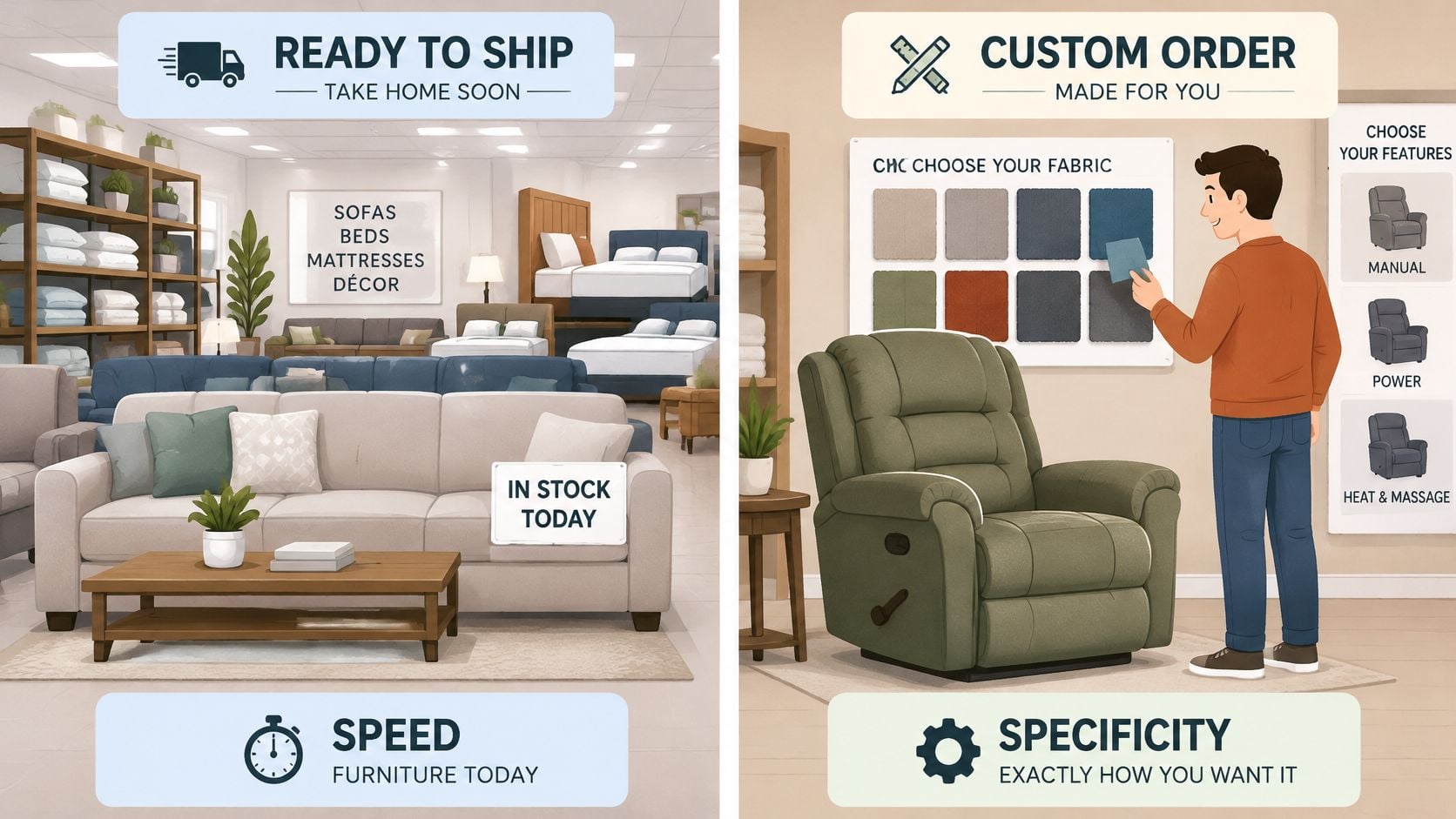
- In-Stock Today: Choose a chair already on the floor, then arrange customer pickup or scheduled professional delivery. This route suits households with a deadline. Review same-day recliner delivery options to compare pickup with scheduled delivery.
- Design Your Way custom order: Buyers can choose from hundreds of fabrics and multiple configurations for La-Z-Boy and Rowe furniture through the Design Your Way custom furniture service. It suits households without an immediate deadline that need a particular color, performance fabric, or configuration.
At Stahl's Westside Bloomington showroom, shoppers can compare upholstery colors in person and operate the lift and stop control. On a sit-test, raise the chair fully, check that the user can stand with control, and confirm the chair leaves a clear path through the room. The showroom measures 88,000 square feet, so it also gives shoppers space to assess furniture at full scale.
Choose an in-stock chair when timing is tight and the available model fits the user and room. Choose custom when the required fabric or configuration matters more than immediate availability. In either case, the deciding test is whether the user can rise safely and the chair can operate without blocking circulation.
Maintenance and Long-Term Safe Operation
A lift chair works hard every day, so a short care routine protects both the mechanism and the user. None of it requires tools or technical skill.
- Clear the path: Keep cords, throw rugs, and side furniture out of the recline and lift zone so nothing pinches or blocks the mechanism.
- Respect the rating: Never overload the chair beyond its rated capacity, and never store items under the chair while it's lifted.
- Test on a schedule: Run the lift and stop control regularly, watching for changes in speed, noise, or stopping point. A hesitation or uneven rise means it's time for a professional check.
- Manage the remote: Replace batteries promptly, and in households with cognitive decline, keep the remote where the caregiver controls access.
- Clean by the care code: Follow the manufacturer's upholstery code and treat spills promptly. The steps in this guide to cleaning recliner upholstery cover fabric and leather care without damaging finishes.
- Keep one folder: Store warranty registration, delivery paperwork, and testing documentation together so a service request moves quickly.
Small changes in motion are early warnings, not quirks to live with. A chair that stops holding position or rises unevenly should come out of daily transfer use until a technician checks it.
Choosing the Right Chair for Your Situation
Choose a lift chair around the user's next transfer and the room's circulation. A chair that raises someone safely but blocks a doorway or leaves no clear path is not a good fit.
The homeowner on a deadline should start with an in-stock standard lift chair, then confirm it fits the room and supports a stable stand. If it passes both checks, take-home availability or professional delivery can address an immediate need without waiting for a custom order.
The quality-conscious buyer can compare La-Z-Boy and Rowe by checking mechanism and electronics warranty coverage, documented testing, and fabric wear. The Good-Better-Best approach is useful when a higher tier provides a clear improvement in durability, rather than adding buttons.
The style-focused decorator can use Design Your Way to select fabric and configuration, then check the chair's scale and clearance against the room before ordering. A preferred fabric does not make a poor fit work.
Right-sizers and caregivers should complete the transfer assessment and capacity check before choosing upholstery or features. At full lift height, the user must remain balanced and be able to stand safely.
Stahl Home Center is a family-owned Bloomington business established in 1967 and a local La-Z-Boy dealer. Its in-stock recliners let shoppers assess the fit and lift in person. Bring room measurements, the user's height, and details about balance and transfer needs when visiting the Westside Bloomington showroom. The practical decision is whether the chair supports a safe stand and leaves room to move around it. Availability, fabric choice, and extra features come after those checks.
For shoppers considering La-Z-Boy in Indiana, Rowe Furniture, custom sofas, or complete rooms, Stahl Home Center offers furniture to test in Bloomington. Run the lift and stop control, check the user's position at the top, and confirm the chair fits the room's circulation before choosing.