

Best Sectional Couches for Bloomington Homes in 2026


In a 2023 Consumer Insights Now survey of 1,877 U.S. adults, 39% planned to purchase a sofa or sectional during the second half of 2023, the highest share among listed furniture and décor categories, according to Home News Now. That makes this an important household purchase, not merely a decorating decision.
The best sectional couches earn their place by fitting the entryway, preserving the room's walkways, supporting the people who sit on them, and remaining serviceable after daily wear. A beautiful sectional that fails any of those tests is the wrong sectional.
Best Sectional Couches at a Glance
For a family of four in a 14-by-18-foot living room with one doorway, a three-piece L-shaped sectional is a practical starting point: it offers seating and a chaise without taking up the space of a U-shaped layout. Households planning a move, accommodating an older parent, or hosting overnight guests should weigh portability, access, and sleeping space more heavily.
The guide below compares sectional types and buying routes. Stock and available configurations can vary, so confirm what is available before choosing.
Quick-pick guide to sectional types
| Sectional type | Best for | Main strength | Buying route |
|---|---|---|---|
| Three-piece L-shaped sectional | A family of four in a 14-by-18-foot living room with one doorway | Combines conversation seating with lounging space | In-stock floor model or custom fabric order |
| U-shaped sectional with chaise | Large family rooms and media rooms | Extensive seating and lounging space | Floor model or Design Your Way order |
| Modular sectional | Movers, renters, and changing layouts | Separate pieces rearrange and can simplify tight-entry moves | In-stock or custom order; confirm availability |
| Power-recline sectional (La-Z-Boy) | Comfort-first buyers and older adults | Independent controls at equipped reclining seats | In-stock or custom order |
| Performance-fabric sectional (Rowe) | Homes with pets, children, or heavy daily use | Custom fabric choices for everyday use | Design Your Way custom order |
| Sleeper sectional | Guest rooms, second homes, and rentals | Converts to a bed for overnight guests | Ask the showroom team about in-stock options |
Check the seat map before buying a power sectional. Corners, consoles, and armless sections may stay stationary even when nearby seats recline.
Stahl Home Center carries La-Z-Boy and Rowe, with custom fabrics and configurations available through its sectional and custom-design offering. Compare reclining layouts with customizable upholstery by sitting in the exact type of seat you plan to use.
Match the recommendation to the household
- New homeowners and relocators: Look first at in-stock L-shaped sectionals, then confirm the pieces fit through the entryway and into the room. Same-day pickup may be possible when a suitable item is in stock.
- Quality seekers: Compare La-Z-Boy options by frame construction, cushion support, serviceability, and warranty terms. Treat each as a separate buying decision.
- Style-focused decorators: Consider Rowe when fabric, silhouette, and layout need to work together. Custom choices make sense when they solve a specific design problem.
- Right-sizers: Choose a visually lighter design with supportive seats; add power recline where needed. Check head support before choosing a lower-profile back.
- Multigenerational homes: Look for a stable frame and seating positions that suit different users. A deep chaise may not work for everyone.
- Second-home owners: Favor upholstery that is manageable to clean. Add a sleeper only if overnight accommodation is needed, and check that the sectional remains comfortable for everyday sitting.
A standard sofa with separate chairs can be a better fit when doors interrupt the walls or household members need different seating positions. In a 2023 report, Design News Now found that 27% of 1,868 U.S. consumers planning a home-furnishing purchase wanted a sectional, while 34% preferred a standard-size sofa.
Choose by how the seats support the people who will use them, not by showroom appearance alone.
Photos can narrow down the style, but they cannot show how a seat feels or whether its back support suits your height. Sit in the sectional and try each type of seat before deciding.
Sectional Configurations Compared by Room Shape
In a 2024 survey of 1,016 U.S. upholstery shoppers conducted by Furniture Today Strategic Insights and published in 2025, 36% of sectional buyers chose a three-piece configuration, making it the most popular size, according to Furniture Today. Popularity makes that layout a sensible starting point, but the room still gets the deciding vote.

Choose the shape around the openings
An L-shaped sectional works well against adjoining walls or as a boundary in an open-plan living room. Measure the wall length required by each arm, including trim, radiators, and door swings. An apparently empty corner may still be part of the route to another room.
A U-shaped sectional suits a broad family room where conversation and shared viewing take priority. Its return sections consume floor area on both sides, so the center opening must remain usable with a coffee table in place. A large room with several doorways may handle an L-shape better.
A chaise sectional adds a long lounging position without a full return of upright seats. It's especially useful when one household member stretches out while another prefers ordinary seating. The chaise should point toward open floor, not across the entrance.
Modular sectionals suit irregular rooms and households likely to relocate. A compact sofa-and-return arrangement can suit a smaller room, but shoppers shouldn't assume that fewer pieces automatically means a smaller footprint.
Check connections, orientation and circulation
Modular construction helps pieces travel separately and permits compatible rearrangements. The trade-off is more seams and connectors to align, plus more crevices to clean. A fixed frame can feel more unified and stable, especially for someone who braces against an arm while standing.
- Mark the walking route: Tape the footprint on the floor, then walk between the room's actual destinations while carrying a laundry basket.
- Label the chaise side: Describe left and right from the seated position on the room sketch, then have the salesperson reconcile that sketch with the manufacturer's terminology. Some labels use a facing-the-furniture perspective.
- Check every main view: Confirm the television or fireplace sightline from the seats used most often, not only from the middle.
- Account for adjacent furniture: Open cabinet doors and pull out nearby dining chairs before approving the layout.
The retailer's sectional sofa layout ideas offer a useful starting point for comparing arrangements.
Traffic flow comes first; seating count comes second. Extra seating isn't useful when everyone has to squeeze past it.
Sizing a Sectional for Your Room and Your Body
The first fit test happens before anyone sits down. A sectional that fits the living room can still fail at the stair landing, and a frame that clears the front door may not pivot through the hallway behind it.
Measure the entire route from the unloading point to the final position. Doorway width alone does not establish whether a long frame can turn where it needs to.
Measure the moving route
- Entry openings: Record the clear opening with the door open, accounting for handles, stops, and storm doors.
- Hallways and stair turns: Measure narrow sections, landings, banisters, and overhead obstructions.
- Elevators: Record the door opening and interior dimensions, including the space needed to rotate a packaged piece.
- Ceiling height: Check low landings and sloped ceilings where a piece might need to tilt.
- Packaged dimensions: Ask for the shipping dimensions of each section, not only the assembled footprint.
Removable legs or backs help only when the manufacturer allows their removal, so confirm that before counting on it. Photographs of awkward turns help the showroom team assess the route, but bring the tape-measure numbers too. When the route is tight, ask which models ship as separate components; that detail often settles the purchase before fabric or color even enters the conversation.
Test usable depth rather than overall depth
Showroom fitting works from a few practical ranges. Usable seat depth for most adults runs about 20 to 24 inches, with roughly 19 to 21 inches suiting sitters under about 5 feet 6 inches and 24 inches or more for those above 6 feet 2 inches. Treat those numbers as a starting point for the sit test; cushion feel decides the rest.
Usable seat depth by user height
| User height | Usable seat depth | Fit check in the showroom |
|---|---|---|
| Under 5 ft 6 in | 19 to 21 in | Feet rest flat, back supported, no pressure behind knees |
| 5 ft 6 in to 6 ft 2 in | About 21 to 24 in | Sit fully back and confirm comfortable thigh support |
| Over 6 ft 2 in | 24 in or more | Seat supports the thighs without forcing the sitter to perch |
The seat-depth explanation separates usable sitting space from the sectional's overall front-to-back measurement, which matters because a deep frame with a thick back cushion can leave less sitting room than the spec sheet suggests.
- Sit fully back. The pelvis should feel supported without a pile of decorative pillows filling the gap.
- Place both feet naturally. Flat foot placement is a better everyday fit signal than the ability to curl up during a quick showroom visit.
- Check the cushion edge. It should support most of the thighs without pressing behind the knees.
- Stand normally. The sitter should be able to rise without rocking repeatedly or hauling against an unstable arm.
For older adults and caregivers, seat height, cushion firmness, and a graspable arm deserve special attention. A sinking cushion can make standing harder even when the frame height looks appropriate, so test the stand-up motion several times rather than once.
Record seat height, usable depth, arm height, cushion feel, and required recline clearance on the chosen model's specification sheet. In a multigenerational home, test each regular user instead of treating the tallest person's preference as the household standard; a household with mixed heights usually does better with an intermediate depth than with the deepest seat in the store.
Fabric and Cushion Durability Tests That Matter
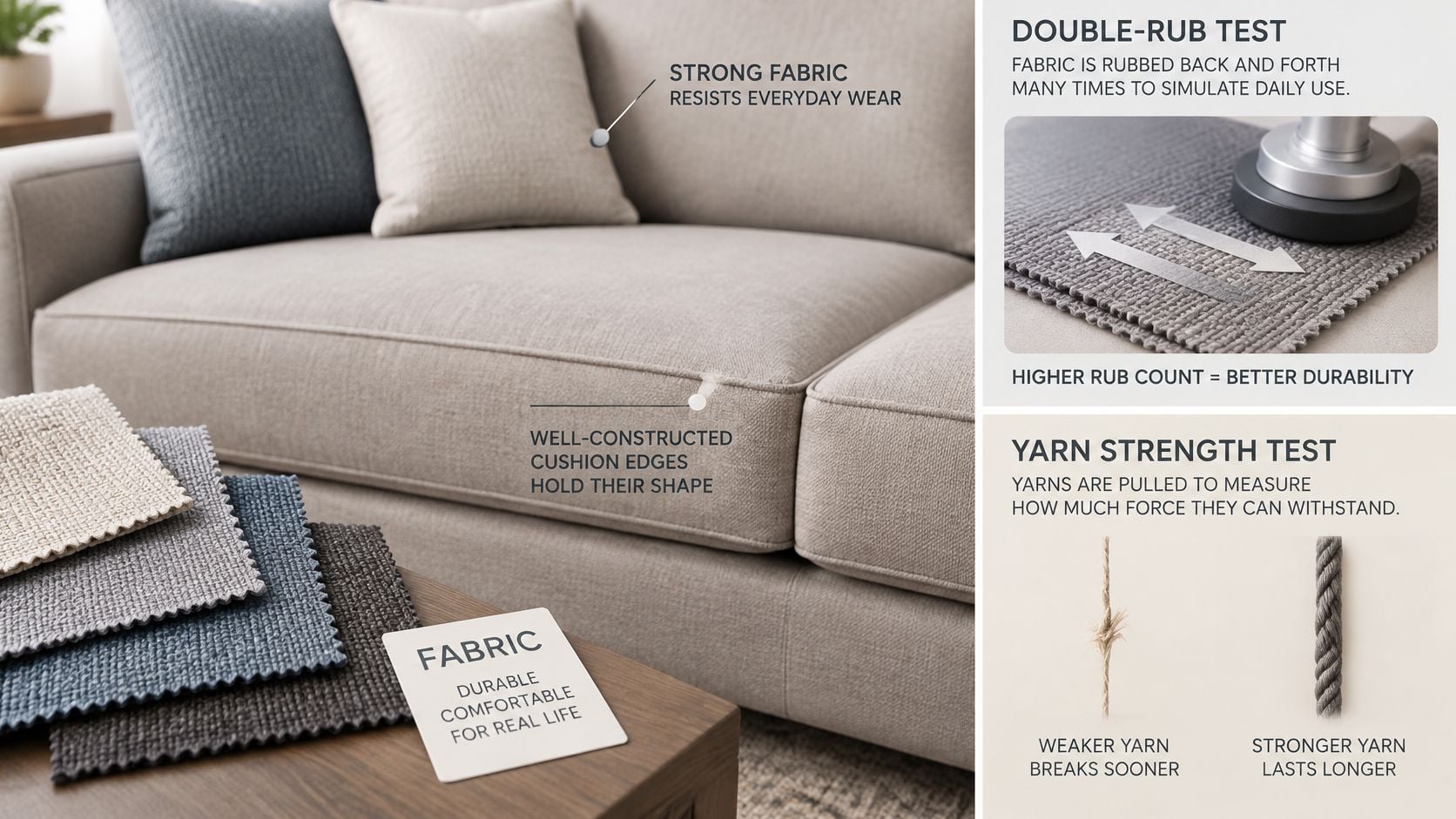
A performance fabric label tells you little until you see the abrasion rating and the test method behind it. The same applies to tags like "family friendly." A label earns its keep only when the seller can explain the abrasion result, the cleaning requirements, and what happens when a cushion or cover eventually needs attention. Ask for the test data before you ask for the color card.
Read the abrasion rating correctly
Wyzenbeek testing reports abrasion in double rubs: the machine rubs the fabric until visible wear appears or the first two yarns break. Martindale reports cycles instead. The two scales aren't directly interchangeable, so a big number means nothing until the seller names the test that produced it.
Typical double rub ranges line up with household use this way:
Wyzenbeek double rub ratings by household use
| Wyzenbeek double rubs | Typical household fit | What the rating does not cover |
|---|---|---|
| Under 15,000 | Light or occasional use, such as formal rooms | Stain, fading and pilling resistance |
| 15,000 to 20,000 | Ordinary home use | Seam strength and cushion compression |
| 30,000 or more | Pets, children, frequent entertaining and high-traffic rooms | Cleanability and color stability |
Match the band to the way your household sits. A formal sitting room can live in the lowest range. A sectional that hosts kids, pets, and regular guests belongs at the top, and its fabric should still carry clear care instructions. Polyester, acrylic, and polypropylene/olefin are common fibers in stain-resistant upholstery textiles, and the finished fabric's cleaning code decides which cleaners are safe to use on it.
Inspect what supports the fabric
The fabric is only the surface.
The questions worth asking at the store go underneath it:
- Cushion construction: Request the foam-density specification and an explanation of the fill. Firmness describes feel; on its own it tells you nothing about foam quality.
- Reversibility: Confirm whether cushions can be flipped rather than merely removed.
- Cover care: Check whether removable covers permit home washing, professional cleaning, or spot treatment only. A zipper isn't permission to machine-wash.
- Frame and suspension: Ask about frame material, reinforced joints, and the support system beneath the cushions.
- Repairability: Find out whether replacement cushion inserts, covers, or matching fabric can be ordered.
In the showroom, press hard into the seat, then watch the cushion recover. Foam that stays dented, or fabric that wrinkles and stays wrinkled after a ten-minute trial, will not improve at home.
The upholstery fabric selection guide can help you organize these questions before the store visit.
Warranty length is a separate question. A long warranty may cover the frame while excluding ordinary cushion softening, upholstery wear, labor, or transport. Read the actual coverage language instead of treating a reassuring headline as full protection.
The softest sectional isn't automatically the strongest value. A moderately firm model with serviceable cushions and replaceable components is often the more sensible long-term purchase.
Recliners, Lift Features and Sleeper Mechanisms
A mechanism should solve a daily problem. Extra movement, charging ports, and hidden storage aren't worthwhile if they make the main seat harder to use.
Reclining comfort without access problems
Manual recline is the simpler choice for someone who can comfortably reach the release and close the footrest. It generally avoids the added expense of powered equipment, but shoppers should test the actual effort required. A mechanism that opens easily may still demand considerable leg pressure to close.
Power recline suits people who need controlled adjustment or have limited grip strength. The important check is control placement: buttons tucked between cushions can be awkward for stiff fingers. An outlet must be accessible without running a cord across a walking route.
Some configurations add USB ports, consoles, or storage. Those features should remain secondary to back support and an easy exit from the seat. For La-Z-Boy Indiana shoppers comparing power recliners and sectionals, the team should identify stocked choices separately from custom-order configurations.
- Test the full motion: Stop at intermediate positions and at full recline.
- Check the moving envelope: Measure the manufacturer's wall clearance and the footrest's reach into the room.
- Try the controls independently: Each intended user should operate them without assistance where practical.
- Ask about service: Confirm access to motors, switches, and replacement mechanism parts.
Lift assistance and overnight accommodation
Lift chairs help a person transition toward standing, but power recline alone doesn't provide lift assistance. A separate lift chair beside a stationary sectional may be more practical than trying to solve every mobility need within one large seating unit.
Caregiver households should check whether the user can approach, sit, operate the controls, and move away safely. The mechanism also needs unobstructed space, including clearance from children, pets, tables, and loose cords.
Sleeper sectionals suit guest rooms, rentals, and second homes when occasional sleeping accommodation justifies the added mechanism. Their sleep surface often differs substantially from a regular bed, so overnight expectations should match the actual mattress or convertible platform.
The sleeper sectional guide provides another way to narrow the format. In the showroom, the mechanism should be opened completely, the sleep surface tested, and the remaining route to the door checked.
Practical rule: Judge a reclining seat at full extension and during the return to standing, not only in its upright display position.
Value Across Price Tiers
Spend up only where the upgrade changes fit, construction, or service access. A lightly used room can stay with an in-stock L-shaped sectional in an ordinary-home-use fabric if the cushions feel supportive and the care routine is simple. A busy family room should pay for parts and upholstery that can be lived on hard and kept in service.
Use the tiers as a spending question. The retailer describes its Good-Better-Best approach and hundreds of fabrics and configurations through Design Your Way on its custom furniture and showroom overview. Custom work earns the extra cost when it solves a doorway, layout, seating-depth, or fabric problem that stocked pieces miss.
Put each tier to work
- Good: Supportive cushions, straightforward care, and no paid features the household will leave unused.
- Better: A La-Z-Boy sectional chosen for the exact model's construction, cushion options, and parts support. The practical jump from Good is what changes under the sitter: confirm the standard insert, available cushion upgrades, reversible covers where offered, and access to mechanism or seat parts.
- Best: A Rowe custom sectional when a made-to-order layout and a documented heavy-use performance fabric match the household. Choose color for taste; choose durability through the fabric rating and serviceable cushions.
Ask one service question and move on: which inserts, covers, and mechanism parts can be ordered later. A stronger frame, reversible cushions, and replaceable parts still need confirmation on the selected model. If two floor samples feel identical after the same sit-tests, the cheaper one is the value buy.
Confirm Your Sectional and Plan Your Visit
If a stocked sectional passes the access, room-fit, and sit-tests, the in-stock route is usually the practical choice. When the required fabric, layout, or recline arrangement is not on the floor, Design Your Way is the better route. Custom buyers should confirm the order details and quoted lead time before committing.
The in-stock living room furniture selection covers thousands of pieces ready to take home today across 88,000 square feet of showroom space. That scale lets a shopper judge several configurations in one trip, though it is still worth confirming the exact sectional can leave the floor rather than assuming every display is immediately releasable.

Bring a short decision checklist
- Color: View the fabric in natural light where possible and request a swatch to check in the room.
- Arm support: Confirm the arm height and padding feel comfortable and provide useful support.
- Cushion consistency: Compare the seats intended for regular use so no single spot sits noticeably softer.
- Service questions: Ask how replacement inserts and upholstery service are handled.
- Purchase details: Record the exact configuration, fabric, pickup arrangements, or scheduled professional delivery terms.
Stahl Home Center has been family-owned since 1967, according to its company history. In the showroom, a visitor can test recline and sleeper mechanisms, compare arm heights between configurations, and check fabric colors under real lighting in a single visit.
A whole-home trip can also cover bedroom sets, mattresses, and recliners in stock. Shoppers looking for fast turnaround should separate take-home-today pickup from scheduled professional delivery, since the two options involve different timing and handling.
Bring room measurements and photos of the doorway, stairwell, or tight turns to Stahl Home Center on Bloomington's west side. Staff can narrow the floor to sectionals that clear the access route, fit the room, and match how the household sits.