Coffee Table and End Tables: A Complete Buying Guide


You’ve probably been there. The sofa is in place, the chairs are set, the rug looks right, and the room still feels unfinished. It’s functional, but it doesn’t feel settled. Most of the time, that missing piece is the combination of a coffee table and end tables that gives the room both purpose and balance.
These aren’t throw-in pieces. They’re the surfaces you use every day for drinks, remotes, books, lamps, and the little routines that make a living room work. They also do quiet design work. The right tables can make a seating area feel grounded, connected, and easier to use.
Table of Contents
- Choosing Your Living Room's Finishing Touches
- Getting the Scale Right with Table Size and Placement
- Exploring Popular Materials and Finding Your Style
- The Art of Pairing Coffee Tables with End Tables
- Why the In-Store Experience Matters for Your Home
- Design Your Way and Protect Your Purchase
Choosing Your Living Room's Finishing Touches
A living room often looks incomplete until the tables show up. I see this all the time with new homeowners and relocators. They’ve handled the big decisions first, then get stuck on the final layer because tables seem simple. They’re not. Small furniture can make a big difference.
The modern coffee table has been anchoring living rooms for a long time. The term dates to 1867, when British designer E.W. Godwin used it for a low-lying table, reflecting a shift away from taller tea tables. That design change built on an older coffee culture that started in 1652 with London’s first coffee house, where smaller tables became useful for serving drinks and conversation, as noted in this history of the coffee table.
That history matters because it explains what a coffee table still does today. It isn’t just decoration. It’s the room’s center surface, the place that supports daily living.
Why these pieces matter more than people expect
A coffee table usually handles the middle of the room. End tables take care of the edges. Together, they make seating feel intentional instead of scattered.
Here’s what they often solve:
- Daily function: holding drinks, lamps, glasses, books, and remotes where you need them
- Visual balance: connecting a sofa, chairs, and rug into one complete seating area
- Comfort: making the room easier to use without leaning, twisting, or standing up every few minutes
A room can have beautiful upholstery and still feel unfinished if the surfaces don’t support how you live in it.
Some homeowners want one dramatic coffee table and nothing else. Others automatically buy a matching set. Both approaches can work, but only if the size, height, and spacing make sense.
Start with use, not style alone
Before you choose wood tone, metal finish, or shape, ask a few simple questions:
- Who uses this room most often
- Do you need lamp space beside a sofa or chair
- Will kids, pets, or frequent guests use these tables hard
- Do you want the tables to blend in or stand out
If you’re also thinking ahead to styling, a few practical decorating ideas in this guide to decorating a coffee table like a pro can help you picture how the finished room will look once the right table is in place.
Getting the Scale Right with Table Size and Placement
Most table mistakes aren’t about color or style. They’re about scale. A table can be beautiful on its own and still feel wrong the second it lands in your living room.
The good news is that sizing rules are pretty straightforward once you know what to measure.

Coffee table rules that work
A coffee table’s height should be within 1 to 2 inches of the sofa’s seat cushions, which are typically 16 to 18 inches high. Its length should be about 1/2 to 2/3 the length of the sofa. For end tables, standard height is 18 to 24 inches, and the top should align within 2 inches of the sofa’s armrest for comfortable reach, according to this coffee table dimensions guide.
That sounds technical, but the logic is simple.
If a coffee table sits too high, it interrupts sightlines and can feel awkward when you reach for a drink. If it’s too low, it starts to feel disconnected from the seating. If it’s too long, the room feels cramped. If it’s too short, the sofa overpowers it.
Practical rule: Your coffee table should feel close enough to use easily, but not so large that it blocks movement around the seating area.
A quick example helps. If your sofa is average in size, a coffee table that covers about half to two-thirds of its length usually looks balanced. That gives you enough surface area without swallowing the room.
End table placement is about reach
End tables have a different job. They support the seat beside them, which means height matters even more than style.
If the end table is far below the sofa arm, setting down a drink won’t feel natural. If it’s too tall, it can look top-heavy and awkward next to the seating. The best end table usually lands close to the arm height so your hand moves sideways, not up or down.
Use this checklist when you measure:
- Check sofa seat height: This helps you narrow coffee table height.
- Check sofa arm height: This guides end table height.
- Measure sofa length: That gives you your coffee table target range.
- Mark floor space: Painter’s tape can help you see how much room the table will occupy.
For anyone unsure where to start, this furniture measuring guide is useful before you shop.
Common scale mistakes
People usually get confused in three places:
| Problem | What it looks like | Better fix |
|---|---|---|
| Coffee table too small | Sofa looks oversized and the center feels empty | Choose a longer or visually stronger table |
| End table too low | Lamp and drink sit below easy reach | Raise height closer to sofa arm |
| Tables crowd traffic | Room feels tight and chopped up | Reduce depth or choose a rounder shape |
If your room is compact, shape can help. A round coffee table often softens movement paths, while a rectangular table usually works well in a standard sofa-facing layout.
Exploring Popular Materials and Finding Your Style
Once the scale is right, material becomes the next big decision. At this stage, lifestyle and design taste need to agree with each other. A table can look perfect in a photo and still be wrong for the way you live.

Wood, metal, glass, and stone
Most coffee table and end tables fall into a few familiar material groups. Each one brings a different feel to the room.
- Wood: warm, grounded, and easy to blend with many styles. Wood often works well in family rooms, traditional spaces, and homes where people want furniture that feels substantial.
- Metal: crisp and architectural. Metal frames can help a room feel more open, especially when paired with slim lines.
- Glass: light-looking and visually airy. Glass can reduce the heavy look of furniture in smaller rooms, but it usually asks for more regular cleaning.
- Stone or stone-look tops: polished, weighty, and more formal in appearance. These can add contrast and texture, especially in rooms with upholstered seating.
Match the material to real life
A busy household and a formal sitting room don’t need the same thing.
If you’ve got kids, pets, or frequent company, wood often makes sense because it feels forgiving and timeless. If you want a cleaner, more modern look, a metal-and-glass combination can keep the room from feeling crowded. If your sofa has a soft, plush shape, a table with firmer lines can create a nice balance.
Some of the best rooms mix visual weight well. A chunky sofa can pair nicely with a lighter table, and a sleek sofa can handle a table with more presence.
Here’s a quick comparison:
| Material | Best for | Watch for |
|---|---|---|
| Wood | everyday living, warmer rooms, classic looks | finish wear over time |
| Metal | modern spaces, slimmer silhouettes | can feel cold if overused |
| Glass | small rooms, airy layouts | fingerprints and smudges |
| Stone | upscale look, strong texture contrast | heavier appearance |
If you’re choosing wood, species and finish matter too. A helpful primer on that is this guide to choosing the right hardwood for longevity and style.
Don’t forget visual weight
Material is often a point of confusion for readers, affecting more than durability. It changes how heavy a table looks in the room.
A black metal frame with glass can physically take up space while still feeling light. A solid wood square table of the same size may feel much larger. That’s why two tables with the same measurements can create completely different results.
When in doubt, compare the table to the sofa arms, the rug pattern, and the room’s light level. Dark, solid pieces feel stronger. Open bases and reflective tops feel lighter.
The Art of Pairing Coffee Tables with End Tables
A lot of people ask the same question. Do the tables need to match?
No. They need to relate.
End tables developed as side pieces that supported the seating area, while the coffee table became the lower centerpiece. That’s why pairing matters. One handles the center. The others support the perimeter. When they speak the same design language, the room feels coherent.
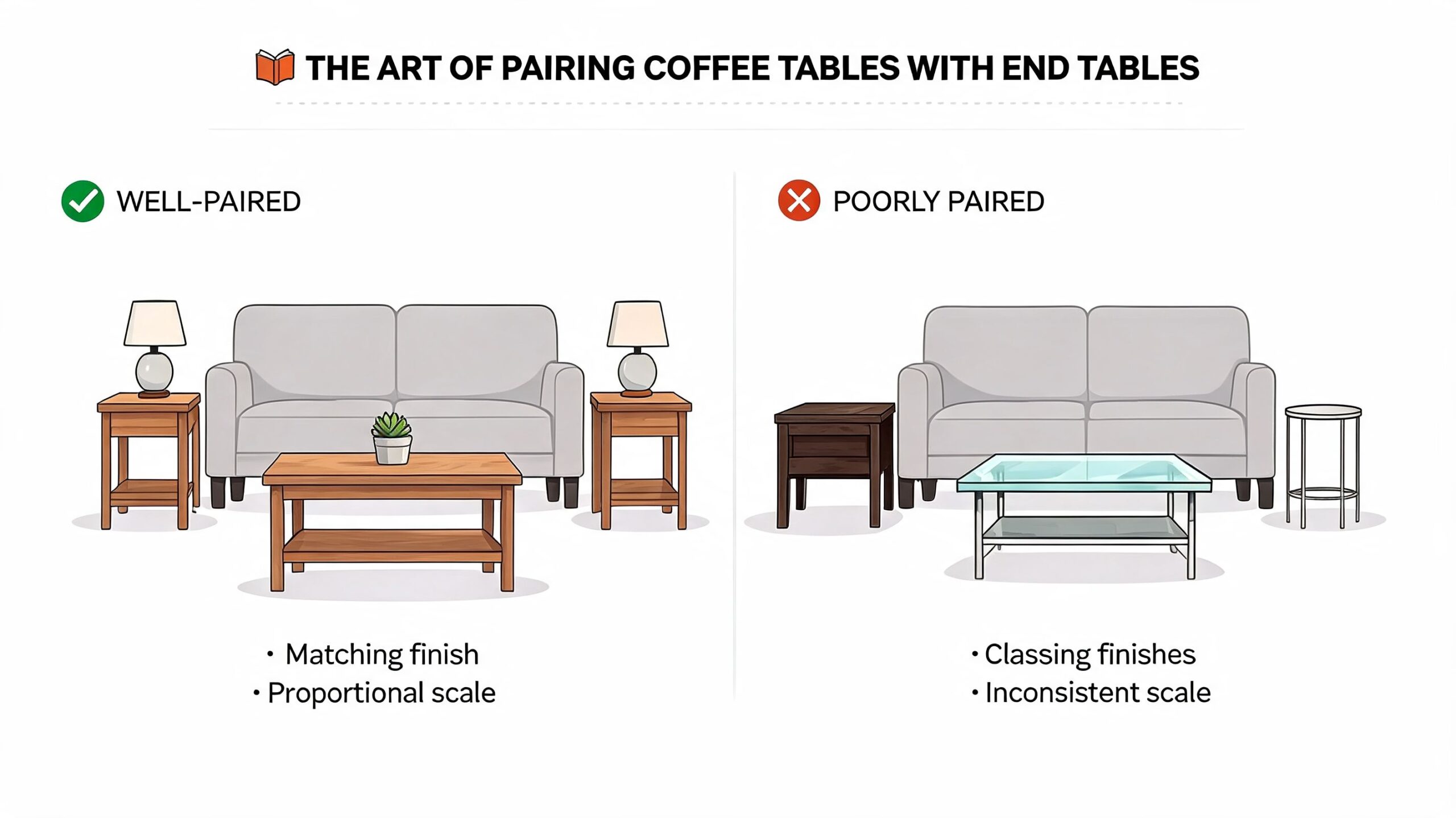
Three pairing approaches that work
Some rooms look best with a full set. Others need a little contrast.
The matching set
This is the easiest route. Same finish, same family of shapes, same design intent. It works especially well when you want a calm room without a lot of visual decisions.The coordinated mix
This is my favorite for many homes. Keep one element consistent, like wood tone or metal finish, then vary shape or silhouette. For example, a rectangular coffee table in wood can pair with smaller round end tables in a similar finish.The collected look
This works when you want the room to feel layered and personal. The pieces don’t match, but they connect through scale, tone, or style. A simple coffee table can pair with more decorative end tables if the heights and proportions still make sense.
What multi-generational homes often need
Households with more than one generation under one roof usually put tables through more daily use. Corners get bumped. Surfaces collect more items. Furniture has to serve more people at once.
A 2025 Houzz report says 68% of multi-generational households prioritize "intergenerational-proof" furniture, and paired sets with scratch-resistant finishes and adaptable heights are especially important, according to the provided Houzz reference link.
That’s one reason some shoppers look at La-Z-Boy and Rowe tables and upholstery together when planning a room. The tables don’t have to be ornate. They need to be sturdy, easy to live with, and visually connected to the seating.
If several people use the room differently, pairing becomes less about matching and more about making every seat functional.
A simple way to judge a pairing
Stand back and check these three things:
- Height relationship: Do the end tables sit comfortably beside the seating?
- Material relationship: Do the finishes feel intentional together?
- Shape relationship: Does the mix create balance instead of clutter?
If all three feel right, the room will usually read as finished, even if the pieces didn’t come as a set.
Why the In-Store Experience Matters for Your Home
Tables are one of those categories that look easy online. Then the box arrives, and the color is off, the top feels flimsy, or the height is just wrong next to your sofa. That’s the problem with buying from a screen alone. You can measure dimensions, but you still can’t fully judge proportion, finish, or feel until the piece is in front of you.

The Sit-Test applies to tables too
People usually think of the Sit-Test as something for sofas and recliners. It matters for tables too. You need to see a coffee table in front of seating. You need to stand beside an end table and feel whether the height is natural for your hand.
That’s hard to judge from product photos.
When you shop in person, you can do a few things immediately:
- Check true color: wood tone, paint finish, and metal finish often read differently in person
- Feel surface texture: smooth, distressed, glossy, matte, or lightly grained all create different impressions
- Test stability: a table should feel solid when you touch it
- Compare sizes fast: what looks oversized online may look exactly right next to a sectional
Why immediate availability matters
If you’ve just moved, set up a second home, or want to finish the room this weekend, waiting can be the most frustrating part of furniture shopping. That’s why in-stock availability matters so much for occasional tables. They’re often the final pieces that make the room usable.
At Stahl Home Center, shoppers can compare coffee table and end tables in an 88,000+ sq. ft. showroom, see options next to upholstery, and choose from thousands of pieces that are In-Stock Today for pickup or scheduled professional delivery. The store is also Indiana’s Largest La-Z-Boy Dealer, which matters for shoppers trying to coordinate tables with recliners, sofas, and sectionals in one trip.
For first-time buyers who want to avoid common mistakes, this guide to the dos and don’ts of furniture shopping is worth reading before heading out.
Buying in person removes guesswork. You stop imagining how the table might work and start seeing how it actually works.
That’s especially helpful for new homeowners and relocators trying to furnish a whole living room without making return-worthy mistakes.
Design Your Way and Protect Your Purchase
Some shoppers want something they can take home now. Others know the exact look they want and don’t mind ordering it. Both approaches are valid. The key is knowing which one fits your timeline and your room.
When custom makes sense
If you’ve already found the right scale and shape but want a more specific finish, fabric pairing, or overall look, custom options can be worth it. For style-focused decorators seeking a more customized result, Rowe Furniture often enters the conversation.
The Design Your Way approach is useful when:
- Your palette is specific: You’re trying to coordinate with existing rugs, art, or case goods.
- Your household is active: Performance fabrics and practical finishes matter.
- Your layout is unusual: A standard floor grouping may not solve the room cleanly.
Custom also helps quality seekers who want a room to feel deliberate instead of pieced together in a rush.
Simple care tips that help tables last
Once your coffee table and end tables are home, a few habits go a long way.
- Use coasters and trays: They help contain moisture and everyday wear.
- Lift instead of drag: Moving a table by sliding it can stress joints and legs.
- Dust with soft cloths: Grit can act like sandpaper on some finishes.
- Clean spills quickly: Fast cleanup is usually kinder to wood, glass, and stone surfaces.
If you’re bringing home wood tables, this guide to protecting wood furniture from scratches and stains covers the basics well.
The right tables should do two jobs
They should make the room look finished, and they should make daily life easier.
If a table is the right height, right scale, and right material for your home, you’ll notice it in small ways. Drinks have a place to land. Lamps sit where they belong. The room feels complete instead of almost done. That’s the standard worth aiming for.
If you’re ready to compare styles in person, test heights beside real seating, and see finishes with your own eyes, visit Stahl Home Center today. Our Westside Bloomington showroom gives you access to a massive selection, including living room furniture Bloomington shoppers can take home now, plus custom options from La-Z-Boy Indiana and Rowe Furniture for those who want a more personalized style.