
Sectional with Reversible Chaise: The Ultimate Buying Guide


More than one-third of buyers consider a sectional for the extra lounging space a chaise provides. A reversible chaise makes that investment more future-proof because the extended lounge can move with the room instead of locking the household into one layout.
A homeowner may be moving into a new place, shifting the television to another wall, accommodating a new doorway, or just trying to make a living room work better for everyday traffic. A fixed chaise can look perfect in the showroom and become awkward at home. A sectional with reversible chaise offers the seating capacity of a sectional with the option to change the lounge side when the room or household changes.
That distinction matters because sectionals represented 27.3% of the worldwide sofa market in 2024, and another market estimate placed them at 28.76% in 2025, meaning the category consistently accounts for more than one-quarter of sofa demand. The format isn't a niche choice. The practical question is whether a particular reversible design delivers useful flexibility, comfortable support, manageable movement, and repairable construction.
Understanding the Reversible Chaise Advantage
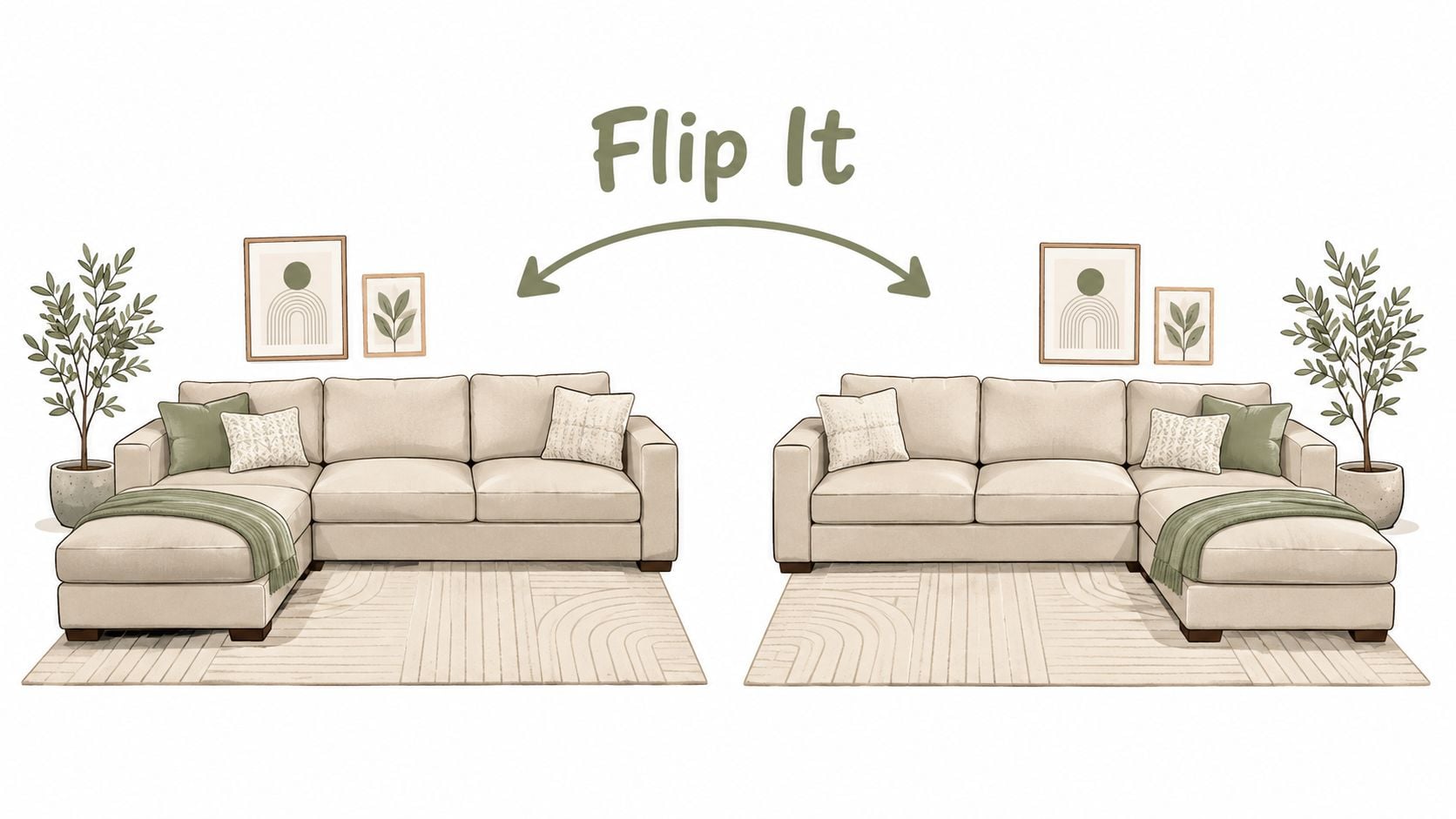
Most product pages lead with “left-facing” or “right-facing.” Those labels describe the showroom arrangement, but they don't fully describe how the furniture will serve a household over time. A fixed chaise is built into one side of the sectional. A reversible chaise system allows the extended lounge portion to detach and reconnect on the opposite side, provided the frame, connectors, and cushions are designed for that change.
The difference becomes clearer through a Good-Better-Best lens:
- Good: A fixed chaise can suit a room with a stable layout and a clear open side.
- Better: A reversible chaise provides a second orientation for households that may rearrange furniture or move.
- Best: An adaptable system combines reversible hardware, comfortable seating, accessible replacement parts, and a frame that can be moved without excessive labor.
The practical meaning of “reversible” deserves more attention than it usually receives. Some systems can be switched with straightforward connector adjustments. Others require tools, a particular sequence, or a different bracket position. The frame may be theoretically reversible while remaining too heavy or awkward for frequent changes. Buyers should ask whether the chaise can be moved without tools, whether the connectors relocate cleanly, and whether the cushions align correctly after the switch. Stahl's guide to what a chaise sectional is helps establish the difference between a chaise arrangement and a standard sectional before a shopper evaluates specific mechanisms.
Flexibility has a practical limit
A reversible chaise can help a growing family open a walkway, help empty nesters adapt after downsizing, or let a relocating professional fit furniture into a new floor plan. It can also protect a second-home or rental furnishing from becoming unusable after a room change. However, switching sides takes time, lifting, floor protection, and careful reassembly.
Practical rule: A chaise is only as flexible as the household's willingness to move it.
The strongest purchase isn't necessarily the model with the most possible layouts. It's the one whose conversion process is clear, whose hardware feels secure, and whose weight and component design make the alternative layout realistic. A fixed configuration may be the better choice when the room has one permanent arrangement and the household values simplicity over adaptability.
Planning for Space and Circulation
A sectional with reversible chaise can fit the room and still make daily movement awkward. The front outline tells only part of the story. Allow for the full depth, chaise extension, back cushions, arm width, coffee table, and the walking lanes that connect the sofa to doors, windows, and other furniture. A room should remain usable after the sectional arrives, not merely accommodate its footprint on paper.
A commonly cited standard sofa footprint is 96 inches by 38 inches, or about 28 square feet. In an average U.S. apartment living room measuring approximately 16 feet by 12 feet, or 192 square feet, that footprint uses nearly 15% of the floor area before adding a coffee table, chairs, media furniture, or circulation (sofa size and furniture planning guidance). A chaise extends the footprint in one direction, so wall length alone cannot confirm a good fit.
Protect the walking lanes
Plan for approximately 30 to 36 inches of clear walking space around the main seating arrangement. A narrower passage may suit occasional movement, while a route to the kitchen, bedroom, or exterior door needs more room. A reversible chaise can preserve that route, but only if the alternative side leaves enough clearance.
Review the layout with four practical questions:
- Where does daily traffic move? The chaise should not force people to squeeze between the sofa and a wall.
- Which side has fixed obstacles? A heat register, door swing, window treatment, or floor vent may rule out one orientation.
- Where will the coffee table go? Leave room to reach it and sit comfortably, rather than placing it wherever a gap remains.
- Does the television remain usable? A projecting chaise can obstruct the viewing path or make one seat less practical.
Use sectional sofa layout ideas to compare the chaise with walls, openings, and nearby furnishings. The strongest arrangement keeps movement natural instead of making every trip around the room depend on the sofa.
Check the conversion before ordering
A reversible chaise offers more than a left-facing or right-facing choice. Ask how the components move through the home, whether the sections separate for narrow doors or stairways, and where the connectors and brackets are stored during a switch. Measure the route from delivery entrance to living room. A sectional that fits the finished room may still be difficult to turn through a hallway.
Hardware deserves a hands-on check. Connectors should align without forcing the frame, fasteners should feel secure after reassembly, and the support points should not shift when someone sits near the join. Ask whether screws need periodic tightening and whether replacement hardware is available. Keep the instructions and spare pieces with the furniture records.
Before ordering, outline both orientations with painter's tape. Test the door swings, main walkway, coffee table position, cleaning access, and television sightline in each version. Then consider the next few years: a layout may need to change after a move, a room conversion, or a new piece of furniture. Choose the sectional whose parts can realistically be lifted, protected, and reconnected when that change arrives.
Selecting Comfort and Upholstery
Comfort depends on the relationship between the sitter's body and the frame. A large sectional isn't automatically comfortable, and a deep chaise isn't automatically supportive. Buyers should sit fully back, place both feet on the floor where possible, and evaluate whether the knees, lower back, and shoulders feel supported.
Typical sectional seat depth is approximately 20 to 24 inches, while common seat height is about 17 to 19 inches (sofa dimensions and ergonomic guidance). Depth near 20 to 22 inches generally supports more upright conversation. Deeper 23 to 25-inch seating favors sprawling and lounging, but shorter users may lose back contact or feel pressure behind the knees.
Compare the sitting positions
A household should test more than the chaise. The corner seat, inside seat, and outer seat can each feel different because of cushion shape, arm position, and back angle. Older adults and multi-generational households may appreciate a seat toward the upper end of the height range because standing can require less effort, but excessive height can leave feet unsupported.
Upholstery deserves the same direct testing. Performance fabrics can make sense in busy households, homes with pets, rental properties, and frequently used second spaces. Standard upholstery may suit a lower-use room or a shopper who prioritizes a particular texture and appearance. The right choice depends on cleaning instructions, fabric testing information, cushion construction, and how much daily wear the chaise will receive. Stahl's sectional sofa fabric guidance gives shoppers a useful starting point for comparing those considerations.
The reversible mechanism also needs inspection. A buyer should ask:
- Connector design: Does the chaise lock firmly, and can the hardware be relocated without specialized tools?
- Cushion alignment: Do the seat and back cushions remain correctly positioned after the configuration changes?
- Maintenance access: Can covers, clips, or individual cushions be replaced if one area wears first?
- Floor protection: Will repeated movement require furniture pads or another protective method?
For a large move or a room rearrangement, heavy moving blankets can protect flooring and upholstery while components are separated and repositioned. A practical resource on heavy duty blankets from Gentle Giant Removals explains why dense protective coverings matter during furniture handling.
Take-home today or customize slowly
Two buying paths can work well. In-stock furniture suits a new homeowner furnishing several rooms, a relocator working on a compressed schedule, or a household that needs a sectional without waiting for a custom production cycle. Custom ordering makes more sense when the room requires a particular orientation, fabric, finish, or comfort configuration.
Stahl's “Design Your Way” program includes hundreds of fabric and leather choices and configuration-related options such as manual or power controls, adjustable lumbar support, swivel bases, and wood finishes for applicable furniture (custom sectional and sofa options). The sensible decision is not just speed versus luxury. It is whether the available piece already satisfies the room's measurements and comfort needs, or whether the household has a specific design requirement worth waiting for.
Measuring Your Space for a Perfect Fit
A sectional may fit the room and still fail before it reaches the sofa wall. It can catch at the front door, stall on a stair turn, block a vent, or leave the main walkway too narrow. Measure the room, the furniture, and the route between them before ordering.
Record the complete furniture profile
Write down the candidate's:
- Overall width, including arms and end pieces.
- Overall depth, including the chaise extension.
- Overall height, particularly if windows, shelving, or artwork sit behind it.
- Seat height, which affects comfort and ease of standing.
- Diagonal depth, which shows whether the frame can clear a narrow doorway, hallway, or stair turn.
Diagonal depth is easy to miss. A piece with a reasonable straight-line width may still fail when it must tilt around a tight corner. Check every doorway, hallway, stairwell, landing, elevator, and turn on the delivery route. Stahl's furniture measuring guide offers a practical framework for recording these dimensions before purchase.
Use painter's tape on the actual floor
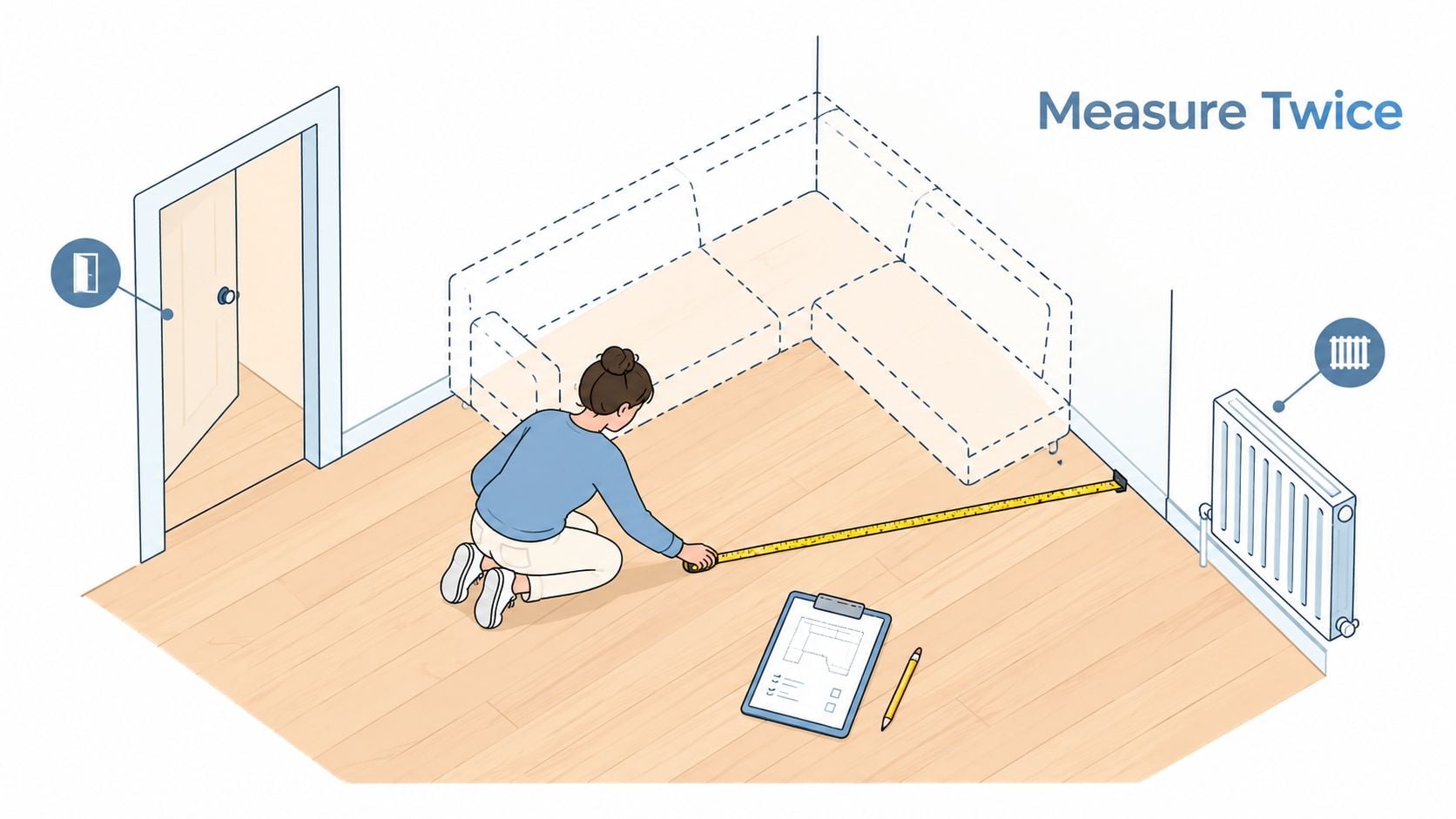
Measurements alone do not show how the room will feel. Mark the full footprint with painter's tape, including the chaise, arms, and any space needed for reclining or access. Then make a second outline with the chaise reversed.
Include:
- Door swings, especially doors opening into the living area.
- Windows and vents, which a tall back or deep chaise may obstruct.
- Traffic lanes, including routes used throughout the day.
- Coffee table clearance, with roughly 18 inches between the sectional and table for access and legroom (sectional arrangement guidance).
- Ordinary circulation, with at least 30 inches, and about 36 inches on a high-traffic route.
Leave the tape down while people walk around the layout, open nearby doors, and use the room normally. A reversible chaise offers long-term flexibility only when both orientations leave the space usable.
Before delivery, confirm how the chaise connects to the sectional. If the orientation may change later, ask whether the connector hardware is accessible, whether pieces can be moved without specialist help, and whether the fittings should be checked after repeated changes. That information matters as much as the left-or-right arrangement.
Check the route before checking out
A showroom fit does not guarantee an in-home installation. Measure the narrowest doorway against the largest component, then check diagonal clearance at every turn. Separate pieces still need a clear route from the delivery vehicle to the final room.
This check matters for apartment residents, relocators, right-sizers, and buyers arranging immediate pickup. A sectional that fits the living room but cannot clear the stairwell is not a successful purchase.
Shopping at Stahl Home Center
A sectional can feel comfortable in a showroom and still create problems at home if the chaise connection is awkward to reach or the pieces cannot be moved through the entry route. Online dimensions narrow the choices, but they cannot show how the cushions support your back, how upholstery changes under showroom lighting, or how much effort it takes to reverse the chaise after a room change.
Stahl Home Center has been family-owned since 1967 and operates an 88,000-square-foot showroom in Bloomington (company history and showroom information). The space lets local shoppers compare sectional proportions, seat heights, upholstery, recliners, and related furnishings in person. A showroom visit also gives you a chance to ask practical questions about delivery, pickup, connector access, and future reconfiguration.
Test the sectional beyond a quick sit
Spend enough time in each position to expose trade-offs. Sit in the corner, stretch out on the chaise, try the upright seats, and stand up several times. Check these points:
- Back support: Does the back cushion support both your shoulders and lower back?
- Seat depth: Can shorter users sit upright without sliding forward?
- Chaise comfort: Does the lounge position support the legs without forcing an uncomfortable angle?
- Fabric feel: Does the upholstery feel suitable for the household's normal use, whether that means softness, texture, or resistance to slipping?
- Configuration quality: Do the pieces meet cleanly, and does the reversible connection feel secure?
Then inspect the practical movement details. Ask whether one person can separate the pieces, whether the connector hardware is reachable without turning the sectional over, and whether fittings should be checked after repeated changes. A reversible chaise provides more than a left-facing or right-facing choice. It can help when furniture must be moved for cleaning, a gathering, a repair, or a later room redesign. That flexibility is useful only when the hardware remains accessible and the pieces can be handled safely.
Physical comparison matters for multi-generational households, quality-conscious buyers, decorators, and anyone who needs to judge the true upholstery color rather than a screen approximation. It can also clarify whether a sectional should anchor the room or whether separate pieces would leave more options later.
Choose the buying path that fits the project
Stahl is Indiana's Largest La-Z-Boy Dealer, with branded seating and sectional options available alongside Rowe Furniture for custom style and performance. The showroom uses a Good-Better-Best philosophy, allowing shoppers to compare construction, upholstery, comfort features, and budget without assuming every household needs the same specification (official promotional information).
The immediate option centers on thousands of in-stock pieces, with thousands available for same-day pickup or delivery according to the company (Stahl in-stock furniture information). This suits a household furnishing a new home, a relocator working around a move, or a buyer who wants to take a sectional home today. The wider selection includes recliners in stock, power recliners, lift chairs, bedroom sets, mattresses, and living room furniture Bloomington shoppers can evaluate in one visit.
The custom option supports hundreds of fabric and configuration choices for a specific room, appearance, or performance need. Review custom sectional configurations after confirming measurements, walking routes, preferred comfort, and how often the chaise may need to change sides. Customization should solve a room and usage problem, not just add color choices.
A local furniture store Bloomington IN shoppers can visit offers a practical advantage when scale, touch, and movement affect the decision. Measure the room, tape both chaise orientations, test the seating, inspect the hardware, and choose In-Stock Today or a custom configuration according to the household's priorities.
Visit Stahl Home Center to compare sectionals with reversible chaise options and other home furnishings in the Bloomington showroom. Test comfort in person, ask about take-home-today inventory, and confirm scheduled delivery arrangements before checkout.