
Choosing Sectional Sofa Fabric: A Practical Buyer’s Guide


A couple can spend an hour choosing a sectional's shape and still make the wrong decision in the final five minutes, when they accept the fabric without asking how it will handle daily life. The color looks perfect under showroom lighting, the chaise fits the room, and the cushions feel comfortable. Then the sectional meets muddy paws, snack crumbs, denim rivets, moving boxes, or a child who treats the armrest like a climbing wall.
Sectional sofa fabric deserves more attention than a quick swatch comparison. Fabric affects comfort, visible wear, cleanability, snagging, color stability, and how confidently the piece will fit the household several years from now. A beautiful silhouette matters, but the upholstery is what everyone touches, sits on, and sees every day.
The practical approach is simple. Match the material to the people, pets, habits, and expectations surrounding the sofa. Then decide whether an In-Stock Today sectional solves the immediate need or whether Design Your Way custom ordering makes more sense. That choice turns fabric shopping from guesswork into a purchase that feels right in the living room, not just under showroom lights.
The Moment You Realize the Fabric Matters Most
A couple walks into a furniture showroom and circles the same sectional twice. One person likes the soft chenille swatch. The other keeps returning to a looped boucle, running a hand across the surface and wondering whether the texture will still look good after a year of real use. Nearby, gray appears blue under one light and warm under another, while every upgraded fabric seems to move the price in a different direction.
That moment feels familiar because upholstery decisions combine too many variables at once. Color changes with daylight and lamps. Texture changes how large or casual the sectional feels. A smooth surface may show every mark, while a patterned weave can disguise daily mess. The question sits underneath all of it: who lives on this couch?
A formal sitting room has different demands from a family room. A relocating professional furnishing a new home may value immediate availability more than an unusually specific textile. A rental owner may need easy care and broad appeal. A household with pets and toddlers needs a fabric that tolerates contact, spills, and repeated cleaning without becoming a constant source of worry.
The upholstery decision outlasts the trend
Frames, cushion styles, and sectional silhouettes matter, but fabric remains the most exposed part of the furniture. It also controls the first physical impression. A fabric can feel cool, brushed, nubby, dense, soft, or slick before anyone notices the frame construction beneath it.
Practical rule: Choose the sectional's fabric for the household first, then choose the color and silhouette that satisfy the room.
That order prevents a common showroom mistake. Shoppers fall in love with an elegant shape, then force a delicate textile into a high-traffic room because the combination looks attractive on the floor. A better process starts with household habits, evaluates realistic fabric families, and only then narrows the visual choices.
For Bloomington homeowners, a physical visit also solves problems online images can't. At Stahl Home Center, the 88,000-square-foot showroom provides room to compare sectional shapes, upholstery textures, custom sofas, power recliners, and other living room pieces in person. Payoff comes from matching the fabric to the way the sectional will be used before falling in love with a silhouette.
The Four Fabric Families Every Shopper Should Know
Most sectional upholstery choices become easier once shoppers sort them into four practical families. Each family has a clear personality, a sensible use case, and a tradeoff that deserves attention.
Performance fabrics are engineered or tightly constructed to manage everyday spills, wear, and heavier traffic. They suit busy households, rentals, and family rooms where cleanup matters as much as appearance. The tradeoff is that “performance” describes a category, not one identical feel. Some fabrics feel smooth and refined, while others have a soft, textured hand.
Leather and leather-match offer a cleanable surface and a distinctive aging pattern. Genuine leather can soften and develop character, while scratches may remain visible rather than disappearing. Leather-match can provide a coordinated appearance at a different price tier, but shoppers should understand which surfaces are genuine leather and which are matched upholstery before ordering.
Microfiber and microsuede rely on dense, fine fibers and tight construction. They feel soft, resist many everyday spills, and often deliver practical value for households that want comfort without a highly formal look. Their honest weakness is appearance variation. Nap direction, handprints, and shading can show across the surface, especially in certain colors.
Blended naturals combine fibers such as cotton, linen, or wool with other materials to create breathability, texture, and a relaxed appearance. They appeal to design-first buyers who want a less synthetic feel. The tradeoff is lower stain forgiveness and greater sensitivity to moisture, friction, and careless cleaning.
For a broader explanation of upholstery materials, shoppers can review Stahl's upholstery materials guide, then ask the showroom team how a specific fabric behaves on the exact sectional being considered.
Sectional Fabric Families at a Glance
| Fabric Family | Best For | Key Strength | Main Tradeoff |
|---|---|---|---|
| Performance fabric | Busy homes, rentals, frequent entertaining | Easier everyday care and strong practical wear resistance | Hand-feel and treatment vary by fabric |
| Leather or leather-match | Design-focused rooms and easy wipe-downs | Distinctive appearance and surface cleanability | Scratches and temperature changes remain visible |
| Microfiber or microsuede | Families seeking soft, practical value | Dense surface and comfortable hand | Nap marks and shading can show |
| Blended naturals | Texture-led interiors and relaxed rooms | Breathability and visual depth | Less forgiving of spills and rough use |
The quick rule is straightforward. Pets and kids usually point toward performance fabric or microfiber, while design-first buyers often prefer leather or blended textiles. A Stahl shopper can also choose between thousands of pieces ready to take home today and a custom path offering hundreds of fabrics and configurations.
Reading the Numbers Behind Fabric Durability
Fabric specifications help, but shoppers need to read them in the right order. The most useful first figure is abrasion resistance, measured through either Wyzenbeek double rubs in much of North America or Martindale cycles in many international markets. The two systems aren't interchangeable, so a showroom label should identify which test produced the number.
Industry guidance places 15,000 double rubs or about 20,000 Martindale cycles around general residential or contract-level use, while 30,000 or more double rubs or about 40,000 Martindale cycles points toward heavy-duty use, according to the ACT abrasion testing guidance. Higher counts generally indicate slower visible wear from repeated seated friction, which makes them more relevant for a family room than for a rarely used formal room.

Abrasion isn't the same as appearance retention
Pilling resistance measures surface fuzzing and pill formation separately from abrasion. The Martindale pilling test uses a 1-to-5 scale, with Grade 5 meaning no change and Grade 1 meaning severe pilling, and observations commonly occur at 500, 1,000, 2,000, and 5,000 rubs, as outlined in these fabric specification guidelines.
A fabric can withstand repeated friction yet develop unattractive pills from clothing and skin contact. For a smooth, light-colored sectional, Grade 4 or 5 is the sensible target. The specification sheet should also be checked for seam slippage, light colorfastness, and Crocking ratings, which indicate the risk of dye transferring through rubbing.
Laboratory tests can't reproduce every living room habit. They don't show exactly how a large dog lands on a cushion, how a child drags a rough toy across an arm, or how a family sits in the same favorite spot every evening. Construction still matters, so shoppers comparing seams can also consult these durable upholstery stitching tips for useful terminology.
A kid-and-pet household should prioritize the heavy-duty abrasion range, strong pilling performance, and a tight, stable weave. A formal sitting room can accept a lighter specification if the fabric's texture and color are the priority. The right number supports the decision, but it never replaces touch, construction, and honest household planning.
Pet and Kid Friendly Fabrics Worth Considering
Pet- and kid-friendly upholstery isn't one material. It's a balancing act between stain resistance, surface texture, claw tolerance, comfort, and how much visual disorder the fabric conceals.
Tight-woven performance fabrics are the strongest all-around starting point for active homes. They give liquids less opportunity to penetrate quickly and reduce snagging compared with open, looped constructions. Solution-dyed polyester and olefin options can also make sense where color stability and practical care matter, though the exact performance depends on the fabric specification.
Microfiber and microsuede work well for households that prioritize a soft hand and easy hair removal. Their dense surface doesn't offer many loose loops for claws to catch, but nap direction can create visible shading. Leather, especially a distressed or pull-up finish, can be a practical choice for homes that accept scratches as part of the material's developing character.
Pet and Kid Friendly Fabrics Side by Side
| Fabric Type | Stain Resistance | Claw/Scratch Tolerance | Texture & Comfort | Best Fit |
|---|---|---|---|---|
| Tight-woven performance fabric | Strong practical resistance, depending on finish and construction | Generally good when the weave has few loose loops | Ranges from smooth to softly textured | Busy family rooms and rentals |
| Solution-dyed polyester or olefin | Useful for everyday spills and color stability | Good when tightly woven | Comfortable, with varied hand-feel | High-use rooms needing practical value |
| Distressed or pull-up leather | Wipes clean, but marks can remain | Scratches become part of the visible character | Cool at first, then warmer with use | Households comfortable with patina |
| Tightly woven microfiber | Good for many surface spills and hair removal | Better than loose-loop textures | Soft and suede-like | Families wanting comfort and easy routine care |
| Loose linen or high-loop boucle | Less forgiving of spills or trapped debris | More vulnerable to pulling and snagging | Textural and visually distinctive | Lower-contact, design-led rooms |
Households with one calm, older cat can often choose microfiber, dense performance fabric, or a forgiving leather finish. A home with several large dogs and toddlers should move toward a tight performance weave or microfiber and avoid loosely woven linen and pronounced boucle loops. Those textures may look wonderful in a showroom, but claws can pull them and debris can settle into their structure.
Shoppers can use Stahl's pet-friendly sofa fabric resource to narrow the conversation before testing specific swatches. The key is not finding a magically indestructible textile. It's choosing a surface that fits the household's actual level of chaos.
The Hidden Tradeoffs Behind Performance Fabric
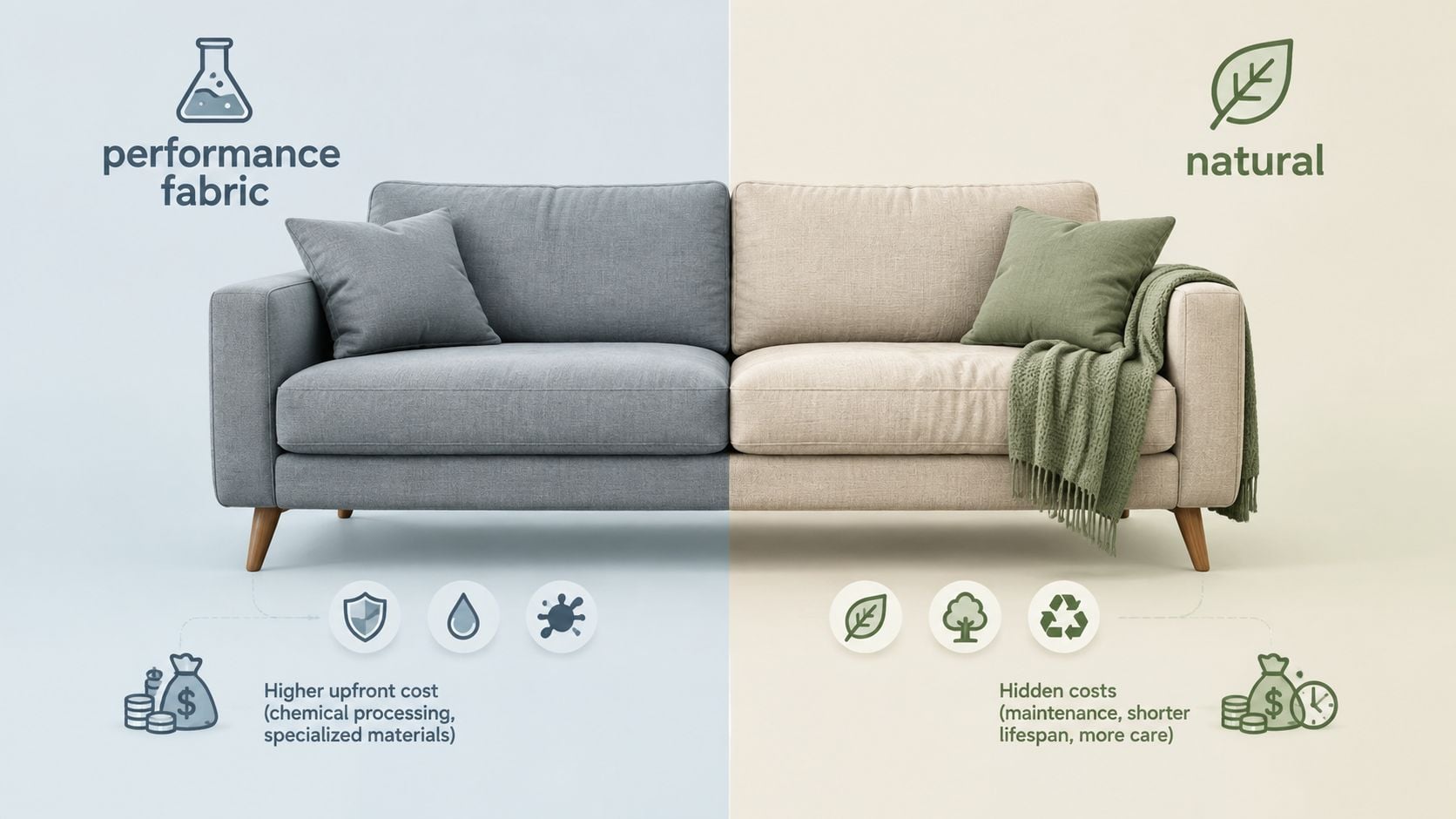
“Performance fabric” shouldn't end the fabric conversation. It describes a desired result, but shoppers still need to ask how the textile achieves stain resistance and whether that treatment fits the household's priorities.
A peer-reviewed study summarized in this performance-fabric guidance found that PFAS finishes improved oil-stain ratings only modestly under ideal conditions. Water-based stains were minimal and easily removed on finished and unfinished fabrics alike. After abrasion or delayed cleaning, PFAS-treated upholstery could perform similarly to, or worse than, untreated fabric.
That finding matters because sectional owners rarely create ideal test conditions. Spills sit while someone gets a towel. A cushion receives repeated friction. A pet tracks outdoor residue onto the same chaise. A treatment that looks impressive in a demonstration may not answer every real-world cleaning problem.
Ask what the fabric is treated with
Some brands have eliminated PFAS and are also avoiding halogenated flame retardants except where code requires them, while PFAS have been common in stain-repellent upholstery for years and policy changes continued into 2025, according to the performance-fabric safety guidance. Buyers who care about chemical exposure should ask for the fabric's treatment information rather than assuming a premium label answers the question.
The better question isn't, “Is this performance fabric?” It's “What is it treated with, how should it be cleaned, and does that tradeoff suit this living room?” A PFAS-free textile may have a different hand-feel, breathability, or stain-response window. A natural blend may reduce reliance on treatments but demand faster cleanup and more careful maintenance.
Stahl's team can help shoppers compare an in-stock sectional with custom fabric options, but the treatment details should be confirmed before an order is placed. Performance is useful. Transparency is better.
How to Test Fabric in the Showroom Before You Buy
A swatch should be handled like a small piece of evidence, not admired from a distance. The right showroom routine takes only a few minutes and reveals more than a product photograph.
Start with the weave. Hold the sample toward light and look for open gaps, uneven density, or loose loops. Run a palm across the surface, then make a gentle fingernail pass across an inconspicuous area. A snag-prone texture deserves extra caution in a home with pets, children, or rough clothing.

Use the whole room test
Ask for a larger cutting when color or pattern is important. A small sample may hide pattern direction, nap variation, and how the textile reads across a broad chaise. If the store allows it, place the cutting at home and view it through morning light, afternoon light, and evening lamps over a day or two.
The sit-test is essential. Sit on the actual floor model for several minutes, not just the edge of the cushion. Check whether the fabric feels hot or cool, whether clothing slides, and whether the texture remains comfortable against bare skin.
Showroom habit: The fabric should feel acceptable after several minutes of sitting, not merely attractive after several seconds of touching.
Before ordering, shoppers should ask about:
- Color variation: Could the dye lot differ between the showroom swatch and the finished sectional?
- Pattern direction: Will the print run railroaded or up the roll?
- Seam placement: Where will seams land on patterned or directional cloth?
- Cleaning code: Which water-based or solvent-based method is approved?
- Cushion details: Are covers removable, reversible, or fixed?
Those asking for a specific layout can review Stahl's custom sectional design options. For shoppers sourcing material for pillows or accent projects, a separate guide to how to find cheap cotton fabric by yard can also clarify fabric quantities and terminology, though sofa upholstery still requires confirmation from the furniture manufacturer.
Keeping Your Sectional Looking New Year After Year
Fabric choice only pays off when the maintenance routine matches the material. A performance weave, leather surface, microfiber nap, and natural blend shouldn't receive the same cleaner, brush, or amount of moisture.
Weekly care should stay simple. Vacuum crumbs and pet hair with an upholstery attachment, preferably a soft brush that won't crush the pile. Use a lint roller on microfiber when needed, and brush textured fabrics in the direction recommended by the manufacturer. Rotate or reverse removable cushions according to their construction so one favorite seat doesn't absorb all the wear.
Fabric Maintenance Schedule by Material Type
| Fabric Type | Weekly Care | Monthly Care | Annual Care | Avoid |
|---|---|---|---|---|
| Performance weave | Vacuum with upholstery attachment; blot fresh spills | Spot-clean with approved water-based cleaner | Review professional cleaning needs and fabric instructions | Over-wetting and high heat |
| Leather | Dust with a soft cloth; remove surface debris | Wipe with an approved leather cleaner | Condition according to manufacturer guidance | Silicone-based protectants and harsh solvents |
| Microfiber | Vacuum gently; remove hair with a lint roller | Treat spots with approved cleaner and soft brush | Refresh nap and inspect high-contact areas | Excess water and aggressive scrubbing |
| Natural blend | Vacuum with a soft brush | Address marks quickly with minimal moisture | Consider professional cleaning and inspect seams | Unapproved detergents and soaking |
The right products usually include a water-based upholstery cleaner for compatible fabrics, a leather conditioner approved for the finish, a lint roller, clean white cloths, and a soft-bristle brush. Never pour cleaner directly onto a cushion. Apply a small amount to the cloth, blot rather than rub, and let the area dry naturally.
Early pilling calls for gentle removal, not repeated scraping. Dye transfer suggests a colorfastness problem or incompatible clothing contact. Raised seams, waviness, or thread tension changes indicate stress that should be addressed before the damage spreads. For adjacent wood or leather surfaces, readers can consult this practical guide to fixing scratches on wood and leather.
Stahl's performance fabric cleaning guide can help owners confirm the appropriate routine for compatible upholstery. The safest general rule remains consistent: follow the manufacturer's cleaning code, use the least aggressive method that works, and never assume more moisture means better cleaning.
Designing Your Way Through Stahl's Custom Fabric Program
Custom upholstery works best when it follows a defined path. Stahl's Design Your Way program lets shoppers begin with a sectional silhouette, compare partner fabric lines, request swatches, confirm the configuration, and place the order through the showroom team. That process gives style-focused decorators room to build a specific look without turning the decision into an endless pile of samples.
Stahl is Indiana's Largest La-Z-Boy Dealer, which gives shoppers access to a substantial fabric library for La-Z-Boy configurations. Rowe Furniture adds another route for custom style and performance, especially for buyers who want a more custom sectional rather than selecting only from floor inventory.
The custom path needs clear questions
A shopper should bring room measurements, preferred seating orientation, lifestyle details, and a short list of fabric requirements. The showroom team can then help confirm:
- Silhouette and configuration: Which sectional shape, chaise position, cushion style, and scale suit the room?
- Fabric availability: Is the textile part of a standard production offering, or does it require special ordering?
- Material ownership: Is the fabric supplied through the furniture line, or is customer-owned material being considered?
- Yardage and timing: What quantity is required, and what production timeline applies?
- Warranty coverage: Which upholstery concerns are covered, and which maintenance conditions affect coverage?
- Delivery coordination: How will the finished piece move from production to scheduled professional delivery?
In-stock and custom paths serve different needs. A relocator trying to furnish a whole home this weekend may choose a sectional, bedroom sets, mattresses, recliners in stock, or other immediate delivery furniture from the showroom floor. A decorator with a precise color, layout, and performance requirement may accept a longer special-order process in exchange for the exact result. Custom orders, customer-owned material, and special-order textiles can extend timelines, so the showroom team should confirm expectations before the order is finalized.
The program is also useful for quality seekers who think in Good-Better-Best terms. A practical fabric can support a budget-friendly sectional, while upgraded La-Z-Boy or Rowe upholstery can provide a more specific texture, construction, or performance profile. The decision should reflect how long the piece needs to serve the household and how much visual control the buyer wants.

For shoppers who want a guided configuration rather than a floor-model decision, Stahl's custom couch design service provides a concrete starting point. For everyone else, the showroom's large selection and thousands of pieces ready to take home today make the sit-test and fabric comparison possible without waiting for an online image to match reality.
Stahl Home Center offers an 88,000-square-foot showroom, thousands of in-stock pieces ready to take home today, and custom sectional options through La-Z-Boy and Rowe Furniture. Visit Stahl Home Center to test sectional sofa fabric in person, compare comfort and color, and choose between immediate pickup or a guided Design Your Way order.