
Sectional Sofa Types: Which Shape Fits Your Room


A homeowner stands in the middle of an empty living room with a tape measure, a coffee mug on the floor, and a simple question. The room needs enough seats for family movie nights, a place for one person to stretch out, and a clear path to the kitchen. A regular sofa looks too small, while some sectionals in photos look large enough to block a doorway. That's the moment when sectional sofa types stop being a style label and become a practical decision about shape, seat depth, fabric, and whether the largest piece can get into the home.
Sectional Sofa Types at a Glance
Picture that same homeowner taping a rough rectangle on the carpet and wondering whether the turn should go left, right, or around three sides. Sectionals are classified by how their connected pieces arrange seating, not by look alone. The table below gives a quick starting point for comparing the main sectional sofa types.
| Type | Shape and layout | Typical seats | Room it suits |
|---|---|---|---|
| L-shaped | Main sofa run with a shorter return at about 90 degrees | 4-6 | Compact rooms, about 10 by 12 feet |
| U-shaped | Seating along three sides around a central zone | 6-9 | Large family rooms, about 15 by 18 feet or more |
| Modular | Separate pieces that connect straight, L-shaped, U-shaped or chaise | Set by the number of pieces chosen | Rooms that change shape or households that move |
| Chaise sectional | Sofa with an extended chaise section on one end | 4-6 | Smaller living rooms, about 94-118 inches long by 59-69 inches deep |
| Sleeper sectional | Sectional with a pull-out bed in one module | Set by the base shape, plus sleeping space when open | Guest rooms and multipurpose spaces |
| Curved sectional | Gently rounded arc of connected pieces | Set by the number of joined segments | Open-plan rooms with a central focal point |
| Wedge sectional | Angled piece that joins two runs at a corner | Adds one corner position to the joined runs | Tight corners and reading nooks |
What the Table Shows Quickly
An L-shaped sectional turns one corner. A U-shaped sectional wraps around a center and asks for a bigger room. A chaise sectional gives one person extended leg room without adding a full second run of backed seats.
A modular design is different in kind, because it describes construction rather than a fixed outline. Sleeper, curved, and wedge options add a function or a corner solution. Those labels can overlap, so one piece can be modular, L-shaped, and fitted with a sleeper at the same time.
What the Table Can't Tell You
Seat count alone doesn't reveal comfort. A deep corner seat can feel roomy for lounging and awkward for sitting upright with feet on the floor. A compact outline can still arrive as one rigid piece that struggles at a stair turn.
Construction, true room sizing, delivery access, and fabric decide whether the shape that looks right on paper works in daily life. Start with the table to narrow the field, then check those four details before falling for a color or cushion style.
Count usable sitting positions, not just total width. Arms, corners, and a chaise take up floor space without always adding another upright seat.
How Each Sectional Shape Is Built
Start with a sketch from above. Sectional sofa types are organized by how connected pieces arrange seats, and that top-down view reveals where people sit, where legs go, and which routes through the room stay open. The build matters as much as the outline, because the same shape can arrive as one heavy frame or as several pieces that separate at the door.
L-Shaped: One Corner, Two Runs
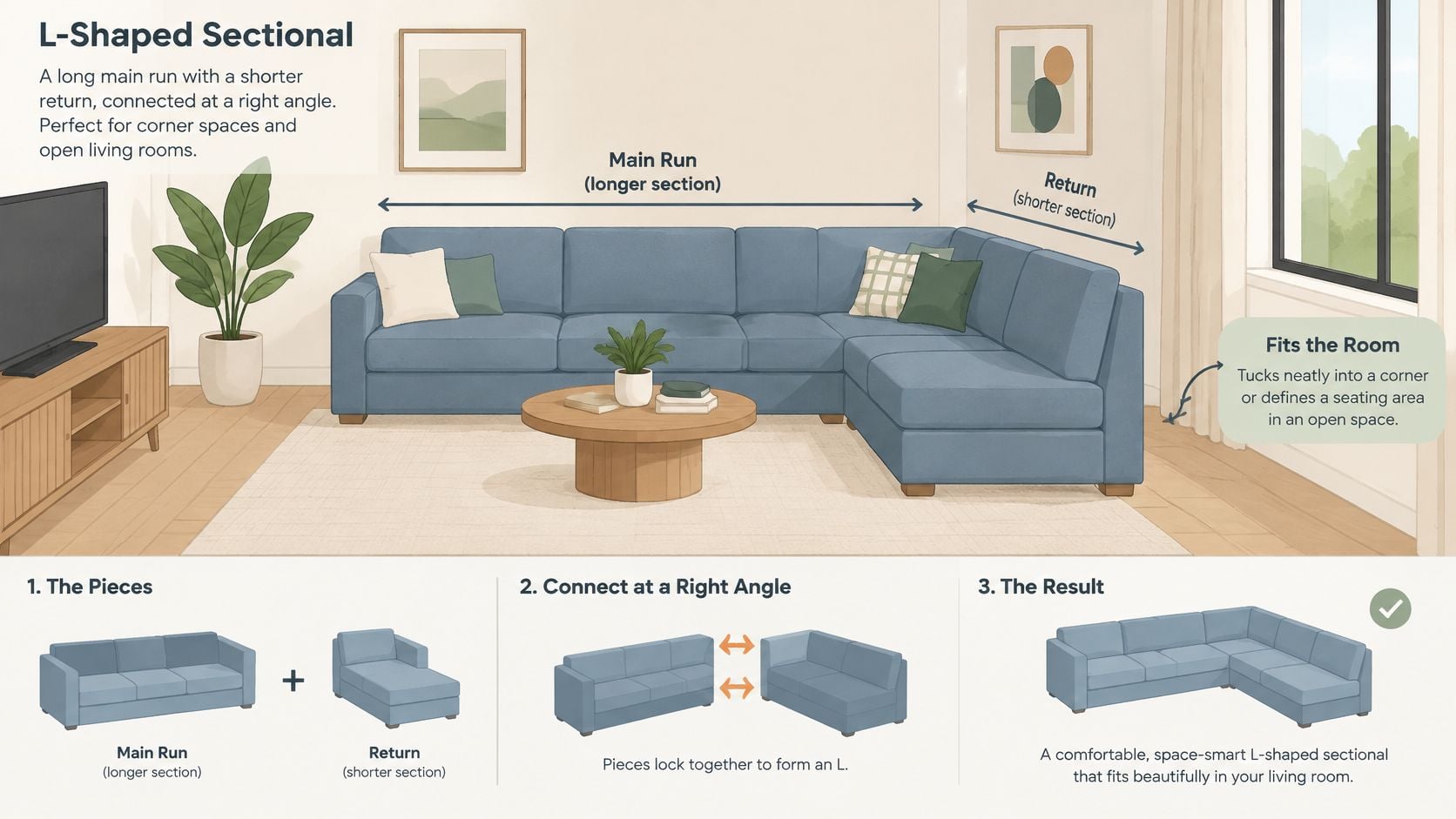
An L-shaped sectional uses a long main run and a shorter return that turns at roughly 90 degrees. The return can carry backed seats for conversation, or it can be a chaise for one person stretching out. That choice changes the build. A backed return is a second sofa joined at the corner, while a chaise return often uses one extended seat platform.
This shape suits rectangular rooms where seating lines a single wall. Suppose a television sits on the long wall and a doorway opens on the right. A left-side return fills the corner and leaves the doorway side clear. Flip it, and the same sofa can sit across the walking route every day.
Orientation labels cause real ordering errors. A buyer who reads the chaise as sitting on the left, while facing the sofa rather than sitting on it, often orders the wrong side. Compare the configuration drawing with the room sketch before confirming. For shoppers comparing flexible builds, a plain explanation of what a modular sectional is helps separate fixed outlines from rearrangeable pieces.
U-Shaped: Three Sides, One Open End
A U-shaped sectional runs seating along three sides and leaves one side open. People face each other more easily, and the center gives a coffee table a clear home. The build usually joins two runs at two corners, so the frame needs more floor area and more clearance at each turn than an L-shape.
That space cost deserves attention. Someone seated in the middle needs a way out without climbing past knees and table corners. Two chaises can form the ends, backed seats can form the sides, or a mix can do both jobs. The component list matters, because two lounging ends do not provide the same upright seating as two backed returns. Delivery also changes: a U-shape that separates into runs can pass a stair turn that a single rigid frame cannot.
Modular: Separate Pieces, Repeatable Joints
Modular sectionals consist of armless seats, corner pieces, end pieces, ottomans, and chaises that connect into straight, L-shaped, U-shaped, or chaise layouts. The arrangement can change when a household moves, grows, or redecorates. The build is the advantage, because each module is a separate box with its own connectors, arms, and finished edges.
Flexibility has a trade-off. Every connector, fixed arm, and corner piece limits where a module can go in the next layout. Draw two arrangements using the exact same pieces, one for the current room and one for a smaller future room. If an arm lands in the middle of the second sketch, that layout is not as flexible as the label suggests. Check the delivery path too: separate modules can clear a narrow hall, but each box still needs a place to land while you assemble.
Three questions narrow the shape before fabric enters the discussion.
- Floor area available. How much room remains after doors, tables, and walking routes are protected?
- Direction seats must face. Do people mainly face a television, each other, a fireplace, or several focal points?
- Likelihood of change. Will the layout stay settled for years, or could a move or room swap change the best outline?
A fixed L or U layout is hard to reorient later. It fits best when the room, focal point, and household routine are stable. Modular construction earns its keep when change is part of the plan, not just a vague someday idea.
Chaise, Sleeper, Curved and Wedge Variants
Specialty pieces change how a sectional gets used, not just how it looks from the doorway. A chaise invites one person to stretch out, a sleeper turns seating into a guest bed, a curve turns seats toward a shared center, and a wedge softens or fills a corner.
The Chaise and Seat Geometry
A chaise is the extended seat that supports the legs along its length. It's useful for reading, watching a game, or putting feet up without a separate ottoman. That depth can become a drawback for shorter users when the back cushion sits too far away and the lumbar area gets no support.
Ergonomic seating guidance starts with usable seat geometry rather than appearance, as explained in an ergonomics and design reference guide. The guide recommends measuring the horizontal distance from the buttocks to the back of the knee and leaving at least 10 mm (0.4 in) of clearance behind the knees. Too little clearance can compress tissues and blood vessels behind the knee. It also warns that a torso-to-thigh angle below 90 degrees increases loading on the spine, back muscles, and thighs.
Those checks turn into a short in-store routine. Shoppers planning this layout can also review how a chaise sectional is arranged before testing orientation in person.
- Measure actual seat depth. Use the distance from the front edge of the seat cushion to the back cushion, not total sofa depth from wall to front.
- Test lumbar support while upright. Sit with feet supported and check whether the lower back touches the cushion without slumping backward.
- Confirm chaise orientation. Match the chaise side against doors, traffic paths, and television sightlines in the room sketch.
Simple sit check. If a shorter person has to perch on the edge to reach the floor, or slump backward to reach the back cushion, that seat depth will feel tiring during an ordinary evening.
Sleeper Sectionals for Guests
A sleeper sectional hides a pull-out bed or another converting surface inside one module. The closed footprint only tells half the story. The open bed needs floor space, a place for the coffee table to move, storage for loose cushions, and a clear route to the door during the night.
Mattress size and support deserve the same attention as seat cushions. An occasional overnight guest may accept a thinner, simpler bed. A guest staying a week, or an adult using the bed often, needs the opened surface tested for support, seams, and usable sleeping length. Bedding storage should be settled before purchase, not after the first visitor arrives.
Curved and Wedge Pieces
A curved sectional follows a gentle arc. Seats turn slightly toward a shared center, which can help conversation in an open-plan room. The curve also changes the gap between seat fronts and a coffee table along its length, and it can leave triangular pockets of unused space behind the arc near a straight wall. Checking reach from middle and end seats keeps the table from serving only one person well.
A wedge is an angled corner piece that joins two runs. It can make a tight corner feel intentional and create a reading nook with angled back support. The trade-off is less freedom to reconfigure, because that angled piece has a specific job.
Mixed-height households usually do best with options. Supportive backs help upright sitters, a movable ottoman lets different people set their own leg support, and modular pieces allow different sitting and reclining positions without forcing everyone into the same deep seat.
Sizing a Sectional for Your Room
Picture the sofa already in the room, not on a showroom floor. A sectional's floor footprint is the space the room must give up. Visual size can mislead, especially when low arms or light fabric make a large piece look smaller. The footprint includes the full outline plus the clearance people need to enter, leave, and walk around the seating.
Room Size Benchmarks
Room dimensions offer a practical way to separate sectional sofa types. A compact L-shaped layout fits rooms near 10 by 12 feet, while a U-shaped arrangement needs around 15 by 18 feet or more. Those ranges are starting points, not rules; a room with a fireplace, a wide traffic lane, or a built-in bookcase may need more breathing room at one end.
A typical sofa-with-chaise sectional measures roughly 94-118 inches long by 59-69 inches deep, with seating for four to six people. U-shaped sectionals are generally larger, around 118-150 inches on each side, and seat approximately six to nine people. Readers working with tighter spaces can compare those figures against small sectional sofa dimensions while sketching.
Those numbers explain a common surprise. A chaise adds depth on only one end, so part of the room stays open. A U-shape adds returns on both ends, so the center can feel enclosed even when total seat count looks attractive.

The Taped Floor Method
Painter's tape turns guesses into something a household can walk through. Leave the outline down through normal routines, including carrying laundry, opening doors, and getting to a favorite chair.
- Measure at floor level. Record room length and width, then note alcoves, vents, radiators, outlets, and built-ins that shrink the usable area.
- Tape the full footprint. Mark both runs of an L-shape or all three sides of a U-shape, including arms and the deepest chaise point.
- Walk the marked area. Check door swings, drawer and cabinet clearance, walkways, and sightlines to the television, fireplace, or window from every regular seat.
- Compare against manufacturer dimensions. Match total length, total depth, and actual seat depth to the tape outline, rather than relying on a single width figure. If the sofa ships in separate modules, measure each module too, since a footprint that seems tight may still work when the pieces arrive one at a time.
Add the coffee table to the tape test. A table that fits neatly on paper can block the only exit from middle seats once people are seated. Place the table, or tape its outline, and ask each regular sitter to stand up and leave without turning sideways.
Open positions belong in the same test. A reclining seat needs space for the footrest and any required wall clearance. A sleeper needs its full bed outline taped before anyone assumes guests will fit comfortably.
Matching Footprint to Room Type
Chaise and compact L-shaped sectionals often work in smaller living rooms because they concentrate extra depth at one end and keep one side open. That open side preserves a natural entrance into the seating area.
U-shaped designs suit large family rooms and open-plan spaces where three-sided seating defines a zone without cutting off the rest of the room. In a smaller room, the same outline can trap the coffee table and make middle seats feel boxed in. The final test is simple: daily movement should still feel easy after the sofa arrives.
Checking the Delivery Path Before You Order
A buyer in a two-story house measured a 36-inch front door and a 110-inch living-room wall, then ordered an L-shaped sectional. The piece cleared the door. It stopped on the stair landing, where the rail and the opposite wall left too little room to pivot the longest section. Fit is a delivery-access problem from the truck or driveway to the final wall. A guide to whether furniture will fit through a door reports online furniture returns averaging about 22.7%, with approximately 58% attributed to size or space mismatches, including items that cannot pass through the doorway.
Walk the Whole Route
Start outside and walk the exact path each piece will travel. Measure narrow points with doors open the way they will be during delivery. A hallway that looks wide on a straight walk can still pinch a sofa at the corner, the way a long board clears a doorway and then catches the jamb when you turn it.
- Entry doors and swing. Record clear opening width, handle clearance, and whether a storm door narrows the turn.
- Hallways and interior turns. Check the tightest corner where a long piece must pivot, not just straight hallway width.
- Stairs or elevators. Measure stair landings, railings, elevator interiors, and the diagonal space available for tilting a piece.
- Ceiling height along the route. Watch low beams, sloped ceilings, light fixtures, and bulkheads over stairs.
- Turning angles at each corner. Mark where a piece must rotate while staying clear of walls and banisters.
A step-by-step refresher on how to measure furniture helps households record those numbers in one place before ordering.
Footprint Versus Largest Piece
The finished floor footprint stays in the room. What has to travel is the largest packaged or assembled module. A smaller-looking sectional can be riskier than a larger one if it arrives in rigid pieces that will not separate.
For each module, ask whether legs or backs come off, whether pieces fully separate, and how many people are needed to move the heaviest part safely. Practical planning for getting your new sofa home safely is a useful reminder that padding, grip points, and a clear route matter as much as raw inches.
A sectional that fits the room can still fail at the stair landing. Measure the largest single piece against the tightest turn.
Judge modular construction as a logistics feature first, and as a styling choice second. Smaller separable modules help apartment residents, second-home owners, and households moving into a tighter floor plan who may carry the same furniture more than once. Separable pieces also make it easier to split seating when a room changes purpose.
At Stahl Home Center, shoppers can take pieces already on the floor home the same day, or place a custom order and schedule professional delivery. The better route depends on timeline, vehicle space, building access, and whether the chosen configuration is already on the floor.
Fabric Choices and Durability by Household
Fabric decides how gracefully a sectional handles pets, snacks, sunlight, and years of people choosing the same favorite seat. An advertised abrasion number helps, but it isn't the whole durability story. Fiber content, weave, finishes, furniture design, cleaning, and daily use all affect real-world wear.
Reading Abrasion Benchmarks
The Association for Contract Textiles abrasion performance guidelines identify approximately 15,000 Wyzenbeek double rubs or 20,000 Martindale cycles as a low-traffic or private-space benchmark. For high-traffic or public use, the benchmark rises to approximately 30,000 double rubs or 40,000 Martindale cycles. The association cautions that ratings from different test methods should not be treated as directly interchangeable.
| Use case | Wyzenbeek double rubs | Martindale cycles | Best-fit sectional |
|---|---|---|---|
| Low-traffic or private use | About 15,000 | About 20,000 | Occasional formal chaise or guest-room sectional |
| High-traffic or public use | About 30,000 | About 40,000 | Family-room U-sectional or pet-friendly modular |
That table answers a frequent point of confusion. A higher number from one test method can't be swapped for a number from the other. Shoppers comparing two fabrics should ask which method produced each rating, then compare like with like. A deeper explanation of sectional sofa fabric choices can help translate ratings into household use.
Matching Fabric to Sectional Type
A family-room U-shaped sectional earns its keep through constant use. People slide into middle seats, pets claim corners, and guests use arms as extra perches during gatherings. That pattern calls for a tested residential performance fabric with clear cleaning instructions.
A reclining sectional adds moving contact points. Fabric rubs at footrests, seat edges, and places where hands grip during stand-up. A modular sofa used daily has another advantage when individual modules or covers can be replaced after damage, instead of forcing replacement of the whole arrangement.
A formal chaise sectional used for quiet reading a few times a week faces a different life. Extreme abrasion ratings may add little practical benefit there. Colorfastness near a sunny window, a weave that doesn't catch on clothing, and cushions that keep their shape may matter more.
Leather, faux leather, and woven performance fabrics also clean differently. A household should test the actual cleaning method on a swatch when possible, using the products allowed by the care instructions. True color should be viewed in the room's lighting, because warm lamps and cool daylight can shift gray, beige, and blue fabrics in different directions.
Checks Beyond the Rub Number
Durability lives in construction details that photos hide. Run through these points before choosing a fabric for any of the major sectional sofa types.
- Seam construction. Look for even stitching and seams that don't pull open when cushions are pressed.
- Cushion closures. Check whether covers unzip for cleaning and whether zippers sit where they'll rub against skin or clothing.
- Cleanability. Confirm allowed cleaning agents, drying needs, and whether a spill must be blotted quickly to avoid a mark.
- Replaceable modules. Ask whether a damaged seat, arm, or cover can be replaced without discarding connected pieces.
- Fiber and weave fit. Match texture and finish to pet claws, denim, blankets, and how often the seat gets used.
Repairability stretches service life. A sectional that can be cleaned easily, re-covered in sections, or repaired module by module often outlasts a slightly higher abrasion score attached to a piece that's hard to maintain.
Choose Your Sectional Type at Our Bloomington Showroom
Photos can't show how a cushion pushes back, whether a seat edge presses behind the knees, or how a fabric color shifts under warm light. Sit upright, stretch out on a chaise, stand up from a low corner seat, and try a recliner on the floor. Those few minutes reveal differences that dimensions only hint at.
Starting Points by Household
| Household | Type to start with | Why it fits |
|---|---|---|
| Newcomers furnishing a whole home | Modular with straight and corner pieces | Can be rearranged after a move |
| Families with pets and frequent guests | U-shaped or L-shaped in a performance fabric | Largest seating capacity and high-traffic rating |
| Right-sizers in smaller rooms | Compact L-shaped or chaise sectional | Smaller footprint and easier access |
| Multigenerational households | Modular with supportive backs and movable ottomans | Adjustable seating for mixed heights |
| Guest rooms and second homes | Sleeper sectional | Seating by day and a bed for visitors |
New homeowners and relocators often need living room furniture in Bloomington quickly, sometimes with bedroom sets and mattresses on the same list. A modular sectional gives them seating now and layout options after the household settles. Shoppers comparing quality tiers can use a Good-Better-Best approach, checking frame feel, cushion support, power recliners, lift chairs, and fabric ratings side by side. Style-focused decorators can look at Rowe Furniture custom style and performance options, plus hundreds of fabrics for custom sofas.
Right-sizers deserve special attention during the showroom visit. A seat that looks inviting can be hard to leave if it's low, deep, and soft with no firm arm nearby. Testing stand-up ease from the exact seat someone will use daily prevents a comfortable lounge from becoming a home frustration.
Bring the Homework Along
A short packet makes showroom comparisons much sharper.
- Room measurements. Length, width, door locations, outlets, vents, and the taped footprint.
- Access-path checklist. Entry clearance, hallway turns, stair landings, elevator size, and ceiling limits.
- Must-have list. Sleeper bed, power motion, chaise side, pet-friendly cleaning, or specific recliners in stock.
- Photos of the room. Daylight and evening shots help judge fabric color against walls and flooring.
Two Buying Routes
In-Stock Today suits shoppers who want to furnish a room this weekend. Thousands of pieces are in stock and ready to take home, which helps households that don't want to wait on long online lead times.
Custom Order suits shoppers with a specific fabric, finish, or configuration in mind. This Design Your Way route lets customers choose fabrics and finishes made just for them. Plan for it when the right chaise side, performance fabric, or exact layout matters more than immediacy.
As Indiana's largest La-Z-Boy dealer, Stahl Home Center gives shoppers a wide range to test in person. The showroom holds 88,000 sq. ft. of in-stock furniture, with family ownership since 1967 and neighbor-to-neighbor service. Visit the Westside Bloomington showroom with your measurements and the delivery-route checklist, test L-shaped, U-shaped, chaise, modular, and sleeper sectionals in person at Stahl Home Center, and compare In-Stock Today pieces with custom fabrics and configurations. The right sectional should fit the room, the route into the home, and the people who'll use it every evening.