
Large Square Ottoman Buying Guide: Sizes, Uses, and Style

The problem usually shows up on a Friday afternoon. The coffee table is too sharp for bare shins, the footrest slides half an inch every time someone kicks back, and the living room still has to handle two adults, one kid, and a guest who just texted that they're on the way over. That's when a large square ottoman stops being a decorative extra and starts acting like the one piece that can carry the room.
A good one can do three jobs at once, sometimes four. It can soften the center of a seating area, replace a coffee table, add a real seat, and hide the throws that never seem to stay folded. The catch is simple, the ottoman has to match the job, the room, and the timeline. If the household wants something today, the in-stock floor matters. If the household wants a specific look, custom order options matter just as much.
Why a Large Square Ottoman Earns Its Place in the Room
A Bloomington family usually doesn't go looking for a statement piece. They're trying to solve a mess of small annoyances. The old coffee table feels unforgiving, the narrow bench wobbles when somebody sits on it, and the room keeps asking for one more place to rest a tray, a book, or tired feet. A large square ottoman solves those problems without adding visual noise.

Why the square shape keeps winning
The square form works because it behaves like a central landing zone. It fits symmetrical seating, anchors sectionals, and gives a household a flat middle surface that doesn't feel borrowed from another room. That's why a square ottoman often reads as calmer and more deliberate than a bench or a tiny table.
It also fits the way people live. A tray sits better on it. Feet land more comfortably on it. A last-minute guest can sit on it without everyone feeling nervous. For shoppers looking at stylish cozy living tips, the ottoman usually shows up as one of the easiest ways to make a room feel finished without crowding it.
Practical rule: if the center of the room has to work harder than the edges, a square ottoman usually earns its footprint.
For buyers trying to pull a whole room together, the ottoman pairs naturally with layering choices like rugs, lamps, and side tables. A useful companion guide is Stahl Home Center's own how to layer furniture and decor to make any room feel complete, because the ottoman makes the most sense when it's part of a balanced layout, not floating alone.
The main question isn't whether a square ottoman looks nice. It's whether it can absorb daily use without turning fussy. That's the standard worth using from the start.
What Counts as a Large Square Ottoman
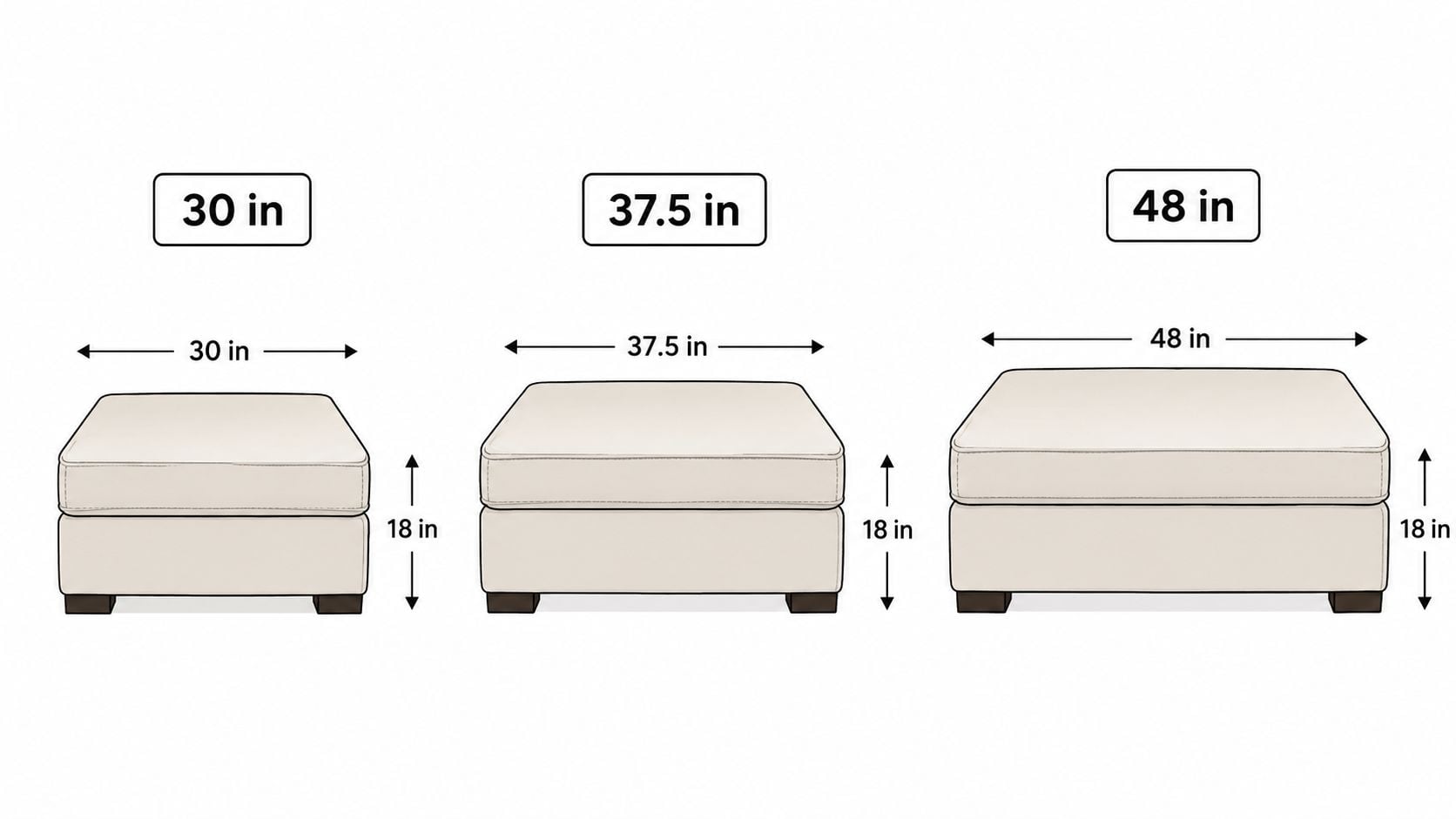
The phrase sounds broad, but in furniture terms it's pretty specific. A large square ottoman usually means a footprint somewhere around 30 to 48 inches per side, with many seating-friendly models around 18 inches high. Those numbers aren't arbitrary. They describe very different uses.
Read the footprint before you read the fabric
At the small end, a 30-inch square ottoman behaves like a compact footrest or a light coffee-table stand-in. Move up to around 37.5 inches square, and the piece starts anchoring a sectional in a real way, with room for trays and books. Push to 48 inches square, and the ottoman becomes more like a communal surface, the kind that can handle several people circling it at once. A larger square footprint gives the room more usable top space.
The square geometry matters because load spreads more evenly across the top than on a narrow bench. That's one reason stronger builds often use kiln-dried hardwood frames with corner-blocked, glued, and reinforced joinery. One large square ottoman example uses 7/8-inch kiln-dried hardwoods and interlocked, glued, corner-blocked joinery to improve stability and reduce racking under repeated shifting loads, which is exactly the kind of construction detail that matters when a piece gets sat on, leaned on, and dragged a little out of place every week. Source product details
A bigger square doesn't just look sturdier. If the frame is built well, it actually is sturdier.
The height matters too. Around 18 inches is a practical middle ground because it works as a footrest and still feels plausible for extra seating. Lower pieces can feel more decorative, while taller pieces start acting like tables rather than ottomans. That's why a buyer should measure seat height first and style second.
For anyone shopping the category in person, that's the first filter. Ignore the fabric at first. Look at the footprint, the height, and whether the top feels like a platform or a pillow. Those details decide whether the piece belongs in the room.
Matching the Ottoman to the Job You Actually Need It to Do
Not everyone needs an ottoman. They need a solution for one of four jobs. The mistake is buying a pretty one that only handles two. A smart buyer matches the size and build to the use, then stops.
Footrest, coffee table, seat, or storage
A 30-inch firm-top ottoman is the cleanest choice when the main job is a footrest. It's compact, easy to place, and doesn't eat floor space. If the household wants a true coffee-table replacement, the safer bet is a 36- to 40-inch flat-top piece at sofa-seat height, because that size gives trays and books enough breathing room without overwhelming the seating zone. For extra seating, a 40-inch-plus ottoman rated to at least 300 pounds is the line worth respecting, especially if two people might sit on it at once. For storage, a compartment around 25.5 inches square by 6.5 inches high is useful for blankets, toys, and throws, but only if the lid and hinges feel built for repeated use. Storage and load ratings reference
| Main job | What to prioritize | What to avoid |
|---|---|---|
| Footrest | Firm top, compact footprint | Soft, sinky cushion |
| Coffee table replacement | Flat top, stable frame, tray-friendly surface | Deep tufting that makes cups wobble |
| Extra seating | Published load rating, solid frame, reinforced lid | Decorative-only construction |
| Storage | Hinged access, usable internal space, sturdy lid | Oversized body with little real storage |
A good ottoman for coffee-table use also needs a top that stays level enough for a tray. That's where the real-world test matters. If the tray shifts when someone leans over it, the piece is only pretending to be functional. Stahl Home Center's own coffee table and ottoman guide is a useful reminder that the ottoman earns its keep only when the use case is clear.
For families, the verdict is blunt. If the ottoman will be sat on, footed on, and used for snacks, prioritize a solid frame and a published load rating. If it's just for feet, the build can be simpler. If it has to do both, don't compromise on firmness.
Frame, Foam, and Fabric Choices That Actually Matter
Shoppers love to get lost in fabric names. That's backward. Start with the skeleton, then the cushion, then the cover. A pretty surface can't rescue a weak frame, and a plush-looking top can still feel wrong if it bottoms out under normal use.
What to feel before you buy
A solid wood frame usually gives a more dependable feel than a looser engineered build, especially in a piece meant to be sat on. Corner-blocked and glued joints matter because they resist racking when kids climb up from one side or when adults shift their weight at the edge. That's the difference between something that settles into the room and something that starts squeaking after a short season of hard use.
Foam deserves equal attention. A 1.8-density cushion foam is the kind of detail that helps an ottoman keep its shape instead of collapsing into a soft hump. Cheaper foam can feel fine on day one, then flatten faster than people expect. If the ottoman doubles as seating, the cushion should feel supportive, not marshmallow-thin.
The fabric choice should follow the household. Leather handles wiping and wear well. Performance fabric is the practical pick when kids, pets, or rentals are in the mix. Linen has a lighter, more refined look but asks for more care. Microfiber is forgiving in busy rooms. Velvet gives a richer finish and suits quieter spaces where the piece won't be abused daily. For a visual cue on how many upholstery directions a family can take, the Pandemonium Millinery stocking assortment shows how varied fabric surfaces can feel, even before the furniture version is chosen.
Good rule: if the room gets heavy traffic, choose the fabric first for durability, then pick the color.
Stahl Home Center's upholstery materials guide fits neatly here because upholstery isn't just a color decision. It's a wear decision. Rotate cushions when the design allows it, blot spills fast, and keep fade-prone fabric out of harsh direct sun. A large square ottoman is meant to be used, not admired from across the room.
Placing a Large Square Ottoman in Real Rooms
Placement makes or breaks the whole idea. An ottoman that's the right size but parked too close to a sofa feels cramped. One that's too far away becomes a decorative island nobody uses. The layout has to respect movement first.
Apartment living room
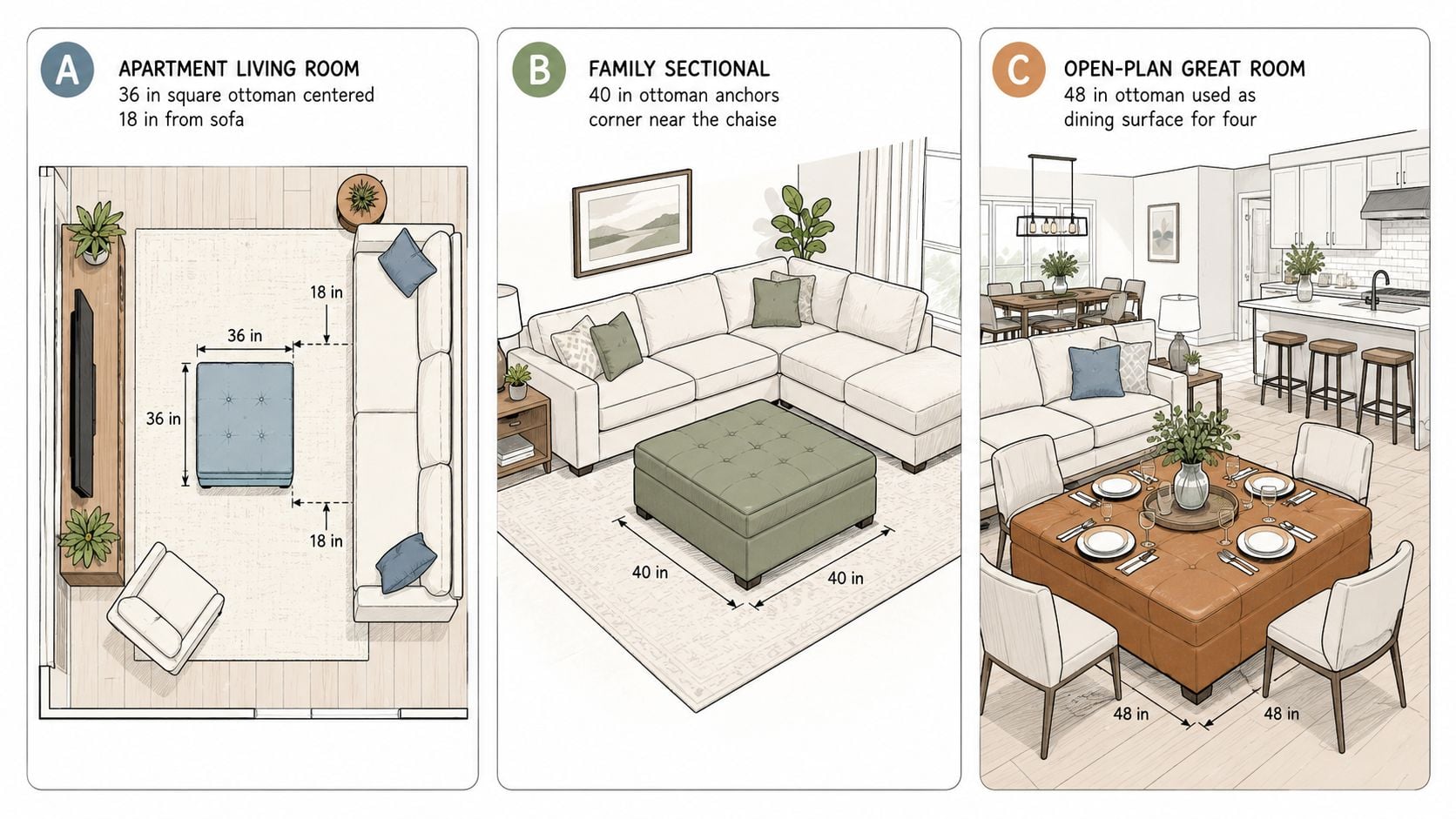
In a smaller living room, a 36-inch ottoman usually makes more sense than a giant one. Set it about 18 inches from the sofa, which keeps leg reach comfortable and preserves everyday circulation. That gap matters because the ottoman should feel available, not like an obstacle course between the couch and the TV.
Family sectional
With a sectional, the ottoman can work harder. A 40-inch piece often anchors the corner without crowding the chaise, especially if the room has enough breathing room around the seating group. The square shape helps here because it balances the long horizontal lines of the sectional with a central mass that feels intentional.
Open-concept great room
A bigger room can take a 48-inch ottoman, and that's where the piece starts acting like a casual gathering surface. It can handle a larger tray, stack books, or even a relaxed meal setup when the household is spread out. The key is still circulation. Standard guidance calls for about 18 inches of clearance between the ottoman and seating, and at least 30 inches of walking space around it. Room layout guidance
A good test is simple. If someone can cross the room without turning sideways, the ottoman isn't crowding the floor plan. If knees bump it every time someone stands up, it's too large or too close. For a step-by-step layout reference, Stahl Home Center's how to place living room furniture keeps the measurement logic practical.
Why Buying in Person Beats Buying Online for This Piece
A large square ottoman is one of those purchases that looks straightforward on a screen and reveals its personality in a showroom. The Sit-Test matters because this piece has to feel right underfoot, hold a tray without wobbling, and look correct next to a real sofa in real light. Photos flatten color, and a swatch never tells the whole story.
That's where a local showroom earns its keep. Stahl Home Center's Bloomington location includes an 88,000-square-foot showroom and says it keeps thousands of pieces in stock for same-day pickup. That matters for anyone who wants to furnish a room now instead of living with an empty center spot for weeks. The store also says it carries one of Indiana's largest selections of La-Z-Boy Indiana seating, plus Rowe Furniture for shoppers who care about custom style and performance fabric options. About the showroom and La-Z-Boy selection
The point isn't just inventory. It's decision speed. A buyer can see whether a top is completely flat, whether the color works beside a sofa, and whether the piece feels sturdy enough for real living room use. For households that want recliners in stock, living room furniture Bloomington shoppers usually appreciate the same logic, because the room has to work on day one, not after a long wait.
Practical rule: the right ottoman in the wrong color still feels wrong, and the right color on the wrong build still fails.
For buyers who want a custom look, Design Your Way opens hundreds of fabrics and configurations through La-Z-Boy and Rowe. That's the second door into the showroom, and it serves a different buyer. One path is take-home-today convenience. The other is a custom order built around the exact room.
Choosing Between Take It Home Today and Design Your Way
The decision is usually simpler than people think. New homeowners, relocators, and anyone trying to furnish a whole home in a weekend should start with the in-stock floor. Walk the showroom, sit-test a few options, and take home the ottoman that fits the room today. That's the fastest route to a room that feels finished instead of half-done.
Style-focused decorators and right-sizers should go the custom route when the room needs a specific fabric, a firmer feel, or a very particular scale. Stahl Home Center's getting started with custom order page fits buyers who want to tailor the piece instead of settling for what's already on the floor. The useful part is that both paths still follow the same Good-Better-Best philosophy, so there's a real answer at more than one comfort and style level.
If the household wants immediate delivery furniture or the simpler satisfaction of taking a piece home the same day, the stock floor wins. If the household wants the exact textile, layout, or finish, custom is the smarter move. Either way, the buyer should keep the same priorities in mind, size to the job, build to the household, then choose the timeline.
Visit the Stahl Home Center Westside Bloomington showroom to compare large square ottoman options in person, feel the firmness, and see what's in stock today. If the room needs to be finished this weekend, the floor has the answer. If the room needs a custom look, the team can help shape that too.