
Sectional Sofa Faux Leather Buying Guide


Saturday morning often reveals whether a sectional was chosen well. Coffee sits on one end, the dog has claimed another, and one partner is reading while someone else watches television. The right sectional sofa faux leather should handle that ordinary, busy scene without making the room feel difficult to clean or uncomfortable to use.
The buying decision starts with more than color. Construction, cushion support, sunlight, household traffic, room layout, and delivery all shape how the sofa will perform. A shopper comparing PU, PVC, and bonded leather can make a much more confident choice by understanding what each material feels like, how it ages, and which household suits it best.
Finding the Right Sectional Sofa in Faux Leather
A faux-leather sectional is a multi-piece sofa arranged in an L, U, or modular configuration. One side may include a right- or left-facing chaise, while another setup may use a loveseat, wedge, armless chair, or reclining seat. The upholstery isn't top-grain hide. Instead, it uses a coated synthetic material or a bonded construction designed to recreate leather's smooth appearance.
That distinction matters because a sectional receives more varied use than a small accent chair. People stretch out, slide across the seat, place drinks on the arms, and create pressure at the seams. A household with children and pets will test the surface differently from a couple furnishing a formal sitting room.
Begin with the material
The three material families most shoppers encounter are PU, PVC, and bonded leather. PU usually feels softer and more flexible. PVC tends to feel smoother, tougher, and slightly stiffer. Bonded leather can look substantial at first but uses a composite structure that may age differently from either PU or PVC.
A helpful resource on how to refresh your living room affordably can also help renters or existing-sofa owners think about layout and appearance before replacing a large piece. For a new purchase, room measurements and daily habits should come before color selection. The practical guidance in this sofa buying guide is useful for checking proportions, comfort, and construction.
Think beyond the showroom moment
A faux-leather sectional may look perfect under showroom lighting, but the home routine is the true test. Will the chaise block a doorway? Will sunlight reach the same arm every afternoon? Does the seat support an upright reader as well as someone who wants to lounge?
The rest of the decision becomes clearer when buyers ask three questions:
- What is the upholstery made from? The label should identify PU, PVC, bonded leather, or a blend.
- How will the sectional be used? Daily family seating calls for a different construction from occasional entertaining.
- Which layout supports the room? A beautiful sectional that interrupts traffic won't feel successful for long.
What Faux Leather Actually Is and Why It Matters
A material label is more useful when it creates a picture in the shopper's mind. PU faux leather is the breathable knit T-shirt of the group. It tends to feel soft, supple, and closer to natural leather, making it appealing for households that want a comfortable surface for reading, lounging, and everyday conversation.
PVC is the raincoat. It forms a smooth, protective surface that handles wiping well and often feels a little firmer beneath the hand. That quality can suit busy rooms, commercial-style seating, or buyers who value a clean, consistent finish over a natural hand.
Bonded leather is the composite board. Leather fibers are combined with a polyurethane binder, placed over a fabric backing, and finished with a surface coating. The result can look rich and uniform when new, but the construction isn't the same as a continuous hide. Creased seats, arm fronts, and frequently handled edges deserve close inspection.
A shopper comparing upholstery options can use this upholstery materials guide to become familiar with backing, surface finish, and care requirements before sitting on models in a store.
Read the label and feel the sample
Press a thumb into the cushion and watch the rebound. A flexible PU surface usually feels more yielding, while PVC often feels smoother and more structured. Bonded upholstery may feel substantial, but the tag and manufacturer information matter more than appearance alone.
| Construction | Base Material | Feel | Typical Price | Best Fit |
|---|---|---|---|---|
| PU | Polyurethane coating over textile backing | Soft, supple, flexible | Mid-range value | Everyday rooms seeking a leather-like feel |
| PVC | Polyvinyl chloride coating over backing | Smooth, firm, wipeable | Value to mid-range | High-use rooms that prioritize easy cleaning |
| Bonded leather | Leather fibers, binder, coating, and fabric backing | Rich-looking, often firm | Value-oriented | Lower-use rooms where appearance leads |
There isn't one universally superior option. The best match depends on whether the household values softness, wipeability, appearance, or a particular budget. Buyers should ask what the surface and backing are made from, not settle for the broad label “vegan leather.”
Faux Leather Compared to Real Leather and Fabric
A family with children, pets, or frequent guests usually judges a sectional by what happens after the first spill, not only by how it looks on delivery day. Real leather, faux leather, and performance fabric respond differently to that daily routine. The right choice depends on the household's priorities, the room's traffic, and the surface a buyer actually enjoys sitting on in a local showroom.
Look and feel
Real leather has a natural grain, subtle variation, and a surface that changes with use. Top-grain leather can develop a patina over time, so small differences between cushions are part of its character. Shoppers who want a consistent contemporary color across a large sectional may prefer faux leather, especially PU or PVC upholstery with a more uniform finish.
Faux leather is not one single material. PU usually feels softer and more flexible, PVC often feels smoother and more structured, and bonded leather combines leather fibers with other materials and a coated surface. These differences matter when a household spends hours lounging, when children climb over the chaise, or when someone wants to wipe an ordinary spill quickly.
Fabric feels warmer against bare legs and adds visible textile texture. Performance fabrics are designed for durability, stain resistance, and easier care in busy homes with children or pets, as explained in this sectional upholstery guidance. They can still snag, collect lint, or need careful spot treatment. A smooth synthetic surface may be easier to wipe, while fabric can feel more welcoming during long movie nights.
Durability and aging
Real leather can remain useful for decades when the household maintains it properly. PU upholstery commonly provides roughly 5 to 10 years of residential life, while higher-end commercial PVC and silicone variants can last longer when their abrasion performance is strong, as described in this faux-leather upholstery reference. Those ranges describe material possibilities, not a guarantee for every sectional. Frame quality, sunlight, body oils, pets, and repeated friction all affect results.
Bonded leather follows a different aging pattern. Its coated surface may begin to show wear within 3 to 5 years under demanding use, particularly where people repeatedly crease one seat or grip the same arm. It can still suit a formal room, guest room, or carefully used space where a polished appearance matters more than intensive daily performance.
The practical choice
Faux leather often suits a buyer who wants:
- A leather-inspired look without full-hide upholstery.
- A wipeable surface for ordinary spills and household messes.
- A modern, consistent color across a large sectional.
- A value-conscious alternative to top-grain leather.
Real leather fits buyers who welcome natural character and gradual aging. Fabric may be more comfortable for households that spend long hours barefoot on the sofa. Faux leather makes more sense when easy surface care and a consistent appearance matter most.
| Category | Faux Leather | Real Leather | Performance Fabric |
|---|---|---|---|
| Appearance | Uniform and contemporary | Natural grain and variation | Textured, warm, and varied |
| Feel | Smooth, often firm to supple | Natural and substantial | Soft and textile-like |
| Cleaning | Wipe-clean for many everyday marks | Generally straightforward with proper products | Stain-resistant options simplify care |
| Aging | May crack, peel, or delaminate | Develops patina with care | May pill, fade, or snag depending on weave |
| Best use | Leather look with practical surface care | Long-term natural material preference | Active homes wanting softness |
How Faux Leather Sectionals Are Built and Tested
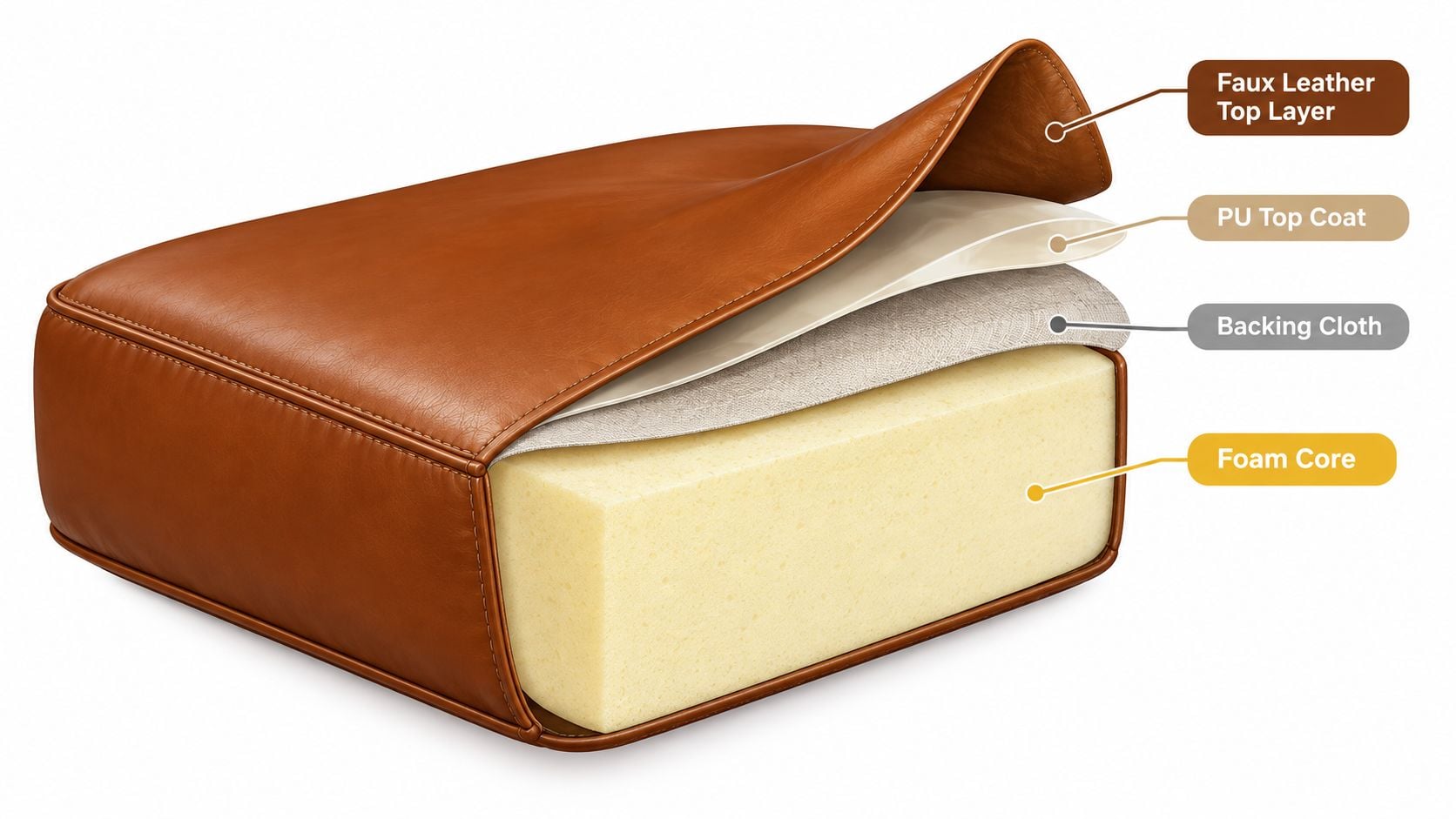
A seat isn't just a surface. It is a layered system that determines whether the sectional feels supportive on the first visit and remains comfortable after repeated use.
The outer cover may be PU, PVC, or bonded upholstery. Beneath it sits a textile backing that helps control stretch and tear strength. The seat core commonly uses polyurethane foam, sometimes with a softer wrap above it to create a more welcoming first impression. The frame may use hardwood, plywood, metal, or a combination, and that foundation helps determine whether the sectional stays tight and aligned.
Turn abrasion testing into household language
Martindale testing rubs fabric or upholstery in a repeated figure-eight motion. Wyzenbeek testing moves an abrasion device back and forth. Higher test results generally indicate greater resistance to repeated friction, but a number on a hangtag doesn't predict every home equally.
A seat edge experiences more stress than a back cushion. A dog that jumps onto the same corner, a child who kneels on the chaise, or a person who drags across the arm creates a different wear pattern from a household that sits carefully. The useful question is whether the reported testing reflects the intended residential or commercial application.
Quality construction guides, including information on high-quality home furnishings, can help shoppers evaluate the frame, cushion, upholstery, and finish as one system rather than treating the surface as the entire product.
Use three showroom checks
- Pinch test: Gently pinch a hidden edge or sample. A surface that feels excessively thin or brittle deserves more questions.
- Seam test: Examine piping, corners, and cushion joins. Straight stitching and smooth tension matter because creases concentrate stress.
- Frame check: Lift one corner slightly, if permitted. A sectional that feels stable and well-supported should not twist easily under light handling.
A comfortable cushion still needs the right firmness for the user. Someone who reads upright may prefer a supportive seat and higher back, while a movie-watching household may prefer deeper lounging space. The upholstery, foam, and frame should be judged together.
Caring for a Faux Leather Sectional the Right Way
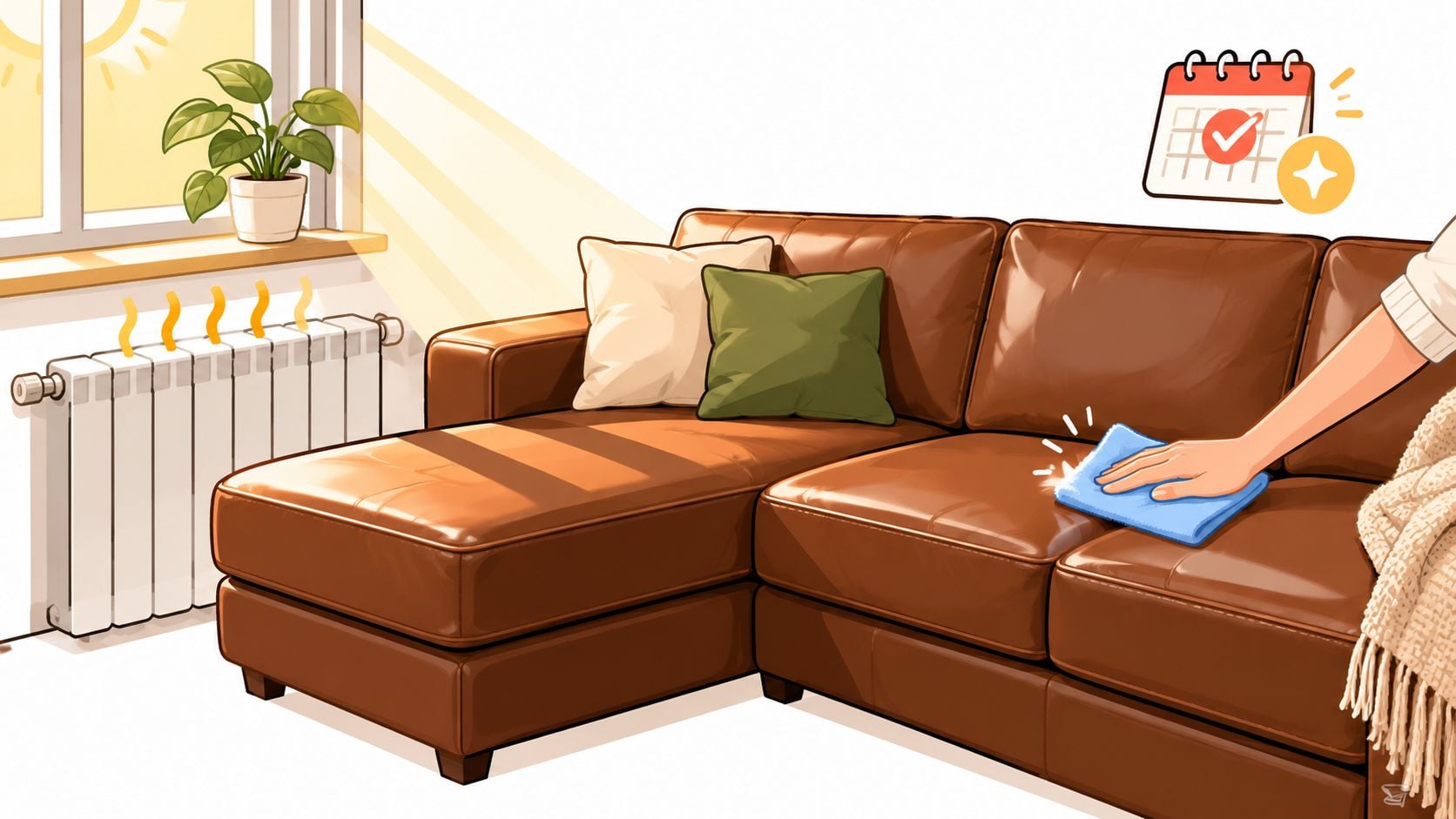
Faux leather usually benefits more from a simple routine than from aggressive treatment. Direct sunlight, heaters, fireplaces, and harsh chemicals can reduce flexibility in the surface coating. Alcohol-heavy wipes, ammonia, solvents, bleach, acetone, and abrasive cleaners may dry or damage the finish.
A ten-minute weekly habit keeps grit from becoming friction. Dust with a dry microfiber cloth, wipe with a lightly damp microfiber cloth, and finish with a dry buff. The cloth should be damp, not wet, and the household should test any approved product in a hidden area first.
Use a small weekly checklist
- Remove surface dust: Wipe arms, seat fronts, and back cushions before grit works into creases.
- Clean lightly: Use mild soap and water only when the manufacturer's instructions allow it.
- Dry the surface: Don't leave moisture sitting along seams or under cushions.
- Protect the placement: Keep the sectional away from radiators, heat vents, and strong direct sun.
For broader upholstery-cleaning principles, this guide to cleaning upholstery offers useful context. Faux leather still requires the product instructions supplied with the sectional, since coatings differ.
Treat stains without grinding them in
Blot ink or wine rather than rubbing. Lift food grease with a clean cloth and a mild approved cleaner. For denim transfer, begin with gentle damp wiping and stop if the color doesn't release easily. Pet messes should be removed promptly, with the surface dried afterward and the product label checked before applying anything stronger.
Seasonally, vacuum seams and crevices with a brush attachment, rotate loose cushions, and inspect the areas where people sit or grip most often. A PU-safe protectant may be appropriate for some products, but it shouldn't be used automatically. Sun and chemical damage are commonly excluded from upholstery warranties, so keeping the care instructions with the household paperwork is worthwhile.
Configurations That Fit Your Living Room
The right shape follows the room's traffic pattern. An L-shaped sectional is the dependable choice for many living rooms because it creates a conversational corner without filling every wall. The chaise can face the television for lounging, or the window for a reading position, depending on how people use the room.
A U-shaped or pit sectional suits an open floor plan, a large family, or regular movie nights. It needs enough surrounding clearance for people to walk around the seating rather than squeeze between the sofa and a wall. A chaise-and-loveseat arrangement can deliver a similar lounging experience in an apartment, bonus room, or compact second living area.
Match the shape to the household
A modular sectional gives renters, right-sizers, and frequent redecorators flexibility. Pieces can be rearranged as the room changes, and some systems allow additions later. A sleeper sectional adds overnight usefulness, but buyers should inspect the actual mattress, support, opening mechanism, and storage area rather than assuming every sleeper feels alike.
Seat depth changes posture. A deeper seat encourages relaxed lounging, while a shallower seat makes upright conversation and standing easier. Seat height matters too, particularly for older adults or anyone with limited mobility. The sectional should support the body without forcing users to perch or struggle to rise.
For additional planning help, these sectional sofa layout ideas can help buyers compare orientation, traffic flow, and room balance before committing to a configuration.
| Configuration | Best Room Type | Typical Footprint | Ideal Household | Key Feature to Check |
|---|---|---|---|---|
| L-shape | Standard living room | Corner-oriented | Couples and families | Chaise direction and doorway access |
| U-shape | Open, spacious room | Broad, surrounding footprint | Large families and hosts | Walkways around the perimeter |
| Loveseat and chaise | Apartment or bonus room | Compact, linear-corner blend | Smaller households | Seat depth and arm width |
| Modular | Flexible or changing room | Adaptable | Renters and right-sizers | Connector strength and reconfiguration |
| Sleeper sectional | Guest-ready living space | Depends on mattress extension | Homes hosting overnight guests | Mattress comfort and opening clearance |
Before ordering, mark the sectional's footprint with painter's tape. Then measure the entry door, hallway, stair turn, and elevator if applicable. A layout that fits the floor plan still needs to fit the route into the room.
Matching a Faux Leather Sectional to Your Household
Material selection becomes easier when it starts with the people who will use the sofa. A pet owner, a right-sizer, and a formal-room decorator may all like the same charcoal color, but they need different upholstery priorities.
Pet owners
Pet households should look for a tightly supported backing, a surface that wipes clean, and removable seat cushions that can be vacuumed around the edges. Mid-tone colors can make everyday fur and minor scuffs less noticeable. Reinforced seams and strong abrasion performance deserve more attention than decorative stitching.
Best for: A busy home where pets climb onto the sectional and cleanup must stay simple.
Allergy-sensitive families
A smooth PU surface may leave less exposed textile for dander to settle into than a heavily textured weave, though no upholstery makes a home allergy-proof. Easy vacuum access, removable cushions, and a configuration that allows cleaning beneath the sofa can matter as much as the cover itself.
A neutral, medium-value color can keep the room calm without making every mark obvious. Buyers should also ask about cushion wraps and backing materials, since the cover is only one part of the seating system.
Best for: Households prioritizing a smooth surface and regular cleaning access.
Right-sizers
Someone moving from a large home to a condo often needs a smaller sectional, a modular design, or pieces that can fit through a stairway turn. A compact L-shape or reconfigurable arrangement may preserve lounging comfort without overwhelming the new room.
PU can provide the desired leather-like appearance in a scaled-down footprint, while a durable performance fabric may be preferable if the household wants more softness. The first priority is measuring the delivery route, not choosing a color.
Best for: Empty nesters and active retirees who need flexible proportions and manageable delivery.
Style-focused decorators
A formal sitting room or low-use library can accommodate a richer-looking bonded construction when daily abrasion isn't the main concern. Contemporary decorators may prefer a clean PU finish, while a more traditional room may benefit from visible texture, precisely stitched seams, or a warm brown tone.
Custom options can also change the outcome. A buyer should compare arm shape, leg finish, cushion profile, and stitching rather than judging the material alone. For more family-oriented planning, this guide to choosing sectionals for families can help connect layout decisions with daily use.
| Household Type | Best Faux Leather | Recommended Configuration | Key Feature to Prioritize |
|---|---|---|---|
| Pet owners | Wipeable PU or durable PVC | L-shape with accessible cushions | Reinforced seams and abrasion performance |
| Allergy-sensitive families | Smooth PU with easy-clean design | Raised or modular configuration | Vacuum access and removable cushions |
| Right-sizers | Flexible PU or performance alternative | Compact L-shape or modular | Delivery-route dimensions |
| Style-focused decorators | Refined PU or bonded leather in lighter use | Formal L-shape or loveseat and chaise | Surface finish, tailoring, and proportion |
Why a Local Showroom Changes the Buying Experience
Two risks make online sectional shopping difficult. The first is ordering a material that looks appealing on a screen but feels too stiff, too slick, or too thin in person. The second is waiting through a long lead time only to discover that the configuration doesn't work with the doorway or room.
A local showroom solves the first problem with the sit-test. Buyers can place PU, PVC, bonded leather, and performance fabric beside one another, then compare hand feel, cushion rebound, seam tension, seat height, and chaise depth. True color also becomes easier to judge under real lighting rather than through a small digital image.
Bring the room into the conversation
A productive showroom visit starts with practical information:
- Room measurements: Include wall length, ceiling height, outlets, vents, and walking paths.
- Entry photographs: Show the front door, hallway, stairs, and the tightest turn.
- Household needs: Note pets, children, mobility concerns, overnight guests, and preferred sitting positions.
- Material questions: Ask for the construction, backing, cleaning instructions, and abrasion information.
A large local furniture store can offer both immediate inventory and custom ordering. Stahl Home Center describes an 88,000-square-foot showroom, thousands of items available to take home, and scheduled professional delivery. It also identifies itself as Indiana's Largest La-Z-Boy Dealer, carries Rowe Furniture, and offers hundreds of fabrics and configurations through its Design Your Way custom-order service. That range can serve a new homeowner furnishing a whole home, a quality-focused buyer comparing La-Z-Boy and Rowe, or a style-focused decorator seeking custom sofas, power recliners, lift chairs, bedroom sets, mattresses, and other living room furniture Bloomington shoppers may need.
Choose between immediate and custom
An in-stock sectional makes sense when the room is ready and the household wants to take it home today through customer pickup or arrange scheduled professional delivery. A custom order makes more sense when the exact fabric, orientation, cushion feel, or configuration matters more than immediate possession.
Practical rule: Sit in the material, test the seat, measure the route, and only then decide whether speed or customization should lead.
A shopper searching for a Furniture store Bloomington IN, La-Z-Boy Indiana, Rowe Furniture, recliners in stock, or living room furniture Bloomington can begin with a short checklist and a clear room plan. That approach turns a large purchase into a practical comparison instead of a guess based on a product photo.
Visit Stahl Home Center to compare faux-leather sectionals, La-Z-Boy and Rowe seating, recliners in stock, and custom configurations in person. Visit our Westside Bloomington showroom today to see our massive selection in person.