
Coffee Table and Ottoman Guide for Real Living Rooms


The living room is already halfway built when the sofa shows up. The blank center starts asking a practical question fast, and the wrong answer makes the whole room feel awkward, cramped, or too precious to use. A coffee table and ottoman decision is really a layout decision, and the best choice depends on how the room gets used, who lives there, and whether the space needs a hard surface, a soft landing, or both.
At Stahl Home Center, that decision gets easier because the answer does not have to come from a screen. The 88,000+ sq. ft. showroom gives shoppers room to compare shapes, finishes, and comfort in person, and the in-stock floor means many pieces are ready to go home today. For a household that wants Furniture store Bloomington IN convenience without waiting around, that matters.
Why the Coffee Table and Ottoman Question Matters
A living room can look complete and still work poorly. The problem usually sits in the center, because that one choice controls how people move, where drinks go, where feet land, and whether the room feels open or crowded. A coffee table gives the room structure. An ottoman gives it flexibility. In many homes, the right answer is not picking one forever, it is choosing the setup that fits the way the room gets used.
That becomes obvious as soon as the sofa arrives. Leave the middle of the room undecided, and people start bumping knees into corners, setting remotes on armrests, or avoiding the center because it feels too tight. A good layout fixes those problems quickly. It also forces an honest decision about use, because a room built for laptop work, TV nights, kids' play, and guest seating needs different support than a formal sitting room.
Practical rule: Start with the activity, not the style. If the room needs a surface, choose stability. If it needs softness and extra seating, choose flexibility.
The history helps explain why both pieces still belong in modern homes. The coffee table is a later furniture form, and one widely cited history traces its rise to the 18th century (Mokk-a history of the coffee table). Other furniture-history accounts connect its development to lower tables used around tea and coffee service, which is why the piece still centers conversation areas so naturally. The ottoman comes from a separate Ottoman-era furniture tradition that later became a household staple.
The better way to frame the choice is straightforward. One piece gives the room a hard, usable surface. The other gives it softness and adaptability. When a space needs both, the layout should reflect that instead of forcing the room to do one job badly.
What a Coffee Table and an Ottoman Actually Are
A coffee table is the low, central table that gives a seating area a solid surface. An ottoman is a low, upholstered, backless piece that works as a footrest, extra seat, or soft landing spot for a tray. That difference sounds simple, but it changes how the whole room functions, especially when you are choosing pieces from a real showroom floor instead of a perfect catalog page.
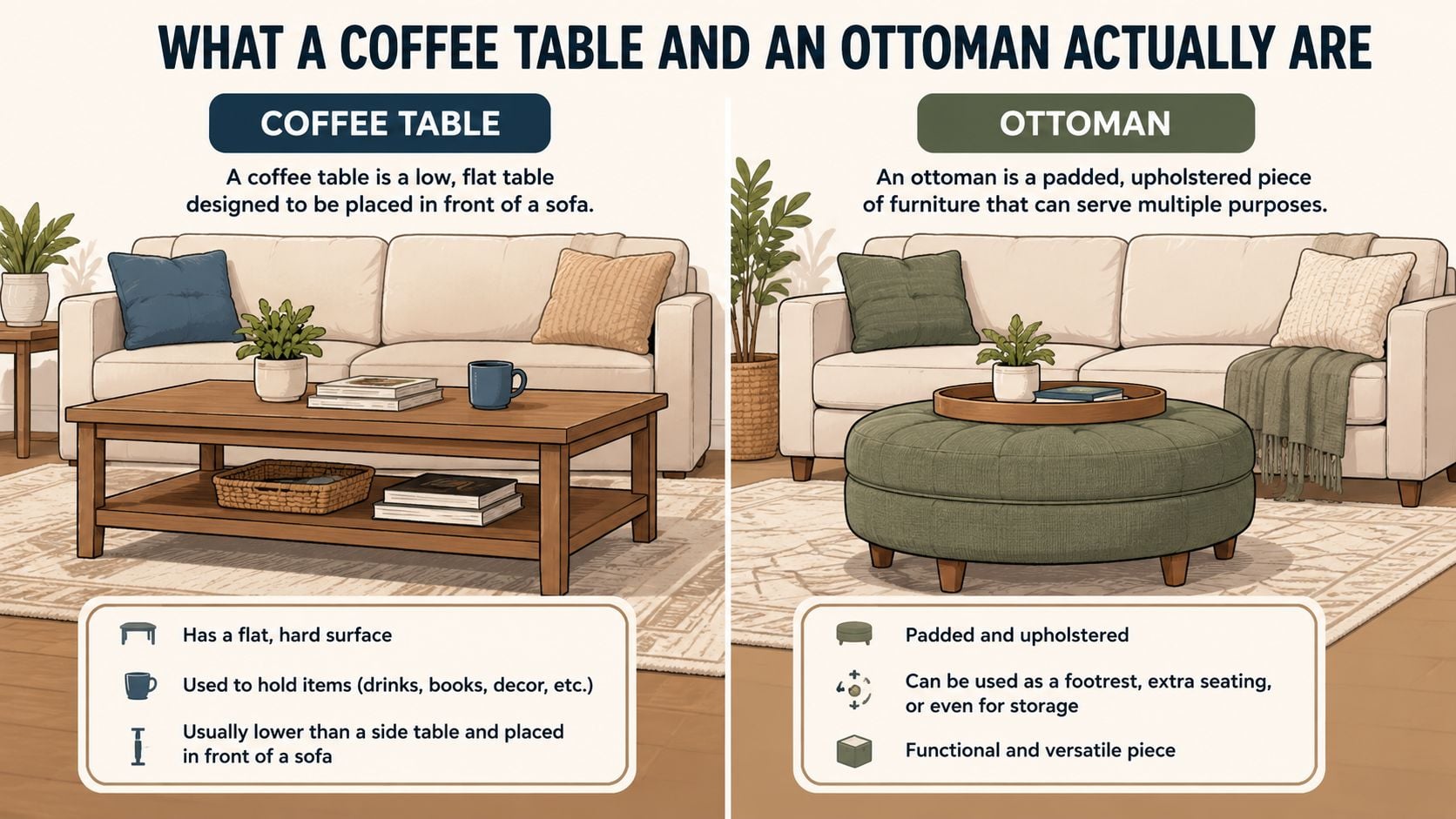
A coffee table gives the room structure. Its hard, flat top is built to hold drinks, books, remotes, and a laptop without wobbling, which is why it stays dependable in everyday use. It also sets a clear center point in the seating arrangement, so the room feels organized instead of improvised.
The piece has a long furniture history as a lower table meant to support conversation and shared use, and that older purpose still shows up in modern living rooms (Mokk-a history of the coffee table). In practice, a coffee table tells you the room is ready for direct use, not just display.
The ottoman does a different job. It is soft, backless, and usually upholstered, so it works as a footrest, an extra seat, or a casual surface when you place a tray on top. That flexibility is the point. It gives you comfort first, then utility second.
The ottoman also comes from a furniture tradition tied to low, relaxed seating and social gathering. That is why it fits rooms that need to feel easy, adaptable, and less formal. A good layout does not force one piece to act like the other, it matches the center of the room to how the space gets used. If you are sorting through styles and want a practical way to think about mixed-use pieces, see our guide to choosing multi-functional furniture for modern homes.
Coffee Table vs Ottoman at a Glance
A showroom floor makes the choice look simple, but the decision is how the center piece has to behave in the room. A coffee table gives you a hard, reliable landing spot. An ottoman gives you softness and flexibility, but it asks for more planning if you want to set items on it every day.
| Attribute | Coffee Table | Ottoman |
|---|---|---|
| Primary role | Stable center surface | Footrest, seat, flexible surface |
| Surface feel | Hard and flat | Padded and softer |
| Drink use | Direct and reliable | Usually needs a tray |
| Visual effect | More structured | More relaxed |
| Best fit | Frequent use, hosting, devices | Lounging, kids, extra seating |
| Maintenance level | Easier to wipe down | Usually needs more fabric care |
| Room size suitability | Works well in most layouts | Better when comfort and flexibility matter more |
A standard coffee table has a hard, flat top meant to securely hold drinks and objects, while an ottoman's padded surface is less stable and typically needs a tray for practical daily use. That difference matters more than style labels. If the center of the room has to handle mugs, plates, remotes, and a laptop without fuss, a coffee table earns its place. If the room needs a softer feel and more ways to sit or rest, the ottoman is the better match.
| Use case | Better choice | Why it works |
|---|---|---|
| Daily drinks and snacks | Coffee Table | Hard surface, easy cleanup |
| Family lounging | Ottoman | Softer edges, more comfortable to put feet up |
| Small rooms with light traffic | Ottoman | Can act as seating without feeling bulky |
| Rooms that host often | Coffee Table | Gives guests a stable place to set things down |
| Mixed-use living rooms | Either, depending on the layout | The right piece depends on what the center of the room has to do |
A tray changes the ottoman from casual to useful, but it does not turn it into a true hard surface. That is why shoppers should decide based on the room's real habits, not on which piece looks prettier in a catalog. For a broader planning lens, the advice in how to choose multi-functional furniture for modern homes fits here, because the center of the room should work with the rest of the layout. If wall styling is part of the setup, the space also benefits when the center piece relates cleanly to the art and storage around it, as shown in how to decorate a living room wall.
A smart showroom shopper does not ask which piece is better in general. The better question is which one will stay useful after the room is lived in for a month, not just admired on delivery day. At Stahl Home Center, the point is to match that answer to in-stock pieces you can fit into the room, use every day, and keep looking right without constant compromise.
Sizing and Layout Rules That Actually Work
The right center piece can still fail if the spacing is wrong. Set it too close and the living room turns into a squeeze point. Push it too far out and people stop using it because it feels awkward to reach. Interior designers commonly recommend leaving 16–18 inches between a coffee table or ottoman and the seating around it, because that keeps reach comfortable while still leaving room to move. Start there.
Measure the room before you choose the piece
The sofa sets the working limits. The center piece should follow the sofa's depth, the traffic pattern, and the room's visual balance. Recent task-based ergonomic guidance recommends a coffee table height 2–5 cm below seat height, an ottoman within ±2 cm of seat height, 35–45 cm of clearance from the sofa, and at least 60–75 cm of walking space on main traffic sides. Those measurements keep the room usable instead of merely arranged.
Use the footprint test before you buy. Mark the proposed size with painter's tape at home, then check how it sits against the actual walk paths and seating depth. If you need a width-and-depth reference while you measure, use a coffee table size guide before making a final choice. That keeps the decision grounded in how people move through the room, not just in how the piece looks on the floor.
Use shape to solve the room, not fight it
A long sofa usually works better with a longer, quieter center piece. A sectional often needs a layout that protects the inside corner and still leaves a clean path around the outside. Open-concept rooms can carry a stronger visual anchor, while shallow rooms usually do better with a lighter profile and fewer hard corners.
Shape changes circulation in a real way. In a 12-foot by 16-foot room with a sectional, a 48-inch rectangular ottoman leaves 18 inches of clearance on the walk path, which keeps movement open without making the center feel undersized. A round coffee table changes that flow, because it softens the turns and reduces the sense of blocked corners in tighter passages. Use the shape that helps the room move cleanly.
If wall styling is part of the plan, a helpful companion read is how to decorate a living room wall. The wall layout and the center furniture should support each other, not compete for attention.
For a tighter fit, a coffee table size guide is worth using before any purchase, because width and depth matter just as much as style. If the room cannot spare the clearance, the furniture will never feel right, no matter how good it looks.
Choosing by Real Use Case
The right answer changes once the room has a job to do. A remote worker, a toddler-heavy household, and a family that hosts often all need a different center piece. The useful question is direct, which piece helps the room work better day to day?
When the couch doubles as a desk
A tray-topped ottoman can pull real weight in a room where the sofa becomes the laptop zone. It gives legs a softer landing and lets the center surface switch from footrest to snack spot to temporary support without forcing the room to feel stiff. The ottoman still has to stay steady enough for daily use, so the tray is not a styling extra, it is part of the setup.
When kids use the room hard
A hard-surface coffee table is usually the cleaner choice for a toddler-heavy home because it gives cups, board games, and snacks one predictable place to land. Softer edges help, but stability matters more than wishful styling. A room that sees races, climbing, and rough play needs fewer surprises in the center, not more.
When the room hosts often
Hosts regret undersized center furniture fast. Guests need a place for drinks, plates, and conversation clutter, and the room needs enough flexibility to let people shift around without feeling boxed in. A coffee table usually handles that better, but a larger ottoman can still work if the room stays casual and a tray is part of the plan.
Best-fit rule: A room with mixed roles usually benefits from a pairing, a coffee table for structure and an ottoman for comfort.
For shoppers who are deciding whether to swap your coffee table for an ottoman, the decision hinges on whether the room prioritizes stable surfaces over soft versatility. If the answer is still unclear, a combined setup usually solves the problem better than either piece alone, and that is the kind of layout Stahl Home Center can help you match to what is in stock on the floor.
Materials, Styles, and Custom Options
Material choice decides how forgiving the piece will be after the honeymoon period ends. A coffee table can be beautiful and still be a bad pick if the finish shows every fingerprint or the corners feel too unforgiving in a tight room. An ottoman can look sharp and still be a poor fit if the fabric can't handle spills, shoes, or daily foot traffic.

Match the surface to the way the room lives
Coffee tables usually come in wood, metal, glass, or stone. Wood feels forgiving and warm. Metal leans cleaner and more modern. Glass can keep a room visually lighter, but it asks for more attention. Stone brings presence, but it also deserves a room that can handle visual weight.
Ottomans ask a different question. The fabric needs to survive contact, feet, and the occasional spill. That's why performance fabrics matter so much in a busy household. The wrong textile turns a useful piece into a maintenance problem.
Typical ottoman height runs about 18–22 inches and coffee tables about 16–18 inches, with ottomans usually upholstered and softer-edged while coffee tables are generally hard-surfaced and more rigid. Those proportions help the room read correctly and also help the pieces work together without awkward height clashes.
Know when to buy today and when to custom order
Some shoppers need the room finished now. In that case, immediate stock is the practical answer. Others want a very specific color, fabric, or configuration, and that's where custom order paths make sense. Rowe Furniture is a strong option for custom style and performance, especially when the right look matters more than speed. La-Z-Boy Indiana shoppers usually come in looking for comfort that can be tried, compared, and taken seriously before they commit.
A more detailed fabric planning guide lives in everything you need to know about upholstery materials. That's the right next step for anyone choosing between a spill-friendly texture and a more decorative finish.
For a busy home, the rule stays simple. If the piece has to work hard immediately, buy the version that can live with real use. If the room has time to wait, design the exact look.
Care Tips That Keep Both Pieces Looking New
Good furniture still looks tired if nobody takes care of it. The fix is boring, which is exactly why it works. Coffee tables and ottomans need different routines because they're built differently, and the owner should treat them that way.
A coffee table's finish should be wiped with the right cleaner for the surface, not whatever is closest under the sink. Wood likes a gentler touch. Glass needs a cleaner that doesn't leave streaks. Metal and stone each need their own basic respect. Heavy tables should be lifted, not dragged, so floors stay clean and the legs stay true.
Ottomans need a softer routine. Vacuum the fabric regularly, brush the surface when dust collects, and deal with spills before they settle in. If the ottoman has removable cushions or insert sections, rotate and fluff them so the shape stays even. A fabric protection product can also help, but it works best as prevention, not as an excuse to ignore spills.
Simple maintenance rule: The weekly habit is easier than the deep clean. Five quiet minutes now beats a weekend repair later.
For leather pieces in the same room, how to protect leather furniture is worth keeping nearby. The core idea is consistent care, not rescue missions.
Bringing It Together at Stahl Home Center
The smartest shoppers usually land in one of three situations. Some need the room finished fast, so the coffee table and ottoman decision should start with what is In-Stock Today. Some want a specific look and should use custom ordering through La-Z-Boy or Rowe Furniture. Others need the room to function better, and for them the right choice is the layout that gives the best circulation, not the piece that looks prettiest on its own.
Stahl Home Center makes that decision easier. The 88,000+ sq. ft. Westside Bloomington showroom gives shoppers room to test scale, compare finishes, and find recliners in stock, living room furniture Bloomington, bedroom sets, mattresses, and immediate delivery furniture without guessing from a thumbnail. If you want a Good-Better-Best path, that mix of stock and custom options gives you real choices instead of forcing a compromise.
The coffee table and ottoman pairing also has a useful history behind it. The coffee table's design roots trace back to the Ottoman Empire, and that connection helps explain why these two pieces still work so well in the same room. They are both built for shared living, low conversation, and easy reach, which is exactly why a showroom floor should let you see them together instead of separately. A piece that looks right alone can still fail once it has to share space with seating, traffic, and daily use.
For anyone ready to turn measurements into a real room, the next step is simple. Review the getting started with custom order path if the look needs to be exact, then visit the showroom and sit-test the options in person before choosing.
Visit our Westside Bloomington showroom today to see our massive selection in person. A CTA for Stahl Home Center.