

Best Sofas for Small Apartments: The Complete 2026 Buying


You've found the apartment, measured the living room, and started planning where the television will go. Then the standard sofa arrives, or worse, fails to get through the doorway, and suddenly the room's only walking path disappears. Small-apartment seating demands more than a short overall width. The right piece must balance usable comfort, seat depth, arm width, circulation, style, and availability.
For Bloomington renters, relocators, and right-sizers, the strongest approach is practical: measure first, test the sofa in person, and choose a configuration that supports the way the room is used. The best sofas for small apartments aren't the smallest models. They're the pieces that preserve movement without making everyday lounging feel like a compromise.
Why Small Apartment Sofas Require a Different Approach
A compact apartment can expose a sofa's flaws immediately. A full-size three-seater may technically fit against one wall, yet still block the route to the kitchen, crowd the coffee table, or force every chair and side table into awkward positions. In a larger home, a few extra inches may disappear into open floor area. In a small living room, those inches can control the entire layout.
One-bedroom apartments average about 50 m², or 540 ft², worldwide, with common urban ranges of 35 to 65 m². The contrast is substantial, from about 23 m² in Hong Kong to about 65 m² in Dubai, as outlined by global apartment size data. Some European standards allow living rooms of only 7.5 m² in existing buildings in the Netherlands and 10 m² in Portugal, which explains why a sofa has to share its footprint with passage, storage, and often a work area.
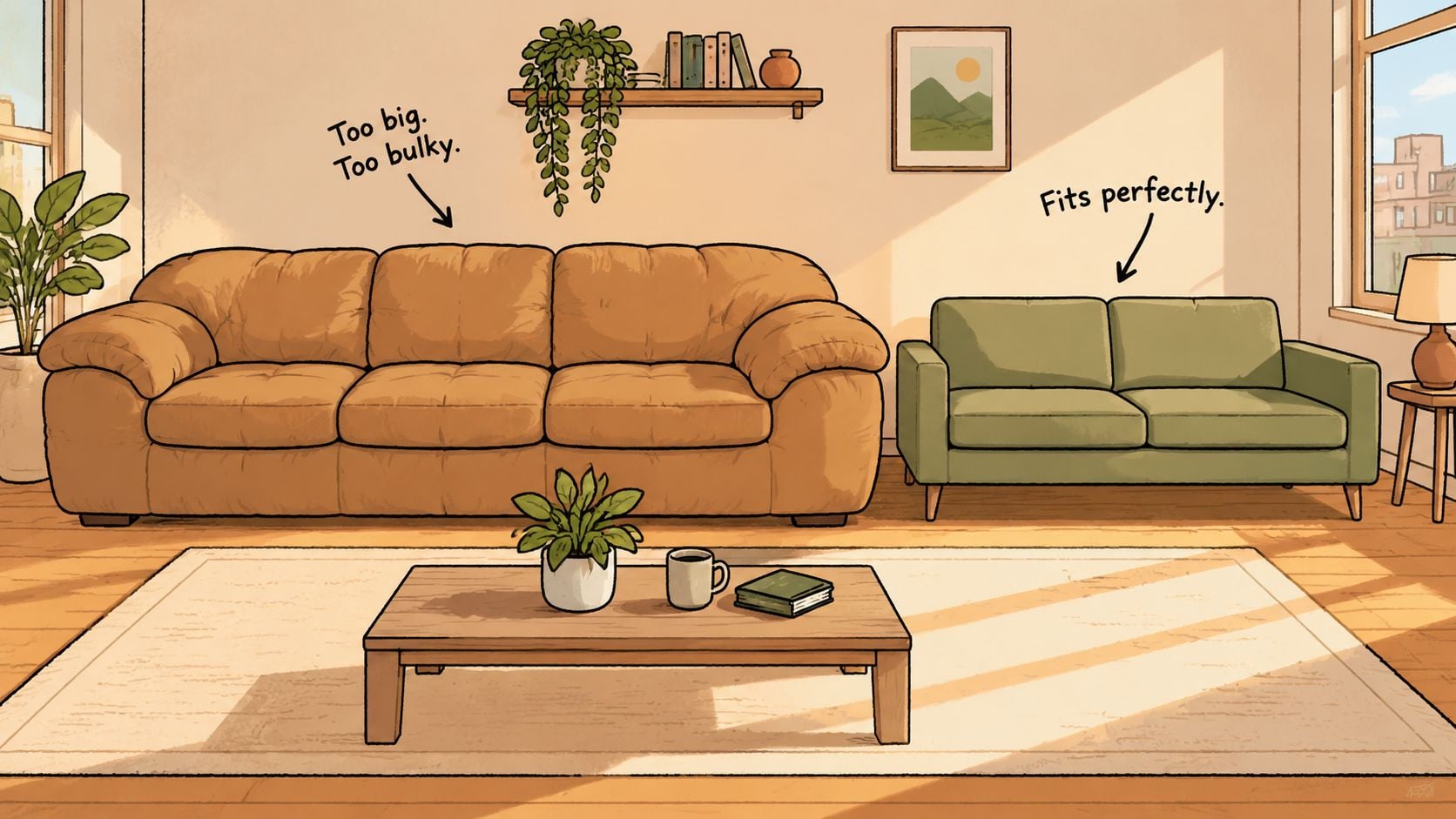
The footprint matters more than the label
A sofa called “apartment-sized” can still feel oversized if it has deep cushions, wide arms, or a low, heavy base. Conversely, a modular loveseat with narrow arms may offer plenty of practical seating while leaving the room visually lighter. Buyers should judge the full footprint, not just the number of seats.
The historical rise of modular seating reflects this need for adaptability. Sectional-style seating can be traced to the 19th century, and modern modular interpretations were promoted in the 1930s for apartment dwellers because sections could be added or removed as layouts changed, according to the same apartment-size reference. That flexibility still matters for renters, remote workers, and households whose needs change from one season to the next.
Practical rule: A sofa earns its place in a small apartment by supporting the room's circulation, not by filling every available inch.
Reduced depth, slim arms, raised legs, and movable modules generally give buyers more control. The best choice may be a compact three-seater for daily use, a loveseat for a narrow room, or a small sectional that separates when furniture has to move. Comfort remains essential, but comfort has to be measured against the room's real walking paths.
How to Measure Your Space Before You Shop
A sofa should never be chosen from a width number alone. The room, building, hallway, elevator, stairway, and doorway all form part of the delivery route. A piece that fits the living room can still fail at the front door.
Start with the room and the route
Measure the wall where the sofa will sit, then measure the room's total length and width. Mark windows, radiators, vents, outlets, door swings, and permanent features. Use painter's tape or flattened boxes to outline the sofa's proposed footprint. This simple mock-up reveals whether the sofa will crowd a walkway before a purchase is made.
For a small living room, expert guidance generally recommends a sofa width under 75 inches, or 190 cm, with 30 to 36 inches, or 75 to 90 cm, of walkway clearance. The same guidance places the coffee table about 14 to 18 inches, or 35 to 45 cm, from the sofa, while rooms under 150 square feet typically benefit from a seat depth of 20 to 24 inches, according to this small living room sofa sizing guide.
Measure the sofa in the way it will be used
Record overall width, overall depth, height, arm width, seat depth, and seat height. Overall depth tells the buyer how far the sofa projects into the room. Seat depth tells the user how far the body sits from the back cushion, which directly affects posture and lounging comfort.
Independent apartment-sofa references commonly place compact models in the 70 to 85 inch width range, with overall depths of 30 to 34 inches and seat heights of 17 to 19 inches. Reducing depth by 2 to 6 inches compared with a standard couch can materially improve pathway clearance, as explained by compact sofa sizing guidance.
Check the access points
Measure the entry door, interior doors, hallway turns, stair width, and elevator opening if applicable. Note whether the sofa can be delivered in sections or assembled inside the apartment. A measured floor plan is useful, but it won't help if the sofa can't make the final turn into the room.
For households between moves, a guide to storage when moving house can help organize furniture and belongings while access routes or room layouts are being resolved. Before visiting a showroom, buyers can also review how to measure furniture and bring the resulting dimensions along.
Use this checklist:
- Room footprint: Mark the sofa, coffee table, television path, and primary walkway.
- Clearance zones: Protect at least the recommended walking space instead of measuring only wall-to-wall width.
- Comfort dimensions: Compare seat depth and seat height, not just exterior measurements.
- Delivery route: Measure every narrow point from the building entrance to the intended room.
- Future flexibility: Consider whether the sofa can be separated, rotated, or reconfigured later.
Comparing the Best Sofa Types for Small Apartments
You can fit a sofa against the wall and still lose the room's comfort. A loveseat may preserve floor space but limit lounging, while a compact sectional can provide a longer, more relaxed seat and consume the passage beside it. Choose by how you use the room, not by width alone.
| Sofa Type | Typical Width | Best For | Key Trade-Off |
|---|---|---|---|
| Apartment-sized sofa | 70 to 78 inches | Daily seating in a small living room | More seating than a loveseat, but depth still affects circulation |
| Loveseat | Compact two-person scale | Studios, bedrooms, and narrow living rooms | Efficient footprint, with less room to spread out |
| Sleeper sofa | Varies by configuration | Guests, remote work, and multipurpose rooms | Added function can increase weight and depth |
| Compact sectional | Modular or apartment-scale layout | Lounging, flexible rooms, and renters | Relaxed seating may consume valuable floor area |
For many one-bedroom apartments, an apartment-sized sofa is the strongest all-purpose choice. Sizing guidance often places small-space sofas around 70 to 78 inches wide. A 2026 design guide also points out that even 96 inches can overwhelm a room after accounting for radiators, outlets, and door swings, as discussed in this small-space sofa guide.
Choose a shallower sofa when guests sit upright, the television is close, or a clear route must run past the seating. Check the actual seat before buying. A narrow exterior does not guarantee comfortable lounging if thick cushions leave little usable depth.
Loveseats and sleepers
A loveseat fits a room with one dominant wall and limited spare depth. It can preserve space for a reading chair, narrow desk, or storage piece. Two adults can sit comfortably, though neither person gets the same lounging spread available on a longer sofa.
A sleeper sofa makes sense when the apartment also serves as a guest room or work area. Inspect the opening mechanism, plan where bedding will go, and test the extended position against the room's main route. The added function should solve a real household need without making daily seating cumbersome.
Compact sectionals
A compact sectional suits renters and remote workers who want the layout to change with the room. Armless modules can form a longer seat, separate for moving, or support a revised arrangement. Before choosing one, review what a modular sectional is and confirm how each piece will work in your floor plan.
Sectionals are not automatically space-efficient. A fixed chaise can occupy floor area that rarely gets used, and a deep profile can make a small room feel crowded. Pick a configuration with restrained arms, practical module sizes, and a layout that follows the room's circulation.
For immediate furnishing, in-stock options also deserve priority. An online sofa with a long lead time cannot help if the apartment needs seating now. Test available pieces in person, compare lounging comfort with the footprint, and choose the sofa that fits both the room and your schedule.
The Hidden Dimensions That Affect Comfort and Space
You sit down after work, expecting to stretch out, but your knees press against the cushion edge and your feet cannot settle comfortably. That experience usually comes from the sofa's usable dimensions, not its advertised size. Seat depth often determines whether a compact sofa feels comfortable or awkward, especially when the room has little space for adjustment.
Shorter users may perch at the front of a deep cushion or tuck their legs sideways. Taller residents can find a shallow seat restrictive, while people who sit upright may prefer stronger lower-back support over extra lounging room. Households that host guests should also favor a posture that works for conversation, not only reclining.
Seat depth is the comfort control
Measure the seating surface from the front edge to the back cushion. Exterior depth can mislead because thick cushions reduce usable room, while a low-profile back leaves more space for lounging. A practical guide to how sofa seat depth affects comfort explains why the same measurement can feel different across sofa designs.
During a sit-test, check whether both feet rest naturally and the lower back stays supported. Shorter users should avoid a cushion that pushes the knees upward or leaves the feet unsupported. Taller users need enough surface to support the thighs without forcing the back away from the cushion. A movie-night sofa can handle a deeper, relaxed posture. A conversational or multipurpose apartment sofa usually works better with a shallower, more upright seat.
Arms and legs change the room's visual weight
Arm width changes how much seating remains inside the sofa's exterior width. Slim arms give each person more usable room without increasing the footprint. On a compact two-seater, bulky arms can take away a noticeable share of the space intended for sitting.
Leg height affects both appearance and maintenance. Raised legs expose more floor, helping a small room feel lighter and making it easier to clean underneath. Low, boxed-in bases create a heavier visual block and can make dusting around the sofa more difficult. Choose the base that suits your cleaning routine, not just the showroom silhouette.
Comfort test: Sit with your back supported and place both feet on the floor. Check whether your knees and hips feel natural. Then try the same sofa in a relaxed lounging position. A piece that works in only one posture will frustrate you during daily use.
Current furniture styling favors lower, deeper, modular forms, but those shapes can consume more floor area than expected. A compact sofa should support the way your household sits, rests, and talks. In-stock inventory gives Bloomington shoppers a practical advantage here: you can compare the dimensions and comfort immediately instead of waiting months for an online order that may not suit the room.
Why In-Person Testing Beats Online Guessing
Online images can't reveal how firm a cushion feels, whether the seat depth supports the body, or how a fabric looks under Bloomington's everyday light. Screen colors vary, upholstery texture can disappear in photography, and a sofa that appears compact may have thick arms or a deep seat.
The sit-test answers practical questions quickly:
- Cushion response: Does the user sink too far, or does the seat provide enough support?
- Back angle: Can someone sit upright without feeling pushed forward?
- Arm placement: Do the arms support relaxed sitting without narrowing the usable seat?
- Fabric feel: Does the upholstery feel comfortable against daily clothing?
- Visual scale: Does the sofa look balanced beside the room's existing furniture?
Stahl Home Center's Bloomington showroom spans 88,000+ square feet, according to Stahl's showroom information. That scale gives shoppers the chance to compare apartment sofas, sectionals, recliners, and upholstery choices in person rather than making a decision from a single online photograph.
Comfort and timing belong in the same decision
A buyer moving into a new apartment may need living room furniture immediately, especially when the rest of the home is also being furnished. Stahl says its showroom carries thousands of in-stock pieces, with many available for same-day pickup or take-home-today service, as described in its current in-stock furniture information. That availability can matter more than an attractive online listing with an uncertain lead time.
For a relocator, the practical path is straightforward. Measure the room, bring the dimensions to the showroom, sit on several compact profiles, and confirm whether the selected piece is available for customer pickup or scheduled professional delivery. New homeowners can also coordinate sofas with bedroom sets, mattresses, power recliners, lift chairs, and other living room furniture Bloomington shoppers may need, rather than solving each room separately.
Choosing Materials and Fabrics That Last
Small-apartment sofas often become the household's main seat, dining-side perch, work break, and guest landing spot. Fabric selection should reflect that workload. A performance upholstery can make sense for households with children, pets, frequent guests, or limited time for delicate maintenance. A more decorative textile may suit a style-focused room that receives lighter use.
The decision should follow the household rather than the showroom sample.
Match upholstery to daily demands
Performance fabrics are useful when spills, repeated sitting, and routine cleaning are part of normal life. Buyers should ask how the fabric should be cleaned, whether the cushion covers are removable, and whether the weave will show wear or attract debris. A lighter color can brighten a compact room, but a practical finish may be more important than the shade.
For additional inspiration on selecting finishes that support everyday living, readers can review these durable living room ideas from Interiors by. The same principle applies in a small apartment: choose materials that make the room easier to live in, not upholstery that requires the household to avoid using the sofa.
Build the look deliberately
Rowe Furniture is a strong option for custom style and performance-minded upholstery. La-Z-Boy offers broad seating flexibility, including sofas, sectionals, recliners, and custom seating. Stahl Home Center identifies itself as Indiana's largest La-Z-Boy dealer and says it offers one of the state's largest selections of La-Z-Boy recliners, sofas, sectionals, and custom seating options, as stated on its La-Z-Boy furniture page.
Stahl's Design Your Way service supports custom orders with hundreds of fabrics and configurations, including specific sectional layouts. Buyers who aren't in a rush can use that process to coordinate the sofa with flooring, wall color, window treatments, and existing furniture.
Before selecting a fabric, compare:
- Wear requirements: Daily-heavy use favors practical, resilient upholstery.
- Cleaning routine: Confirm the recommended care before choosing a light or textured textile.
- Room scale: A large pattern may dominate a small sofa, while a subtle texture can add interest without visual clutter.
- Configuration: Check whether the selected fabric and layout are available for the exact sofa dimensions.
- Maintenance access: Raised legs and removable cushions can make routine cleaning easier.
A detailed look at stain-resistant upholstery fabric can help shoppers ask better questions before committing to a material.
Setting Your Budget and Making the Final Decision
Set the budget around how the sofa will work in the room, not simply its listed size. A Good-Better-Best approach keeps the choice clear. The good option meets the apartment's space and immediate needs. The better option adds stronger comfort, more resilient upholstery, or sturdier construction. The best option combines lasting durability with the configuration and style your household will use every day.
Timeline matters just as much as price. If you are furnishing a home this weekend, prioritize In-Stock Today seating that can be picked up or scheduled for professional delivery. If the room has a precise design brief, a custom sofa or sectional may justify waiting for selected fabrics and layout options. Months-long online lead times are a poor trade when you need comfortable seating now.
Use four decision filters
- Space: Does the sofa preserve the walkway and coffee table clearance?
- Comfort: Does the seat depth support the primary user while sitting upright and lounging?
- Lifestyle: Will the upholstery handle the household's daily activity?
- Timeline: Is immediate availability more valuable than a custom specification?
Stahl says its showroom has thousands of in-stock pieces, with many available for same-day pickup or take-home service. Custom orders remain available for particular fabrics or layouts, as outlined in the in-stock and custom furniture options. Bloomington shoppers therefore have two practical paths: choose from available pieces for an urgent move, or order a custom design when the schedule allows.
A smart budget avoids paying for dimensions the apartment cannot use. A compact sofa with the right seat depth can deliver better lounging comfort than a larger model that blocks circulation. Test the sitting position before committing, then choose the option that balances comfort, usable floor space, construction, and delivery timing.
Visit Stahl Home Center and Find Your Perfect Fit
A tight Bloomington apartment still needs a sofa you can relax on. Stahl Home Center has been family-owned since 1967, with a large showroom and family-business service described in Stahl's company history.
Bring your room measurements, doorway dimensions, and a clear idea of how the sofa will be used. Then test compact sofas, modular sectionals, premium recliner and sofa brands, and performance upholstery options in person. Pay attention to seat depth, arm width, back support, and whether the piece leaves a usable walkway.
Stahl's same-day furniture pickup information explains the process for shoppers who need seating without waiting through a long online lead time. In-stock furniture can support an immediate move, while custom configurations suit shoppers who have time to specify fabrics and layouts.
Visit Stahl Home Center in the 88,000+ sq. ft. Westside Bloomington showroom. The team can help match comfort, fabric, configuration, and timing, with thousands of in-stock pieces available to take home today.


