

Best Sectionals for Apartments: A Practical Buying Guide


You've found a sectional that looks just right online, but the living room is narrow, the hallway turns sharply, and the elevator seems smaller now that furniture is involved. That's a familiar apartment-furnishing puzzle: a sofa can fit the room on paper and still block a walkway, feel uncomfortable to sit on, or fail to make it through the building.
The best sectionals for apartments aren't automatically the smallest or the most stylish. They're the ones that suit the room, the people who use them, and the route from the street to the living room. A little measuring before shopping can prevent a costly mismatch and make it easier to choose between a fixed frame, a modular design, or a chaise arrangement.
Why Apartment Sectionals Need a Different Approach
A sectional that feels welcoming in a spacious house can quickly take over an apartment living room. Consider a renter who buys a deep L-shaped sofa after judging it by its width alone. Once it's in place, the chaise crowds the route to the kitchen, the balcony door opens only partway, and there's nowhere comfortable to set a table. The problem isn't that sectionals don't belong in apartments. It's that the room, the routine, and the delivery route all need to be considered together.
Apartment sizes offer a useful starting point, but they don't tell the whole story. Newly built U.S. rental apartments averaged 908 square feet in 2024, down from 930 square feet in 2015, a decline of 22 square feet, or approximately 2.4%, according to reported apartment-size figures. That national average can't predict the usable area in a particular living room, especially when kitchens, entryways, and dining areas share an open floor plan.
Location matters, too. Apartments completed from 2015 through 2024 averaged 649 square feet in Seattle, while the cited averages in Tallahassee and Gainesville were approximately 1,120 square feet, according to an analysis of apartment sizes by market. That difference is a reminder that a general “apartment-sized” label won't guarantee a good fit for the person buying it.

A better starting point is measurement before browsing. Map the room, consider how people move through it, and check whether the sectional can reach the installation spot. Then think about the comfort of the people who'll sit there, not just how many seats the product description promises.
The practical test: A good sectional fits the room without making everyday movement or comfortable sitting feel like a compromise.
Measuring Your Space and Your Seating Needs
Before choosing a style, sketch the living area and mark its length and width. Add the places where doors swing, windows sit, and existing furniture needs to stay. In an open-plan apartment, mark the route between the entry, kitchen, dining area, and balcony as well as the furniture footprint. Apartment averages can provide context, but they can't replace these room-specific measurements.
Next, distinguish usable seat depth from the frame's published depth. Frame depth measures the whole piece from front to back; usable seat depth is the distance from the cushion's front edge to the surface that supports the sitter's back. A bulky back cushion can make the actual sitting space much shallower than the product dimensions suggest.

Check the seat against the people who use it
Comfort depends partly on the sitter's buttock-to-popliteal length, measured from the back of the buttocks to the crease behind the knee. The ergonomic guidance in this sofa seat-depth and height guide suggests measuring this distance while sitting against a wall, then adding roughly 2 inches to allow for cushion compression. For many average-height adults, a usable depth around 20–22 inches is a reasonable place to start for upright sitting; lounging-oriented seating may call for approximately 23–26 inches. Check that the shortest regular user can sit with feet supported rather than choosing depth by appearance alone.
Protect the walking routes
Plan for at least 36 inches (90 cm) on the primary route between frequently used areas. 40–42 inches (100–110 cm) can feel more comfortable where people pass often, while an occasional secondary passage may narrow to about 24 inches (60 cm) as a compromise, based on furniture-clearance guidance. A sectional that leaves room for a coffee table but pinches the everyday path won't feel well-sized.
For smaller-room inspiration beyond the sofa itself, compact home décor from Quote My Wall can help with thinking through how furnishings and visual details work together. Keep the core checklist simple: measure the room, trace clear routes, compare usable seat depth, and consider the needs of the shortest regular sitter.
Modular Versus Fixed Sectionals for Apartments
A modular sectional consists of separate pieces that connect to form a seating arrangement. A fixed sectional has a more permanent configuration and frame. Either can work in an apartment, but the choice affects delivery, future moves, and how easily the room can be rearranged.
Modular pieces can be useful when doorways, elevators, and hallway turns complicate delivery. They may also let a household split the sectional into separate seats or change its orientation after moving. The trade-off is that connectors and joints need to hold pieces in place; alignment and long-term stability are worth checking rather than assuming flexibility comes free. A fixed sectional may feel more structurally straightforward, but its shape and largest pieces can limit the route into the room or the layout after a move.
A modular sectional guide can help clarify how separate pieces form a configuration. Before choosing one, check whether each module can serve as a useful seat on its own and whether replacement connectors or components are available.
| Factor | Modular | Fixed |
|---|---|---|
| Delivery | Separate pieces may be easier to carry through tight routes. | A large rigid component may be difficult to turn through a doorway or landing. |
| Reconfiguration | Pieces may be rearranged, separated, or oriented differently. | The layout is less adaptable if the room or household changes. |
| Floor-space recovery | Splitting the modules may free space for another use. | The connected arrangement generally stays in one footprint. |
| Structural simplicity | Connections add flexibility but create more joints to inspect. | A fixed frame can offer a simpler, more stable structure. |
| Best fit | Useful when moving, changing room layouts, or adapting shared spaces. | Useful when the room and orientation are settled and stability is the priority. |
The choice is really a question about how long the sectional needs to serve one layout. A renter expecting a move or a household that uses the room for work and guests may value reconfiguration. Someone settled in a room with a clear layout may prefer a fixed frame. Compare what happens when the sectional is split, not just how it looks assembled.
The Delivery-Path Test Every Buyer Should Run
A sectional can fit the living room and still fail the delivery test. The deciding obstacle may be a lobby door, an elevator turn, a stair landing, a handrail, or an interior doorway. Check the route from the building entrance to the exact spot where the sectional will sit, not only the front door of the apartment.
Trace the complete route before ordering
- Start at the building entrance. Note doors, turns, narrow corridors, service-elevator rules, loading restrictions, or delivery reservations that may affect access.
- Measure every tight point. Check doorway openings, hallway widths, elevator openings and interiors, stair turns, landings, handrails, ceiling clearance, and the final doorway.
- Check the sectional and its components. Gather the height, width, depth, diagonal depth, and packaging dimensions. Ask whether legs, arms, backs, or other parts can be removed.
- Compare the turning space, not just the opening. A sofa may be carried tilted and rotated, so a doorway's width alone doesn't tell whether the item can pass through.
- Flag the tightest point. If one rigid component can't rotate through that space, the overall room dimensions won't solve the problem.
Stahl's furniture-measuring guide can support the room-and-opening check. For buildings where unloading or curb access needs advance attention, practical Richmond move parking permit advice is a useful example of why the delivery plan can start outside the apartment itself.
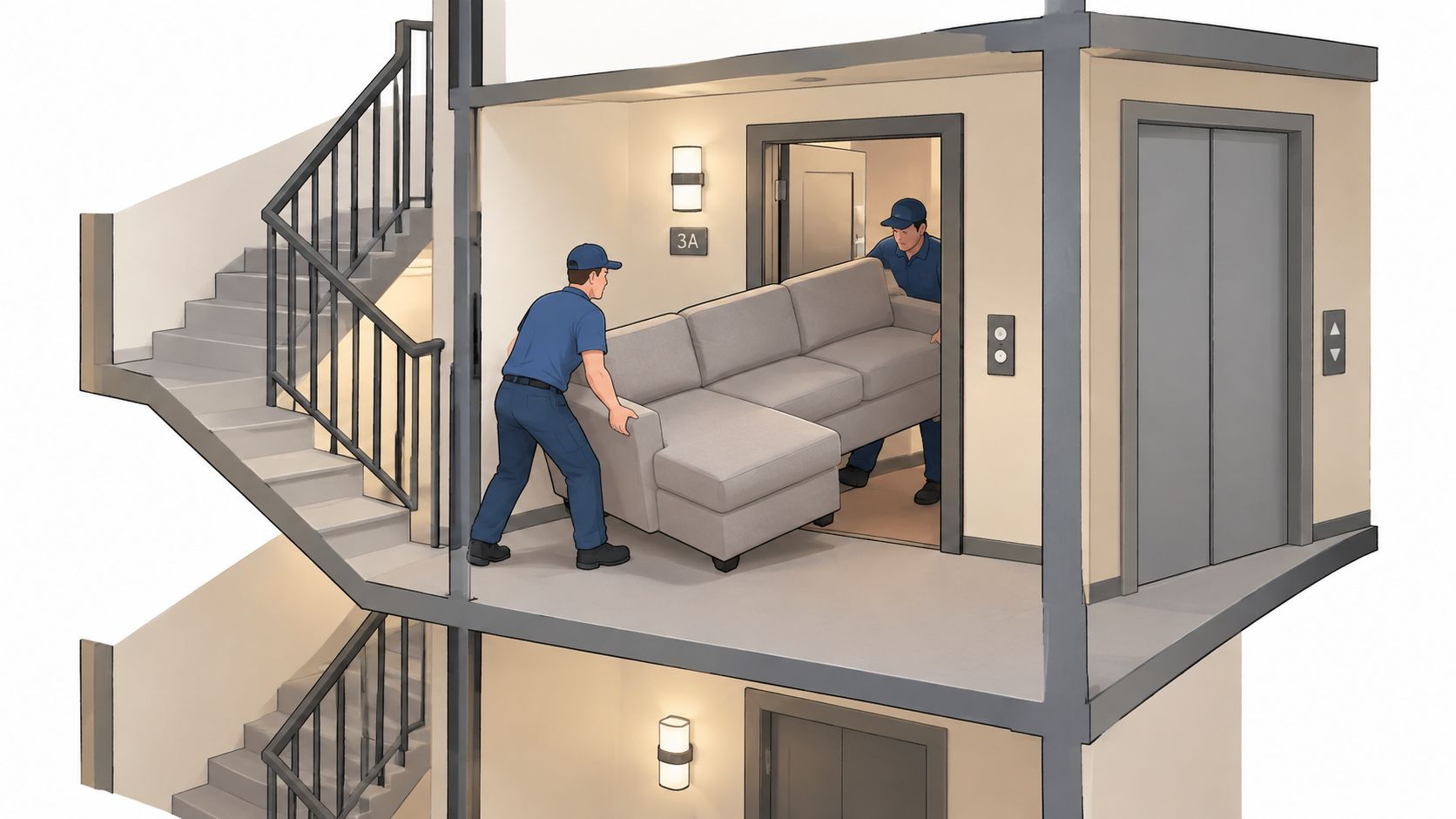
Modular, armless, or knock-down construction may be safer when the route includes tight turns or limited elevator space. The key comparison is not only the sectional's total footprint. It's the largest piece that has to make the whole trip. Before ordering, confirm the assembled dimensions, individual component sizes, packaging, and removable-part details with the seller or delivery team.
Choosing Fabrics and Features for Apartment Life
In an apartment, one living room may handle everyday lounging, meals with friends, remote work, and overnight guests. Upholstery and built-in features should suit that mix. A visually appealing fabric isn't automatically the easiest choice for a home with pets, children, or frequent entertaining.
Performance fabrics are worth considering when routine spills and wear are likely. Ask about the specific fabric's cleaning instructions and durability rather than treating “performance” as a guarantee that maintenance won't be needed. A textured or darker upholstery choice may feel more forgiving in a busy living area, while a lighter fabric can suit a room where appearance and brightness are priorities.
The layout should guide the features. A storage chaise can keep blankets or other living-room items close by, but its lid needs room to open. A sleeper sectional can provide a guest surface without a dedicated guest room, though it needs clear floor space when opened. A swivel or reversible chaise can make it easier to change orientation, but only if the floor plan leaves enough room for the moving part.
For more help comparing materials, Stahl's sectional sofa fabric guide is a useful place to consider how upholstery choices fit household routines. The simplest way to choose is to start with a real use case: a pet owner may prioritize cleanability, a frequent host may need flexible seating, and someone downsizing may want a comfortable seat that's easier to get in and out of. Each feature earns its place only if it solves a problem the household has.
Longevity also depends on whether parts can be repaired or replaced. A 2025 sustainable-sofa pre-study identifies repairability and ease of assembly and disassembly as design considerations in a circular-sofa project report. Ask whether covers, cushions, connectors, or individual modules can be replaced. Modular construction may help a sectional adapt to another room, but a fixed frame can be the simpler choice when flexibility isn't needed.
Styling Sectionals for Common Apartment Floorplans
The right placement depends on what the apartment's layout needs the sectional to do. A sectional might anchor a corner, mark the edge of a living zone, or leave a window and balcony route open. Start by drawing the footprint on the floor plan, then check whether the arrangement still supports the way people move and use the room.
In a studio, a compact chaise or a smaller L-shaped configuration can distinguish the sitting area from the bed or work zone without filling the middle of the room. For a one-bedroom apartment, an L-shaped sectional may use a corner efficiently, provided the short side doesn't interrupt the route between the entry and kitchen. A two-bedroom apartment may allow a wider arrangement, but door swings, dining space, windows, and television placement still determine what works.
In an open-plan layout, the back of a sectional can help define the living area without adding a divider. Keep sightlines open if the living and dining spaces share light, and check the view toward the television from the main seats. A chaise can make a narrow room feel blocked if it extends across the main route, even when the rest of the sectional fits comfortably.
Sectional sofa layout ideas can help with visualizing possible arrangements. In person, shoppers can test whether the arm shape, seat depth, and back height feel proportionate rather than guessing from a photograph. That sit-test matters: the sectional that looks lighter on screen may feel bulky in the room, while another with similar dimensions may leave the space feeling more open.
A useful layout choice balances visual weight and practical clearance. Lighter upholstery, visible legs, and slim arms may help a small room feel less crowded, but they don't compensate for a blocked path. Seeing several arrangements side by side can help clarify that trade-off before a delivery is scheduled.
Where to Shop and Why In-Stock Matters
A sectional is a long-term comfort purchase, and online dimensions don't reveal everything. The sit-test lets shoppers feel the cushion support, check whether the seat depth suits their body, and see how upholstery color looks in person. That matters when an apartment has limited room for a piece that turns out to feel too deep, too firm, or different in color from its pictures.
A large showroom also makes it easier to compare configurations side by side. Stahl Home Center's Bloomington showroom covers 88,000 square feet, and the company says it has served the local market since 1967, as described in its company history. For apartment shoppers, the practical benefit is being able to compare different sectional sizes, layouts, fabrics, and complementary furnishings in one visit rather than trying to judge each option from separate online images.
Stahl Home Center is Indiana's Largest La-Z-Boy Dealer and also offers Rowe Furniture for custom style and performance. Its Good-Better-Best approach helps shoppers compare quality levels without treating one price or feature set as the right answer for every household. Sectionals, sofas, recliners, and other living-room options can be considered alongside needs such as durability, fabric, and fit.
Choose the buying path that fits the move-in plan
For a homeowner or relocating renter trying to furnish several rooms, the benefit of in-stock options is simple: thousands of items are in stock and ready to take home today. Pickup availability can matter when the apartment is ready now, while other purchases such as bedroom sets, mattresses, or living room furniture need to come together on a tight schedule. Scheduled professional delivery is another option when transporting a sectional independently isn't practical.
Custom ordering is different. With Design Your Way, shoppers can choose from hundreds of fabrics and configurations for a specific look, including options from La-Z-Boy and Rowe. That route suits a style-focused buyer who isn't in a rush and wants a particular performance fabric, orientation, or configuration. Ask about availability and timing before deciding, since an in-stock piece and a custom order serve different timelines.
For a quality-focused household, compare the frame, cushion feel, upholstery, and construction instead of assuming the lowest price is the best value. A budget-friendly option may make sense for a temporary home or a room that gets occasional use. A higher-quality sectional may be worth considering when it'll serve daily family life and needs to remain comfortable through changing routines.
A practical path from shortlist to purchase is:
- Set the essentials: Write down the room footprint, seat-depth preference, needed configuration, and delivery-route limits.
- Compare comfort in person: Sit fully back, check foot support, and consider how the upholstery looks in the room's light.
- Choose a timeline: Select an in-stock option when immediate availability matters, or explore custom fabrics and configurations when personalizing the piece matters more than speed.
- Confirm the final details: Verify component dimensions, access requirements, pickup arrangements, or scheduled professional delivery before completing the purchase.
Shoppers can review sectionals available for quick delivery as one way to narrow down options that may suit a shorter timeline. Availability can vary, so the useful question is whether a particular piece is ready for pickup or needs to be scheduled for delivery. That check helps prevent a good room plan from turning into a timing surprise.
Frequently Asked Questions About Apartment Sectionals
How can a sectional fit through a narrow apartment doorway?
Measure the entire route, including turns, elevators, landings, handrails, and the final doorway. Compare those openings with the sectional's largest component, diagonal depth, and removable parts. If the route is tight, ask whether the piece can be separated before delivery.
Is a chaise or an L-shaped sectional better for a small apartment?
A chaise can provide lounging space with fewer connected seats, while an L-shaped configuration can make use of a corner. The better choice depends on which direction leaves the main walking route open and works with the windows, doors, and television position.
Can a sectional work in a studio?
Yes, if it defines the sitting area without crowding the sleeping, cooking, or work zones. A compact layout or reversible arrangement may offer more flexibility when the same room serves several purposes.
Should a sectional be modular?
Choose modular construction if separate pieces would help with delivery, future moves, or rearrangement. Choose a fixed design if the layout is settled and structural simplicity matters more than changing configurations.
Is a sectional worth choosing over a regular sofa?
A sectional can provide lounging space and seating in one arrangement, but it needs more careful planning than a standard sofa. Compare the footprint, delivery route, and everyday use before deciding.
Which fabric works for pets or frequent guests?
Look for upholstery suited to the household's cleaning needs and ask for care guidance. Performance fabric may be a practical option, but the specific material still matters.
Visit Stahl Home Center's 88,000-square-foot showroom to sit-test sectionals, compare La-Z-Boy and Rowe options, and explore in-stock pieces or custom fabrics and configurations. For help finding an apartment-ready fit, visit Stahl Home Center and bring along the room measurements and delivery-path notes.


